Ingredients
Equipment
Method
- Preheat oven to 175°C (350°F). Brown butter in a small saucepan until milk solids turn amber and smell nutty; pour immediately into a bowl. Combine with graham cracker crumbs, sugar, and salt until the mixture holds together when pressed. Press firmly into the base and partially up the sides of a 9-inch springform pan. Bake 10 minutes until set and lightly golden. Cool completely, at least 20 minutes. Reduce oven to 160°C (325°F).
- Wrap the outside of the cooled springform pan with two layers of heavy-duty foil pressed up the sides. Set inside a large roasting pan.
- Beat room-temperature cream cheese blocks with the paddle attachment on medium speed for 3 to 4 minutes, scraping the bowl at 1 and 2 minutes, until completely lump-free. Add both sugars; mix on medium-low 60 seconds until no visible granules remain.
- Add pumpkin puree, cinnamon, ginger, nutmeg, cloves, salt, and cornstarch. Mix on low 30 to 45 seconds until uniform. Add eggs and egg yolk one at a time on low speed, waiting until each just disappears before the next. Add heavy cream and vanilla; mix on low 20 seconds until incorporated. Stop immediately.
- Pour filling over cooled crust and level gently. Tap the pan three times on the counter. Place in the roasting pan. Pour just-boiled water into the roasting pan to reach 2.5cm up the outside of the springform.
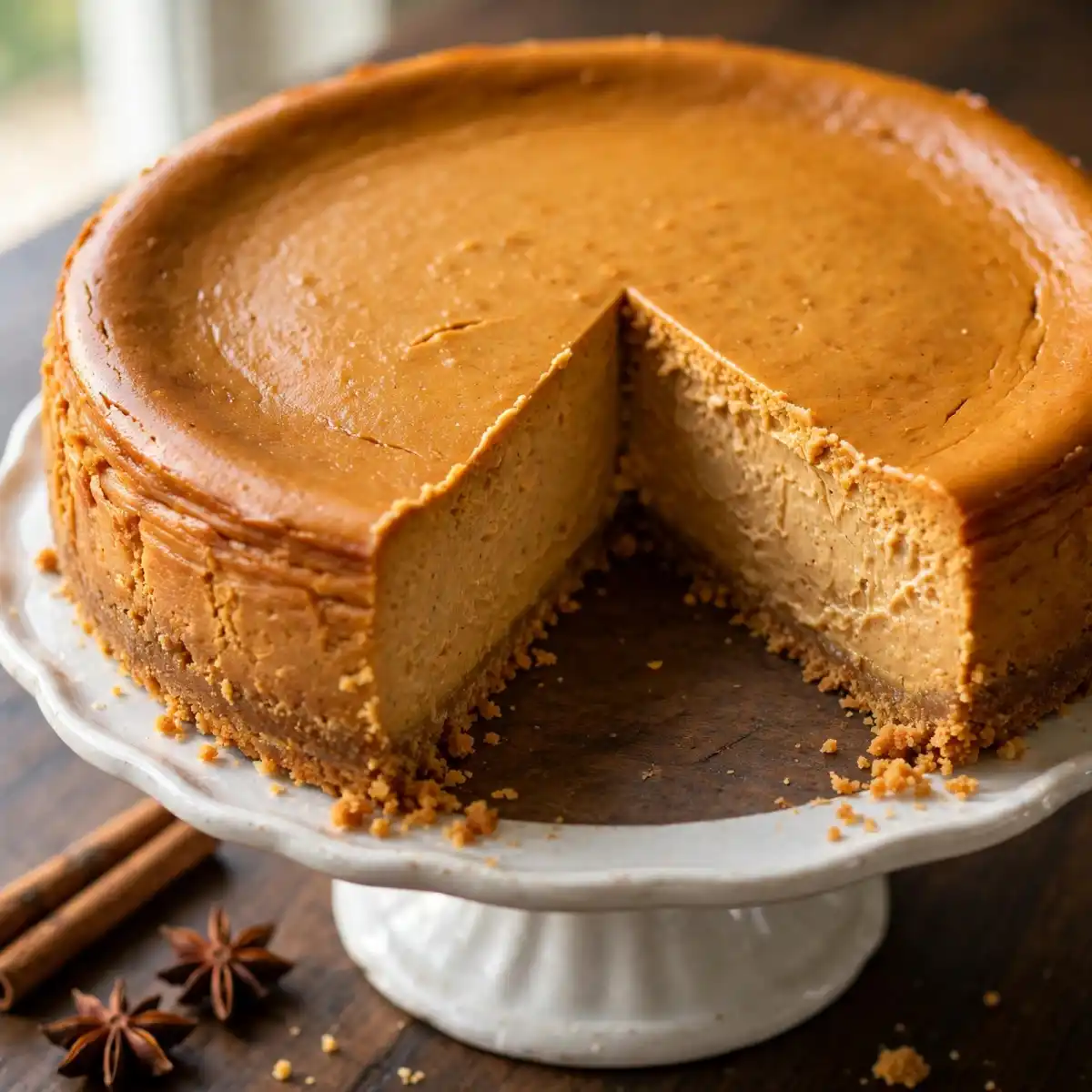
- Bake at 160°C for 60 to 70 minutes until the edges are set and matte, the center wobbles gently as a uniform trembling circle, and an instant-read thermometer reads 65 to 68°C at the center.
- Remove the roasting pan from the oven. Cool the cheesecake in the water bath for 30 minutes. Lift the springform pan from the water, remove foil, and immediately run a thin knife around the inside edge to loosen the filling from the walls. Cool at room temperature 1 more hour, then refrigerate overnight or at least 6 hours before slicing.
Notes
- Both cream cheese blocks and eggs must be at full room temperature (18 to 21°C) before mixing begins; cold dairy produces lumpy filling.
- Never beat on medium or high speed after adding the eggs; excess air causes cracking during cooling.
- Run the knife around the inside edge immediately after removing from the oven, not after cooling; this prevents cracking as the filling contracts.
- The cheesecake is better at day 2 and day 3 than the day it's made; plan ahead.
- Allergens: Contains dairy (cream cheese, butter, heavy cream), eggs (whole eggs and yolk), and gluten (graham crackers).
- This recipe has not been tested in a certified allergen-free kitchen and cannot be guaranteed safe for any specific allergy.
This recipe has not been tested in a certified allergen-free kitchen and cannot be guaranteed safe for any specific allergy.