Classic French Toast — Custardy Center, Crispy Golden Edges
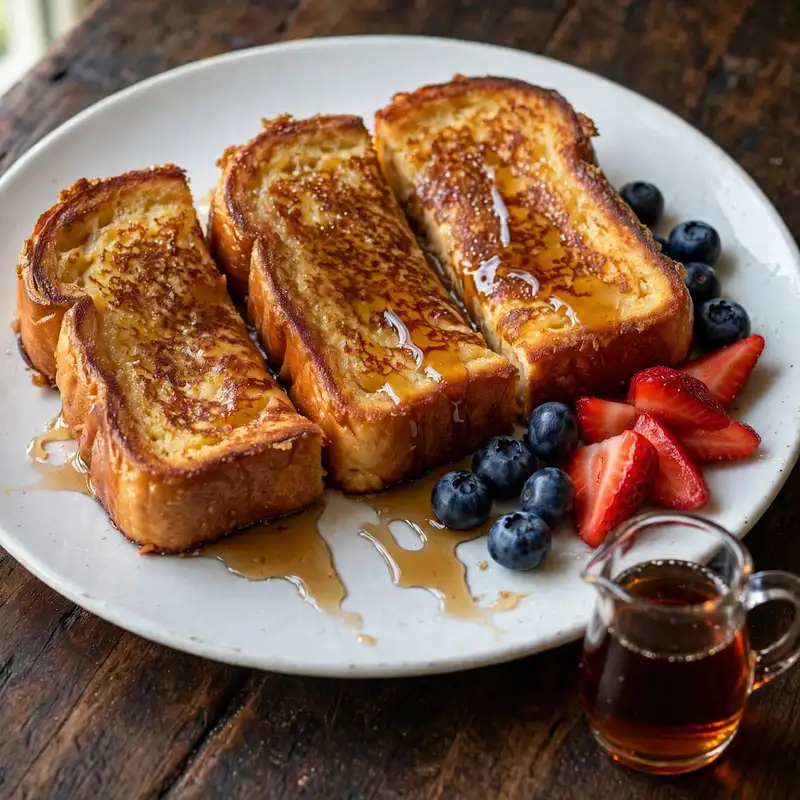
The difference between a good French toast and a forgettable one comes down to about 30 seconds of soaking time and the right bread. When you do it correctly, each slice comes out of the pan with a surface that’s deep golden and slightly crisp, and an interior that’s thick and custardy from the egg mixture soaked all the way through to the center. It’s the kind of breakfast that makes a weekend morning feel genuinely different from a Tuesday.
This French toast recipe uses thick-sliced brioche or challah soaked in a custard of eggs, whole milk, cream, vanilla, cinnamon, and a pinch of nutmeg. The custard is rich enough to produce a substantial, filling interior without the bread turning soggy or falling apart in the pan. It comes together in about 20 minutes from a cold kitchen, serves 4 comfortably, and works equally well as a weekday breakfast when you have thick bread on hand or a proper weekend brunch spread. The method stays the same whether you top it with maple syrup, fresh fruit, or powdered sugar.

Why You’ll Love This French Toast
- Custardy all the way through. The egg-and-cream custard soaks into thick-cut bread during a 30 to 45-second rest on each side, producing an interior that’s dense and creamy rather than dry or eggy on the outside and raw in the center.
- Crispy edges without burning the surface. A medium heat and a small amount of butter produce a controlled, even golden crust on both sides without scorching before the inside sets.
- Ready in 20 minutes. No oven time, no resting, no special equipment beyond a shallow bowl and a skillet. This is genuinely one of the fastest scratch breakfasts you can make.
- Works with whatever bread you have. Brioche and challah produce the richest result, but thick-sliced sandwich bread, sourdough, or even cinnamon raisin bread all produce a satisfying version with the same custard and method.
- Toppings are completely flexible. The base custard flavor complements anything from plain maple syrup to caramelized bananas to a savory fried egg placed alongside. The recipe gives you a reliable foundation for whatever direction you want to take it.
Ingredients You’ll Need
Recipe Timing
| Detail | Info |
|---|---|
| Servings | 4 |
| Difficulty | Easy |
| Course | Breakfast, Brunch |
| Cuisine | American, French-inspired |
| Prep Time | 5 minutes |
| Cook Time | 15 minutes |
| Rest Time | 0 minutes |
| Total Time | 20 minutes |
For the bread, thickness is the most important variable. Slices cut to at least 2.5cm (1 inch) thick hold up to soaking without falling apart and produce the custardy interior that defines a good French toast. Slices thinner than 1.5cm absorb the custard too quickly, become fragile in the pan, and cook through before the exterior has time to develop a proper crust. Brioche is the premium choice because its high butter and egg content means it absorbs the custard without becoming structurally compromised. Challah behaves similarly. If you’re using a regular sandwich loaf, look for the thickest-sliced option available, or cut your own from an unsliced loaf.
Day-old or slightly stale bread actually performs better than fresh bread for French toast. Fresh bread is slightly more porous and can absorb the custard unevenly, sometimes taking in too much liquid in some spots while leaving others dry. Bread that has dried slightly on the counter overnight or been left uncovered in the refrigerator has a more uniform, denser crumb that absorbs the custard at a consistent rate. If you only have fresh bread, leave the slices on a wire rack at room temperature for 30 minutes before soaking.
For the eggs, large eggs at room temperature incorporate more smoothly into the milk and cream than cold eggs straight from the fridge. Take them out 15 minutes before you start if possible.
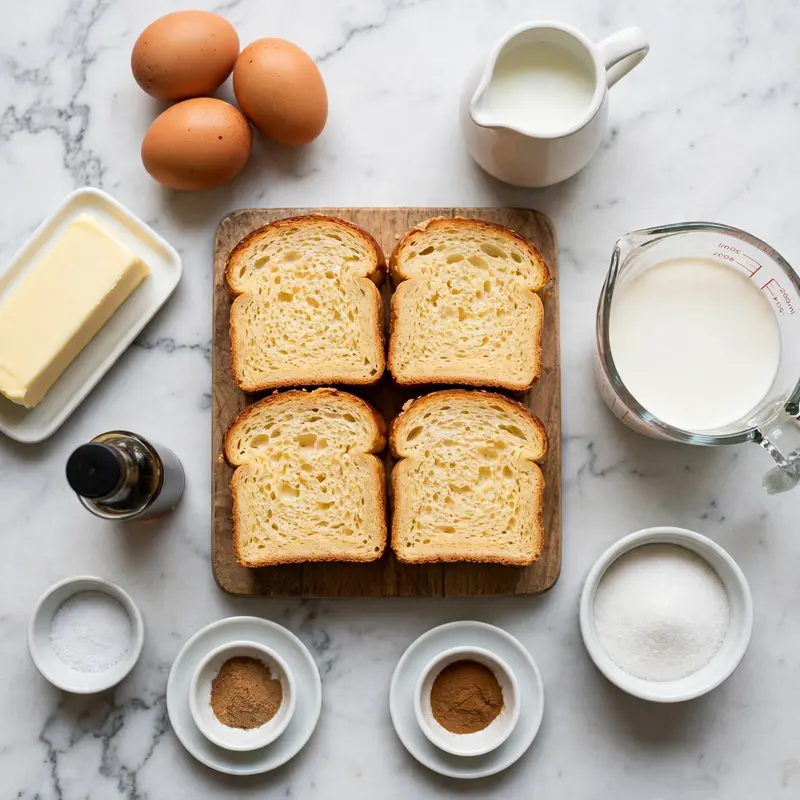
- 4 thick slices brioche or challah, cut 2.5cm (1 inch) thick — the structural base; thickness determines whether the interior is custardy or just eggy on the outside; day-old bread is preferred
- 3 large eggs, room temperature — the primary protein binder in the custard; provides structure and richness
- 1/2 cup (120ml) whole milk — contributes to the custard’s body; whole milk’s fat content is important for richness
- 1/4 cup (60ml) heavy cream — adds richness that whole milk alone can’t quite provide; the cream is what produces the genuinely custardy interior
- 2 tablespoons granulated sugar — sweetens the custard and helps the surface caramelize to a deeper golden color during cooking
- 1 teaspoon pure vanilla extract — the dominant flavor note in the custard; rounds the egg flavor and adds warmth
- 1 teaspoon ground cinnamon — adds warmth without overpowering; pairs naturally with maple syrup and fresh fruit toppings
- 1/4 teaspoon ground nutmeg — a subtle background spice that adds complexity; freshly grated nutmeg is noticeably more aromatic than pre-ground
- Pinch of fine salt — sharpens the sweetness and makes the vanilla more distinct
- 2 tablespoons unsalted butter, divided — for cooking; use about half a tablespoon per slice; butter produces the golden-brown color and a richer surface flavor than neutral oil; add fresh butter for each batch to prevent burning
For serving:
Powdered sugar, pure maple syrup, fresh berries, sliced banana, whipped cream
Allergen and Dietary Disclosure
This French toast contains eggs (in the custard), dairy (whole milk, heavy cream, butter), and gluten (brioche or challah bread). It also contains tree nuts if brioche or challah brands processed near nut facilities are used; check the bread label if this is a concern.
For gluten-free: use a certified gluten-free thick-sliced bread. The custard itself contains no gluten. Most gluten-free bread is softer and more fragile than wheat-based bread; reduce the soaking time to 15 to 20 seconds per side to prevent the slices from falling apart during cooking.
For dairy-free: replace whole milk and heavy cream with full-fat oat milk or full-fat coconut milk in the same quantities. Replace the butter with refined coconut oil or a vegan butter alternative. The custard will be slightly thinner and the browning slightly less deep, but the flavor is still very good.
For egg-free: a standard egg-free French toast is difficult to achieve with the same custardy interior, since eggs are the structural element. A reasonable substitute is a mixture of 1/2 cup silken tofu blended until smooth with 2 tablespoons of cornstarch and the remaining custard ingredients. The texture will be more bread-like than custardy but the flavor carries through.
This recipe has not been tested in a certified allergen-free kitchen and cannot be guaranteed safe for any specific allergy.
Equipment Needed
- Wide, shallow bowl or baking dish — for soaking the bread slices in the custard. The dish needs to be wide enough to lay a full slice of bread flat without folding or overlapping the edges into the custard mixture unevenly. A 9×13-inch baking dish or a wide, shallow pasta bowl both work well.
- Large non-stick or well-seasoned cast iron skillet, 12-inch — for cooking the soaked slices. A non-stick surface prevents sticking without requiring excessive butter. A cast iron skillet produces slightly more even browning across the full surface of the bread compared to thinner pans that develop hot spots.
- Flat spatula with a wide head — for flipping the soaked slices without breaking them. A standard slotted spatula or a large fish spatula both work; the wide surface supports the full slice during the flip rather than bending it in the middle.
- Wire whisk — for fully combining the custard ingredients. A fork works for mixing but takes considerably longer to fully break down the egg proteins and incorporate the cream into a uniform custard. A whisk produces a smoother, more uniformly mixed custard in about 20 seconds.
Step-by-Step Directions
Step 1: Make the Custard
Crack the eggs into a wide, shallow bowl or baking dish. Add the whole milk, heavy cream, granulated sugar, vanilla extract, cinnamon, nutmeg, and fine salt. Whisk vigorously for about 30 seconds until the mixture is completely smooth and uniform in color with no visible egg white streaks remaining. Lift the whisk and let the custard fall back into the bowl; it should form a thin, even stream rather than dripping in separate blobs, which confirms that the eggs are fully incorporated.

Chef’s Note: Whisking the custard until no egg white streaks remain is more important than most French toast recipes acknowledge. Egg white that isn’t fully incorporated into the custard cooks on the surface of the bread as an uneven, slightly rubbery layer rather than a smooth golden crust. Thirty seconds of vigorous whisking prevents this entirely.
Step 2: Slice and Stage the Bread
If your bread isn’t already sliced, cut it into 2.5cm (1-inch) thick slices on a slight diagonal angle, which gives each piece a larger surface area than a straight cut and produces a more visually appealing final plate. Lay the slices out in a single layer on a cutting board or clean countertop next to the skillet so they’re ready to go directly from the custard into the hot pan.
Step 3: Preheat the Pan and Butter It
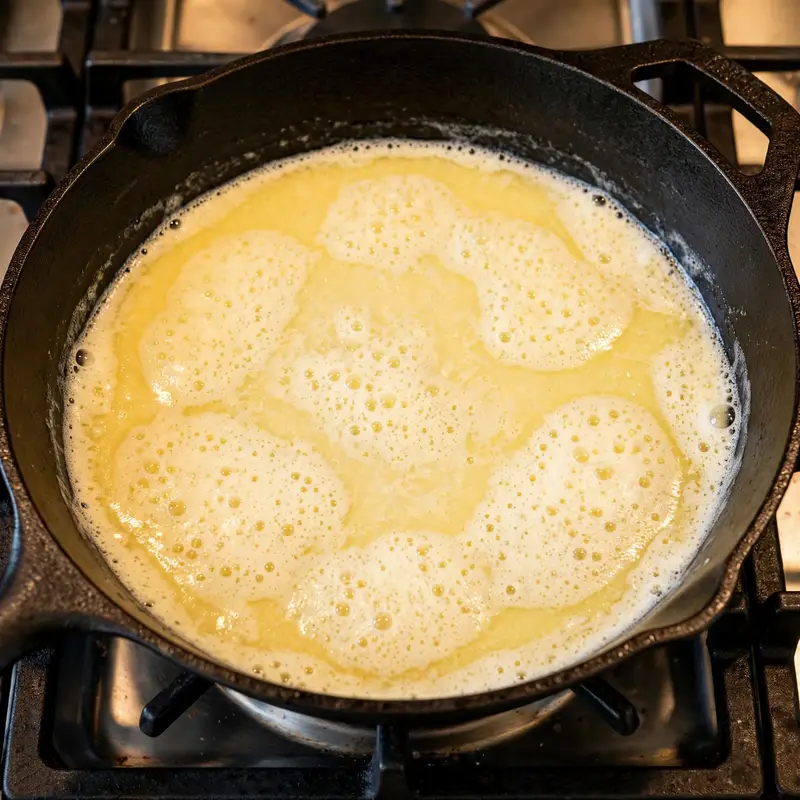
Place the skillet over medium heat and let it warm for 90 seconds before adding any butter. A pan that’s fully preheated before the butter goes in prevents the butter from burning before the bread makes contact; adding butter to a cold pan means the butter sits there heating slowly and browns before the bread arrives. Add half a tablespoon of butter to the preheated pan and let it melt completely, swirling to coat the base. The butter should foam actively but not brown; if it begins to brown immediately, reduce the heat to medium-low.
Chef’s Note: Medium heat is the correct temperature for French toast, not medium-high. The bread needs enough time in the pan to cook the custard through to the interior before the exterior burns. Medium heat produces a deep golden-brown crust in about 2 to 3 minutes per side; medium-high heat produces a dark exterior with a raw, underset custard center in the same time.
Step 4: Soak the First Batch of Bread
Lay one or two slices of bread flat in the custard dish. Let them soak for 30 to 45 seconds on the first side, then carefully flip and soak for 30 to 45 seconds on the second side. Lift the slice and let any excess custard drip back into the dish for 3 to 4 seconds before transferring to the pan; excess dripping custard pooling around the bread in the pan extends the cooking time and can prevent the bottom crust from forming properly.
Chef’s Note: The 30 to 45-second soak per side is the range that works for 2.5cm thick bread. Thinner slices need only 15 to 20 seconds per side. If you press the slice lightly in the center and it springs back without feeling liquid or collapsing, the bread has absorbed the right amount of custard. If it feels completely saturated and barely holds its shape, it’s been soaking too long.
Step 5: Cook the First Side
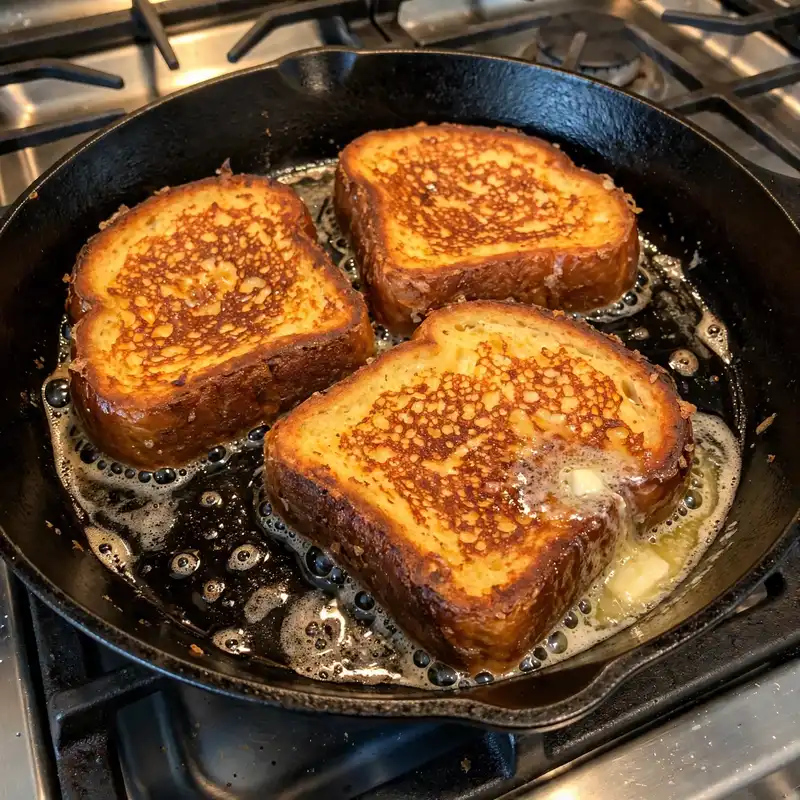
Place the soaked bread slice in the buttered pan without overcrowding. Cook undisturbed on the first side for 2 to 3 minutes until the bottom surface turns a deep, even golden-amber color when you lift the edge slightly with the spatula. The bread should release cleanly from the pan surface when it’s ready; if it sticks when you try to lift it, give it another 30 seconds and check again.
Step 6: Flip and Cook the Second Side
Slide the spatula fully under the slice and flip it in one decisive motion. Partial flips that let the bread fold in the middle break the custard-soaked interior. The second side typically cooks in 1.5 to 2 minutes, slightly faster than the first because the bread is now warmer. The finished slice should feel set throughout when you press the center gently; a spot that still feels soft and liquid hasn’t cooked through. Remove to a warm plate and repeat with the remaining slices, adding a fresh small piece of butter to the pan before each new batch.
Step 7: Serve Immediately
French toast is at its best within 3 to 4 minutes of coming out of the pan, while the exterior is still slightly crispy and the interior is hot. Dust with powdered sugar directly over the plate, add your chosen toppings, and serve. If you’re cooking for 4 people and need to hold earlier batches, place the finished slices on a wire rack set over a baking sheet in a 95°C (200°F) oven; this keeps them warm without making them soggy.
Common Mistakes and Troubleshooting
| Problem | Cause | Solution |
|---|---|---|
| Exterior burnt but interior raw | Heat too high, or bread soaked too briefly | Use medium heat and soak each side for a full 30 to 45 seconds; thick bread needs time to cook through |
| Bread falls apart in the custard | Bread too fresh or too thin, or soaked too long | Use day-old or slightly stale bread cut at least 2.5cm thick; limit soak time to 45 seconds per side |
| Custard slides off the bread rather than being absorbed | Bread too dense or impermeable (e.g., a very crusty sourdough) | Score the surface lightly with a knife or use a bread with a more open crumb like brioche or challah |
| French toast sticks to the pan | Pan not hot enough before butter was added, or butter burned away | Preheat pan for 90 seconds before adding butter; add fresh butter before each new batch |
| Eggy, unpleasant surface taste | Egg white streaks not fully whisked into the custard | Whisk vigorously for a full 30 seconds; no white streaks should be visible before soaking |
| Flat, one-dimensional flavor | Vanilla or spices were insufficient, or salt was skipped | Use a full teaspoon of pure vanilla and don’t skip the salt; it amplifies sweetness and makes the vanilla more distinct |
Variations and Substitutions
- Overnight French toast bake: Arrange thick-sliced bread in a greased 9×13-inch baking dish. Pour the full custard recipe over the top, press each slice gently, cover with plastic wrap, and refrigerate overnight. The next morning, bake uncovered at 175°C (350°F) for 35 to 40 minutes until the top is golden and the custard has set throughout. This version feeds 6 to 8 and requires almost no morning effort.
- Stuffed French toast: Slice each piece of bread through the middle horizontally without cutting all the way through, creating a pocket. Fill with 2 tablespoons of cream cheese mixed with a teaspoon of powdered sugar and a few fresh berries, press the edges closed gently, and soak in the custard as usual. Cook for an extra 30 seconds per side to ensure the cream cheese heats through.
- Savory French toast: Omit the sugar, cinnamon, and nutmeg from the custard. Add 2 tablespoons of finely grated Parmesan, 1/4 teaspoon of garlic powder, and a generous crack of black pepper. Serve with a fried egg on top and hot sauce alongside. This version works particularly well with sourdough or a hearty whole grain bread.
- Orange zest French toast: Add the finely grated zest of one large orange to the custard along with the vanilla and cinnamon. Replace 2 tablespoons of the milk with fresh orange juice. The citrus adds a bright, floral note that works especially well with fresh blueberries or raspberries as a topping.
- Thick-cut sourdough version: Sourdough has a tighter, more impermeable crumb than brioche; score each slice lightly in a crosshatch pattern with a sharp knife before soaking to help the custard penetrate. Extend the soak time by 15 seconds per side. The tanginess of the sourdough against the sweet vanilla custard is a distinctly good combination.
- Gluten-free French toast: Use certified gluten-free thick-sliced bread and reduce the soak time to 15 to 20 seconds per side to prevent the more fragile gluten-free crumb from falling apart. Cook on medium-low rather than medium heat, as gluten-free bread tends to color faster than wheat bread.
Serving Suggestions
- Serve immediately while the exterior is still slightly crispy. French toast held for more than 5 to 6 minutes without any warming method softens at the surface and loses the textural contrast between the crust and the interior, which is one of its defining characteristics.
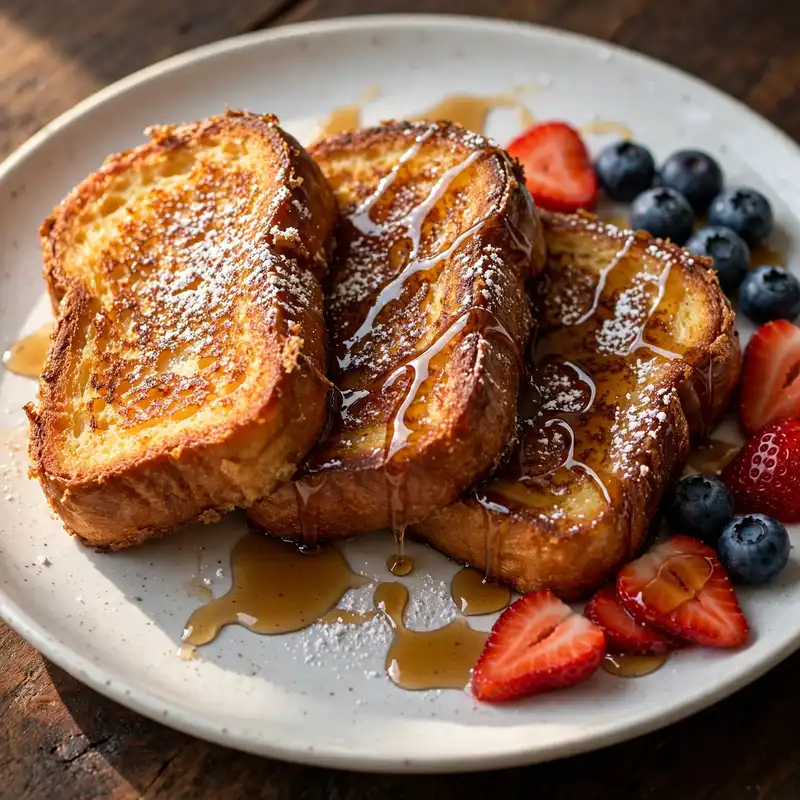
- Pure maple syrup is the classic accompaniment and for good reason: its deep, complex sweetness complements the vanilla-cinnamon custard without competing with it. Warm the syrup briefly in a small saucepan or in the microwave for 20 seconds before serving so it flows easily and doesn’t cool the toast.
- Fresh seasonal fruit alongside adds both color and acidity that balances the richness of the egg and cream custard. Sliced strawberries, blueberries, or raspberries work particularly well because their natural tartness cuts through the sweetness of the maple syrup.
- A large spoonful of lightly sweetened whipped cream on top makes this feel like a special occasion breakfast without any extra cooking. Make the whipped cream before you start cooking the toast so it’s ready when the first slices come out of the pan.
- For a complete brunch plate, serve alongside scrambled eggs and fresh orange juice. The protein from the eggs extends the meal’s staying power and the juice provides a bright, acidic contrast to the rich toast.
- A dusting of powdered sugar applied through a small fine-mesh sieve just before serving adds a professional-looking finish that takes about 5 seconds and makes the plate look significantly more composed.

Tips for the Best Results
- Use the richest, thickest bread you can find. Brioche produces the best result by a meaningful margin because its enriched dough, high in butter and eggs, creates a crumb structure that absorbs the custard evenly without becoming waterlogged. If brioche isn’t available, challah is the second-best choice. Both should be sliced to at least 2.5cm thick for the interior to stay custardy through the full cooking time.
- Let slightly stale bread work in your favor. A slice left uncovered on a wire rack for 30 minutes before soaking, or day-old bread from the previous morning, absorbs custard more consistently than fresh bread because the crumb has dried slightly and develops a more even porosity. Fresh bread sometimes has pockets that absorb custard heavily and dry spots that resist it, producing uneven results.
- Whisk the custard until genuinely smooth. This takes about 30 seconds of consistent effort. You’re looking for a uniform pale yellow mixture with no visible egg white threads floating in it. Those threads cook into rubbery patches on the surface of the bread that taste notably more eggy than the surrounding custard.
- Cook in small batches. Overcrowding the pan reduces the surface temperature significantly and causes the bread to steam rather than sear on the contact side. The result is a pale, soft exterior rather than a golden, slightly crispy one. Cook one to two slices at a time depending on your pan size and add a fresh bit of butter before each batch.
- Adjust your heat between batches. The pan gets progressively hotter during cooking. The first batch often needs the full 2 to 3 minutes per side; by the third or fourth batch, 90 seconds may be enough. Check the underside color regularly after the first minute of the later batches and reduce heat slightly if the browning is happening too fast.
Storage Tips
Refrigerator
Cooked French toast keeps in the refrigerator for up to 3 days in a sealed container or wrapped tightly in plastic wrap. Lay the slices flat or separated by parchment paper to prevent sticking. The surface softens considerably in the refrigerator; reheating in the oven rather than the microwave restores some of the original texture. The flavor actually holds very well in storage, and day-old French toast reheats into a genuinely satisfying breakfast.
Freezer
Fully cooked French toast freezes well for up to 2 months. Allow the slices to cool completely on a wire rack, then freeze in a single layer on a baking sheet for 1 hour until solid before transferring to a freezer bag. This prevents the slices from sticking together. Frozen slices can go directly from the freezer into a preheated toaster or oven without thawing; this is actually the best method for restoring the crispy surface.
Reheating
The toaster produces the best reheating result for refrigerated or frozen slices: a single slice on a medium setting takes about 90 seconds to heat through and regains a noticeably crisper surface than microwave reheating provides. For oven reheating, place slices on a wire rack over a baking sheet at 175°C (350°F) for 8 to 10 minutes; this method works well for multiple slices at once. Microwave reheating at 50% power for 60 to 90 seconds warms the slice through but leaves the surface soft.
Make-ahead note: The custard mixture can be whisked together the night before and stored covered in the refrigerator for up to 24 hours. Stir it briefly before using to recombine any ingredients that have settled. This reduces the morning prep to simply slicing the bread and heating the pan.
Nutrition Information
Per serving, approximately two thick slices (1/4 of the recipe), without toppings:
| Nutrient | Amount |
|---|---|
| Calories | 380 kcal |
| Protein | 12g |
| Total Carbohydrates | 42g |
| Dietary Fiber | 1.5g |
| Total Sugar | 12g |
| Total Fat | 18g |
| Saturated Fat | 9g |
| Cholesterol | 190mg |
| Sodium | 310mg |
| Vitamin C | 0mg |
| Calcium | 120mg |
| Iron | 2.1mg |
| Potassium | 160mg |
Nutrition values are approximate and may vary based on bread brand and portion sizes. Maple syrup, powdered sugar, fruit, and whipped cream not included.
Why This Recipe Works
The custardy interior of good French toast depends on the right ratio of liquid to egg in the soaking mixture and the right bread structure to absorb it. This recipe uses three eggs to three quarters of a cup of total liquid (half milk and half cream), which produces a custard with enough protein from the eggs to set firmly during cooking and enough fat from the cream to stay moist and rich rather than turning rubbery or dry. Custards with too high a liquid-to-egg ratio produce a soaking mixture that the bread absorbs too freely, resulting in an overly wet interior that takes a very long time to cook through. Custards with too much egg relative to liquid produce a surface that tastes noticeably eggy and a cooked interior that’s more like an omelet than a custardy custard.
The heavy cream in the custard is doing more than just adding richness. Its fat content coats the starch granules in the bread during soaking, which slows the rate at which those granules absorb water and swell during cooking. This produces a more stable, cohesive interior structure in the finished French toast compared to a custard made entirely from whole milk, which produces a softer, more delicate interior that can collapse slightly as it cools. In practice, you can taste the difference clearly: the cream version has a dense, substantial bite while the all-milk version is good but noticeably lighter and less structured.
The soaking time of 30 to 45 seconds per side is calibrated specifically for 2.5cm thick bread. This is long enough for the custard to penetrate through to the center of each slice without the surface layers becoming saturated to the point of structural failure. The surface and inner crumb need to hold together through the pan flip, which happens when the bread still has enough structural integrity to support its own weight. Bread soaked for 2 to 3 minutes per side becomes fragile and often tears during cooking; bread soaked for 10 to 15 seconds per side remains mostly dry at the center and produces a result that’s essentially just fried bread.
Medium heat is the correct cooking temperature for French toast, and it’s the setting most often overridden by people who want faster results. At medium heat, the exterior reaches the Maillard reaction temperature (around 150°C/300°F at the surface) in about 90 seconds, which begins producing the golden-brown crust and the characteristic caramelized flavor. The interior simultaneously climbs in temperature, and by the time the exterior is deep golden (at around 2 to 3 minutes per side), the custard at the center has reached approximately 74 to 76°C (165 to 168°F) and fully set. At medium-high heat, the exterior reaches its target color in about 60 seconds, but the interior is still well below set temperature, producing a common failure mode: perfect crust, raw center.
Using day-old bread is a practical recommendation with a specific structural explanation. Fresh bread contains more free water in its crumb than bread that has dried slightly. When fresh bread is soaked in custard, the excess moisture in the crumb resists absorption and can cause the custard to pool in some areas while other areas of the crumb remain relatively dry. Bread that has lost some surface moisture through overnight exposure has a more uniformly porous crumb that absorbs the custard at a consistent rate across the full surfa
Frequently Asked Questions
Can I make French toast ahead of time?
Yes. Cooked French toast stores in the refrigerator for up to 3 days and in the freezer for up to 2 months. For the best reheating result, use a toaster or oven at 175°C (350°F) rather than a microwave; the toaster and oven restore some surface crispness while the microwave leaves the slices uniformly soft. The custard mixture can also be made the night before and stored covered in the fridge; stir briefly in the morning before soaking the bread.
Why does my French toast always turn out eggy and rubbery on the outside?
Egg white streaks not fully incorporated into the custard are the most common cause. Egg whites that aren’t fully whisked into the milk and cream cook on the surface of the bread as an uneven, rubbery layer. Whisk the custard for a full 30 seconds until completely smooth with no visible white threads. Cooking on heat that’s too high also causes the egg proteins at the surface to seize rapidly before the interior has time to cook through, producing an uneven, rubbery exterior with a wet center.
What bread works best for French toast?
Brioche is the best choice for a rich, custardy result because its enriched, high-fat crumb absorbs custard evenly and holds together well during cooking and flipping. Challah is a close second. Thick-sliced sandwich bread works if it’s the only option; cut it thicker than the standard pre-sliced width by using an unsliced loaf. Sourdough produces a tangier version with a slightly denser interior. Texas toast, which is pre-sliced thick, is a very practical choice for a straightforward weeknight version.
How do I know when the French toast is fully cooked?
The most reliable test is pressing the center of the slice gently with your fingertip through the spatula. A slice that’s cooked through feels set and springy and doesn’t leave a wet indentation. A slice with an uncooked custard center feels noticeably softer and slightly liquid at the center. The exterior should be a deep, even golden-amber color before you flip; a pale exterior almost always means the interior is still raw. Each side needs roughly 2 to 3 minutes at medium heat for 2.5cm thick bread.
Can I use plant-based milk instead of whole milk and cream?
Yes, with some texture change. Full-fat oat milk is the best substitute for whole milk here because its fat and protein content most closely approximates dairy milk’s behavior in a custard. Full-fat coconut milk substitutes for the heavy cream reasonably well, though it adds a mild coconut flavor. Almond or rice milk are too thin and low in fat to produce the same custardy interior; the result will be edible but noticeably lighter and less rich. Replace at the same volume as the dairy components.
Is French toast gluten-free?
The custard itself contains no gluten; the only source of gluten in the standard recipe is the bread. To make a fully gluten-free version, substitute certified gluten-free bread. Gluten-free bread tends to be softer and more fragile than wheat-based bread, so reduce the soak time to 15 to 20 seconds per side and cook on medium-low heat to prevent crumbling. The flavor of the custard and the cooking method stay identical; only the bread handling requires adjustment.
Can I cook French toast in oil instead of butter?
You can, but the result is noticeably different. Butter contributes flavor compounds to the surface of the bread during cooking that neutral oil cannot replicate. The browning that occurs when butter contacts the custard-soaked bread surface involves both the Maillard reaction and a small amount of butter-specific flavor development from the milk solids. Neutral oil produces a visually similar golden color but a plainer, less complex surface flavor. Clarified butter is a good middle-ground option if you want butter flavor without the burning risk at slightly higher heat.
Conclusion
French toast earns its reputation as a reliable, satisfying breakfast because the method, when followed carefully, is genuinely consistent. Cold custard, thick bread, medium heat, and patience in the pan produce a result that’s custardy at the center and golden at the surface every time. The individual details, fully whisked custard, day-old bread, fresh butter per batch, are each small decisions that accumulate into a noticeably better plate than skipping any of them produces.
Once you’ve made French toast with thick brioche and proper soaking time, the thin-sliced, quickly dipped version is hard to go back to. The recipe scales from two servings to a full brunch for eight without changing anything about the method; it just takes a few extra minutes at the pan.
If you loved this recipe, save it to your breakfast and brunch recipes Pinterest board so you can find it easily later. For more recipes and daily food inspiration, follow TheCookingVibes on Pinterest.
Classic French Toast
Ingredients
Equipment
Method
- Crack eggs into a wide shallow bowl. Add whole milk, heavy cream, sugar, vanilla extract, cinnamon, nutmeg, and salt. Whisk vigorously for 30 seconds until completely smooth with no visible egg white streaks.
- If using fresh bread, leave slices on a wire rack for 30 minutes to dry the surface slightly. Lay bread slices next to the stove, ready to transfer from custard to pan quickly.
- Heat a large skillet over medium heat for 90 seconds. Add 1/2 tablespoon of butter and let it melt and foam without browning. Swirl to coat the base evenly.
- Lay one or two bread slices in the custard and soak for 30 to 45 seconds per side. Lift and let excess custard drip back for 3 to 4 seconds before placing in the pan.
- Cook the first side undisturbed for 2 to 3 minutes until deep golden-amber when the edge is lifted with a spatula. The slice should release cleanly; if it sticks, give it another 30 seconds.
- Flip in one decisive motion. Cook the second side for 1.5 to 2 minutes until golden. Press the center gently with the spatula; it should feel set and springy throughout.
- Transfer to a warm plate and repeat with remaining slices, adding fresh butter before each batch. Serve immediately with powdered sugar, maple syrup, and fresh fruit.
Notes
- Day-old or slightly dried bread absorbs the custard more evenly than fresh bread; leave slices on a rack for 30 minutes if only fresh bread is available.
- Whisk the custard thoroughly until no egg white streaks remain; unincorporated whites cook into rubbery patches on the surface.
- Cook on medium heat, not medium-high; higher heat browns the exterior before the custard inside sets.
- The custard can be made the night before and refrigerated; stir briefly before using.