
Classic Fresas con Crema — Fresh Strawberries, Silky Sweet Cream
The first time you make fresas con crema at home, you’ll be surprised by how quickly it comes together and how much more it tastes like something than the sum of its ingredients suggests. Fresh strawberries, Mexican crema, a pour of sweetened condensed milk, and a splash of vanilla: four ingredients stirred together in the time it takes the strawberries to macerate, and the result is something genuinely good, cold and sweet and creamy in a way that feels both casual and considered at the same time.
Fresas con crema is a classic Mexican street food and home dessert built on ripe strawberries coated in a pourable sweet cream sauce made from Mexican crema, sweetened condensed milk, and vanilla. It’s served cold, usually as a dessert or afternoon snack, and it comes together in about 10 minutes with no cooking required. The cream sauce is the detail that makes it: not heavy whipped cream, not sour cream alone, but a loose, pourable mixture that sits between the two and coats each strawberry piece with a flavor that’s simultaneously tangy, sweet, and lightly vanilla-scented.

Why You’ll Love This Fresas con Crema
- No cooking, no equipment. A bowl, a spoon, and a knife are genuinely all you need. The cream sauce comes together by stirring three ingredients together in under 2 minutes.
- The tang-to-sweet balance is built in. Mexican crema’s mild acidity prevents the cream sauce from tasting flat or cloying against the condensed milk sweetness. That balance is what makes this more interesting than strawberries and whipped cream.
- Ripe strawberries do most of the work. Macerating the strawberries with a small amount of sugar for 5 minutes draws out their natural juice, which thins the cream sauce slightly and deepens the strawberry flavor throughout every spoonful.
- Scales from one serving to a crowd. The recipe doubles, triples, and quadruples without changing any technique. It’s one of the most practical desserts for a large gathering.
- Endlessly adaptable. The base cream sauce works with any soft fruit, not just strawberries, and takes additions like lime zest, chili powder, or cinnamon without losing its character.

Ingredients You’ll Need
Recipe Timing
| Detail | Info |
|---|---|
| Servings | 4 |
| Difficulty | Easy |
| Course | Dessert, Snack |
| Cuisine | Mexican |
| Prep Time | 5 minutes |
| Cook Time | 0 minutes |
| Rest Time | 5 minutes (strawberry maceration) |
| Total Time | 10 minutes |
For the strawberries, peak-season ripe fruit is the most important ingredient decision in this recipe. A strawberry that’s deep red all the way through with a fragrant smell at the stem end will produce significantly more juice during maceration and a noticeably more intense strawberry flavor in the finished dish. Pale, firm strawberries that smell of nothing produce a result that tastes more of cream than of strawberry, which misses the point of the dessert entirely. If fresh strawberries aren’t in season, thawed frozen strawberries work reasonably well; drain the excess liquid before using and reduce or eliminate the macerating sugar since frozen fruit is already softer and releases liquid more readily.
For the Mexican crema, look for it in the refrigerated section near sour cream and cheese at most grocery stores. Mexican crema has a fat content typically around 30%, which is slightly lower than heavy cream and higher than sour cream, and it’s considerably less tangy than full sour cream. Its pourable, slightly loose consistency is exactly what produces the flowing, coating sauce that defines fresas con crema. If Mexican crema is unavailable, the closest substitutes are crème fraîche thinned with a tablespoon of whole milk, or a mixture of 2 parts sour cream to 1 part heavy cream stirred together until smooth.
For the sweetened condensed milk, full-fat is the correct choice. The fat in full-fat condensed milk contributes to the sauce’s body and the way it clings to the strawberry pieces. Low-fat condensed milk produces a thinner, slightly watery sauce that doesn’t coat the fruit the same way.
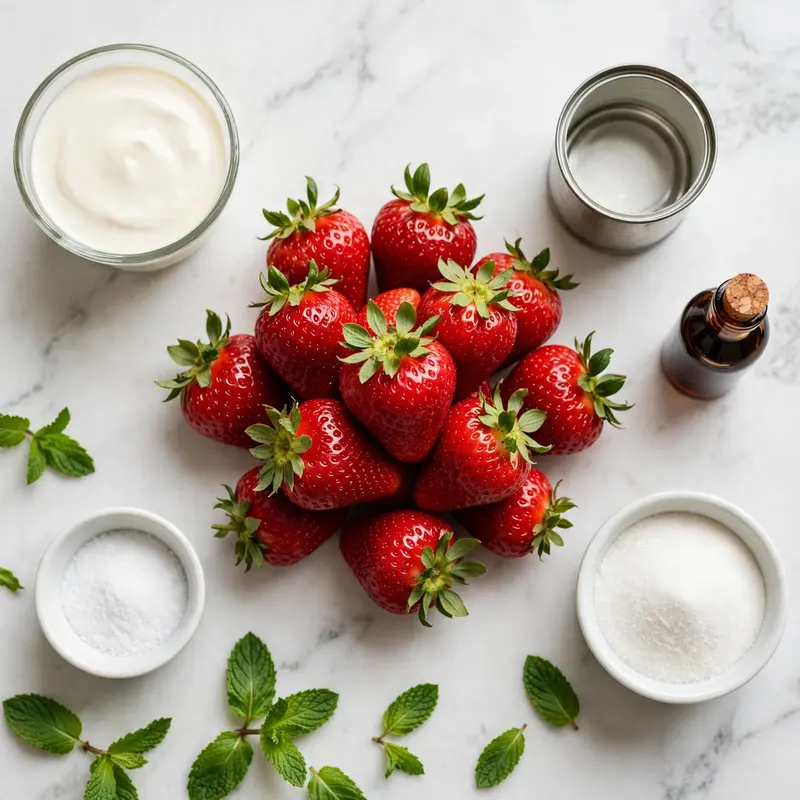
- 500g (about 1 lb) fresh strawberries, hulled and halved — the primary ingredient; deep red, ripe, fragrant fruit is essential for the best flavor
- 1 tablespoon granulated sugar — draws moisture from the strawberries during maceration, creating a light natural syrup that loosens and flavors the cream sauce
- 1 cup (240ml) Mexican crema — the tangy, pourable base of the cream sauce; crème fraîche thinned with milk is the best substitute
- 1/3 cup (80ml) sweetened condensed milk, full-fat — the sweetener and body builder for the sauce; adjust up or down based on preferred sweetness
- 1 teaspoon pure vanilla extract — rounds out the cream and connects the sweetness of the condensed milk with the tang of the crema
- Pinch of fine salt — added to the cream sauce; sharpens the sweetness and makes the strawberry flavor more distinct; easy to skip and easy to regret skipping
Optional garnishes:
- Fresh mint leaves
- A light dusting of ground cinnamon
- A small pinch of chili powder or Tajin seasoning
- Extra drizzle of sweetened condensed milk over the top at serving
Allergen and Dietary Disclosure
This fresas con crema contains dairy (Mexican crema, sweetened condensed milk). It is naturally gluten-free, egg-free, and nut-free in its standard form. Check that any Tajin or spice blend used as a garnish is free from shared equipment allergens if relevant.
For dairy-free: replace the Mexican crema with full-fat coconut cream and the sweetened condensed milk with coconut condensed milk or a full-fat coconut cream sweetened to taste with 2 to 3 tablespoons of powdered sugar. The coconut flavor is present but mild and works reasonably well against the strawberries, particularly with a small amount of lime zest stirred into the mixture.
For lower sugar: reduce the sweetened condensed milk to 2 tablespoons and taste the sauce before adding the macerating sugar; very ripe strawberries often don’t need additional sugar at all. The total sweetness can be adjusted entirely to preference since there’s no baking chemistry involved.
This recipe has not been tested in a certified allergen-free kitchen and cannot be guaranteed safe for any specific allergy.
Step-by-Step Directions
Step 1: Macerate the Strawberries
Hull the strawberries and halve them lengthwise from tip to stem. Place them in a large bowl, sprinkle the granulated sugar over the cut surfaces, and toss gently to coat. Set the bowl aside at room temperature for exactly 5 minutes. During this time, the sugar pulls moisture from the cut strawberry surfaces through osmosis, creating a small pool of sweet, concentrated strawberry juice at the bottom of the bowl. That juice becomes part of the sauce.

Chef’s Note: Five minutes of macerating at room temperature produces noticeably more juice than strawberries straight from the refrigerator. Cold fruit releases moisture much more slowly. If your strawberries were just taken from the fridge, give them the full 5 minutes and the juice will still develop; it just benefits from a room-temperature start.
Step 2: Make the Cream Sauce
While the strawberries macerate, combine the Mexican crema, sweetened condensed milk, vanilla extract, and pinch of salt in a small bowl or measuring jug. Stir with a spoon until the mixture is completely smooth and uniform in color, with no visible streaks of condensed milk running through the crema. Taste the sauce at this point; it should be sweet, mildly tangy, and vanilla-forward. If it tastes too sweet, add a small spoonful more of crema to balance it. If it tastes too tangy, stir in an additional teaspoon of condensed milk.
Chef’s Note: The cream sauce should be pourable rather than thick. If the crema you’re using is particularly thick, stir in 1 tablespoon of cold whole milk to loosen it to a consistency that flows freely from a spoon. The sauce needs to coat the strawberries evenly without sitting in a heavy pool at the bottom of the bowl.

Step 3: Combine and Serve
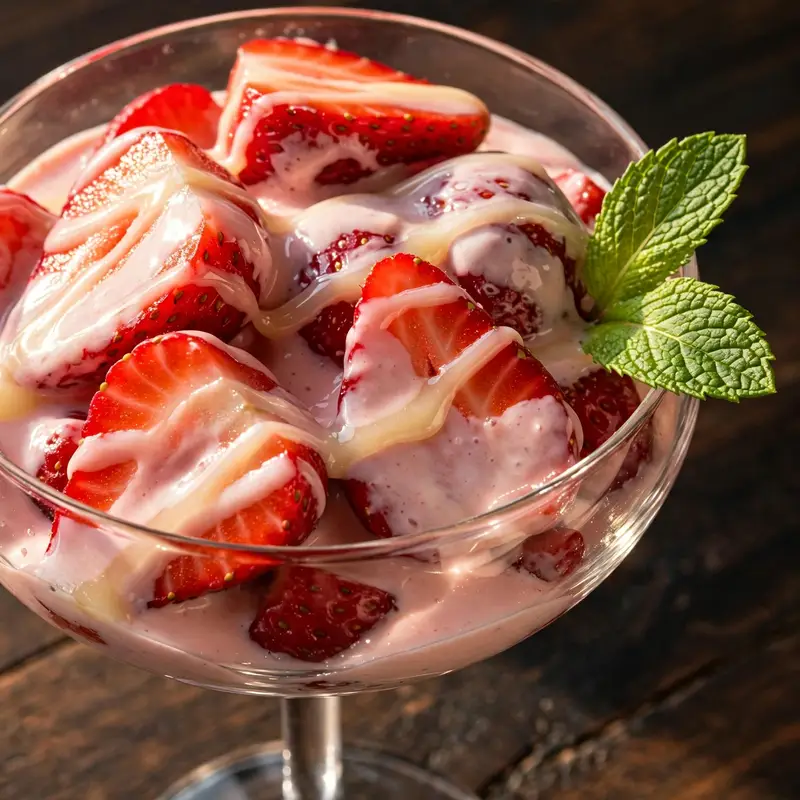
Pour the cream sauce directly over the macerating strawberries and any collected juice in the bowl. Fold everything together gently using a large spoon, lifting from the bottom of the bowl rather than stirring in circles, until every strawberry piece is coated and the strawberry juice has loosened and tinted the cream sauce to a pale pink. Taste and adjust; this is the moment to add more condensed milk if the sauce needs more sweetness, or a small extra squeeze of lime juice if you want more brightness.
Spoon into individual serving bowls or glasses immediately, or refrigerate the assembled dish for up to 2 hours before serving for a colder, slightly more set result. Garnish each serving with fresh mint, a dusting of cinnamon, or a final drizzle of condensed milk directly over the cream surface.
Common Mistakes and Troubleshooting
| Problem | Cause | Solution |
|---|---|---|
| Sauce too thick and won’t coat the strawberries | Crema was very thick, or too little liquid overall | Stir 1 to 2 tablespoons of cold whole milk into the sauce before combining with the strawberries |
| Cream sauce tastes flat or one-dimensional | Salt was skipped, or vanilla extract was insufficient | Add the pinch of salt and taste again; salt lifts the sweetness and makes the flavors more distinct |
| Strawberries taste bland in the final dish | Underripe or out-of-season fruit used | Choose deep red, fragrant strawberries; if unavailable, add an extra half tablespoon of sugar to the maceration step |
| Sauce too sweet | Too much condensed milk, or very sweet strawberries | Add more crema a tablespoon at a time to balance; a few drops of fresh lime juice also cuts perceived sweetness |
| Dish watery after chilling | Strawberries macerated too long, or very ripe fruit used | Serve within 2 hours of assembling; if the dish has been sitting longer, drain some of the accumulated liquid before serving |
| Cream separating or looking grainy | Mixed crema and condensed milk while either was very cold | Bring both dairy components to room temperature before mixing; cold crema and cold condensed milk don’t emulsify as smoothly |
Variations and Substitutions
- Fresas con crema with lime and chili: Stir 1 teaspoon of fresh lime zest and 1/4 teaspoon of chili powder into the cream sauce before combining with the strawberries. The lime zest adds a floral citrus top note and the chili creates a warm finish that builds slowly after each bite. A dusting of Tajin over the finished bowls amplifies both elements.
- Mixed fruit version: Replace half the strawberries with a combination of sliced mango, halved seedless grapes, and peeled kiwi slices. The cream sauce works with all of these, and the color contrast in the bowl is visually striking. Mango in particular pairs very well with the tangy crema.
- Fresas con crema cups: Layer the ingredients in individual clear glasses rather than combining them in a bowl. Place a layer of hulled whole small strawberries at the base, pour the cream sauce over, add another layer of sliced strawberries, and drizzle condensed milk directly on top. The layered presentation works well for parties and potlucks.
- Cinnamon vanilla version: Add 1/4 teaspoon of ground cinnamon to the cream sauce along with the vanilla extract. Cinnamon and strawberry is a combination that’s less common but genuinely good; the spice adds a warm background note that makes the cream sauce taste slightly more complex.
- Dairy-free coconut version: Substitute full-fat coconut cream for the Mexican crema and coconut condensed milk for the regular condensed milk. The sauce is naturally coconut-forward; stir in 1 teaspoon of lime juice and 1/2 teaspoon of lime zest to brighten it and keep the strawberry flavor from being overwhelmed by the coconut.
- Frozen strawberry version: Thaw 500g of frozen strawberries completely and drain off the excess liquid. Skip the macerating sugar entirely since frozen fruit is already soft and very sweet. Combine with the cream sauce and serve immediately; frozen strawberries don’t hold their shape for more than about 30 minutes in the cream sauce, so this version is best assembled right before eating.
Serving Suggestions
- Serve in clear glass bowls or cups so the pink-tinted cream sauce and red strawberries are visible through the sides. The visual is part of the appeal, and a clear vessel shows it off far better than an opaque bowl.
- Spoon over a scoop of vanilla ice cream for a more substantial dessert. The cold cream sauce and the cold ice cream melt together into something between a sundae and a float, and the strawberry juice tints the ice cream as it melts.
- Serve alongside churros for dipping. The crispy exterior and cinnamon sugar of a warm churro contrast directly with the cold, creamy strawberry mixture in a way that’s intentional and satisfying.
- For a casual brunch setting, serve fresas con crema in small individual glasses as part of a fruit-based spread. It requires no utensils beyond a small spoon and holds well for an hour before the strawberries start to soften.
- Top with crushed animal crackers or crushed vanilla wafers for a textural element. The crumbled cookies absorb the cream sauce quickly, so add them right before serving rather than in advance.
- Pair with a cold glass of hibiscus agua fresca. The tartness and deep color of the hibiscus drink contrasts with the pale sweetness of the cream sauce and makes both taste more distinct alongside each other.

Tips for the Best Results
- Use the ripest strawberries you can find. This recipe has nowhere to hide a bland strawberry. The fruit’s flavor is the centerpiece, and the cream sauce amplifies what’s already there rather than masking anything. A deeply fragrant, fully red strawberry with no pale core near the hull produces a dessert that tastes significantly better than one made with underripe or out-of-season fruit.
- Don’t skip the macerating step. Five minutes with sugar makes a measurable difference. The juice that collects at the bottom of the bowl is what gives the cream sauce its strawberry flavor and its pink tint. Without it, the sauce tastes of crema and vanilla but not particularly of strawberry, which misses the defining characteristic of the dish.
- Taste the cream sauce before combining with the strawberries. The right balance of sweet to tangy varies depending on the crema brand and the condensed milk brand, and both vary in intensity. Tasting before combining lets you make adjustments when they’re still easy to make. Once the strawberries and their juice are in, adding more crema works, but adding more condensed milk requires extra stirring to distribute it evenly.
- Serve cold. Fresas con crema served at room temperature has a noticeably looser sauce and a softer texture than the same dish served cold from the refrigerator. Assemble the dish and refrigerate for at least 20 minutes before serving if you have the time; the cold temperature firms the sauce slightly and makes each spoonful feel cleaner and more distinct.
- Add garnishes at the very last moment. Fresh mint leaves wilt quickly in contact with the cream sauce. Cinnamon absorbs moisture and becomes invisible within 15 minutes. Tajin seasoning dissolves into the surface within 5 minutes of application. All of these garnishes are most effective applied directly before the bowl reaches the table.
Storage Tips
Refrigerator
Assembled fresas con crema keeps in the refrigerator for up to 24 hours in a covered container. After this point the strawberries have released enough additional juice to thin the cream sauce considerably, and the texture becomes watery and slightly less appealing. The dish is genuinely at its best within the first 2 hours of assembly when the strawberries are still slightly firm and the sauce has the right coating consistency. If you need to prepare it further in advance, keep the cream sauce and the macerating strawberries stored separately in the refrigerator for up to 24 hours and combine them right before serving.
Freezer
Assembled fresas con crema does not freeze well. The strawberries break down completely during freezing and thawing, and the cream sauce separates into a grainy, watery liquid that doesn’t come back together on thawing. If you want to plan ahead, freeze the strawberries raw and unsweetened for up to 3 months, then thaw and use them in the recipe from the frozen version guidance in Variations above. The cream sauce should always be made fresh.
Reheating
Fresas con crema is served cold and requires no reheating. If a stored portion has become very cold and the crema has thickened in the refrigerator, let it sit at room temperature for 5 minutes and stir gently before serving. The sauce loosens as it warms slightly and returns to its original pouring consistency without any heat required.
Make-ahead note: For best results, macerate the strawberries and make the cream sauce separately up to 4 hours in advance, store both covered in the refrigerator, and combine them within 30 minutes of serving. This approach produces the freshest-tasting result regardless of timing.
Nutrition Information
Per serving, approximately 1/4 of the recipe:
| Nutrient | Amount |
|---|---|
| Calories | 265 kcal |
| Protein | 4g |
| Total Carbohydrates | 35g |
| Dietary Fiber | 2g |
| Total Sugar | 31g |
| Total Fat | 13g |
| Saturated Fat | 8g |
| Cholesterol | 40mg |
| Sodium | 85mg |
| Vitamin C | 65mg |
| Calcium | 130mg |
| Iron | 0.5mg |
| Potassium | 320mg |
Nutrition values are approximate and may vary based on brands and portion sizes. Optional garnishes not included.
Why This Recipe Works
The cream sauce in fresas con crema works because of the specific fat and acid balance in Mexican crema. Mexican crema sits at approximately 30% milkfat, which gives it enough body to coat the strawberry surfaces without being so thick that it sits in a heavy layer. Its acidity, much milder than sour cream but more present than heavy cream, serves two functions simultaneously: it prevents the sweetened condensed milk from tasting cloying by providing a counterpoint, and it brings out the natural acidity already present in the strawberries, making the fruit taste more intensely of itself rather than just sweet.
Sweetened condensed milk as the sweetener rather than regular sugar does something that plain sugar cannot. Condensed milk is a cooked product; the milk sugars and proteins have already undergone mild Maillard reactions during its production, producing flavor compounds associated with light caramel and cooked cream. These compounds add a subtle depth to the sauce that a sugar-only version doesn’t have. The body that condensed milk contributes, from its protein content and its concentration of milk solids, also gives the sauce its characteristic coating consistency that simple cream-and-sugar combinations lack.
Macerating the strawberries with sugar before combining them with the cream sauce addresses a flavor distribution problem common to fresh fruit desserts. Without maceration, the cream sauce stays entirely separate from the strawberry flavor; you taste each element independently rather than as a unified whole. When sugar draws moisture out of the cut fruit surfaces during maceration, that moisture carries soluble flavor compounds, including volatile aromatic esters responsible for the characteristic strawberry smell, into the liquid that then mixes through the cream sauce. The result is a cream sauce that tastes of both cream and strawberry rather than two ingredients sitting alongside each other in the same bowl.
The pinch of salt in the cream sauce is present for the same reason salt appears in nearly every dessert recipe: it suppresses bitterness at the threshold of perception, amplifies sweetness, and increases the contrast between flavors that would otherwise blend into each other at high sugar concentrations. Condensed milk is intensely sweet, and that sweetness at a high concentration can paradoxically make the other flavors in the sauce harder to detect. A pinch of salt restores that contrast, and the strawberry and vanilla become more distinct immediately. I’ve tested this recipe with and without salt at equal proportions of all other ingredients. Without salt, the sauce tastes sweeter but less interesting; with salt, it tastes balanced and more clearly of its individual components.
Frequently Asked Questions
Can I make fresas con crema ahead of time?
Yes, with one adjustment. Prepare the cream sauce and the macerating strawberries separately up to 4 hours in advance and store them covered in the refrigerator. Combine them within 30 minutes of serving rather than assembling the full dish hours early. Strawberries in cream sauce continue releasing liquid over time, and the dish assembled more than 2 hours in advance will have a noticeably thinner, more watery sauce by serving time. Keeping the components separate until close to serving preserves both the sauce consistency and the texture of the fruit.
What can I use instead of Mexican crema?
Crème fraîche is the closest substitute in terms of fat content and mild acidity, though it’s slightly thicker. Thin it with 1 tablespoon of whole milk before using to achieve a pourable consistency. A mixture of 2 parts full sour cream to 1 part heavy cream stirred together also works well; the sour cream provides the tang and the heavy cream provides the fat content that keeps the sauce from being too sharp. Plain heavy cream produces a sauce that’s richer but lacks the mild tanginess that balances the sweetened condensed milk; it works but the flavor is flatter.
How do I know if my strawberries are ripe enough?
Press one gently near the stem; it should give very slightly without collapsing. The surface color should be deep red with no white or green patches near the hull. Lift a strawberry close to your nose and take a breath; a ripe strawberry has a distinct, floral fragrance even without cutting into it. An unscented strawberry, regardless of its color, will taste of very little once it’s in the cream sauce. If your strawberries are slightly underripe, increase the macerating sugar to 2 tablespoons and extend the maceration to 10 minutes to draw out more juice and concentrate what flavor is there.
Can I use frozen strawberries?
Yes. Thaw completely, drain off the excess liquid that collects during thawing, and skip the macerating sugar since frozen strawberries are already soft and release liquid very freely. The texture will be softer and the fruit won’t hold its shape as cleanly as fresh strawberries, but the flavor is still good, particularly with ripe-at-harvest frozen berries. Assemble and serve frozen strawberry fresas con crema immediately rather than chilling it, since the soft fruit deteriorates in the sauce within about 30 minutes.
Is fresas con crema gluten-free?
Yes, the standard recipe is naturally gluten-free. Mexican crema, sweetened condensed milk, vanilla extract, fresh strawberries, and sugar contain no gluten. Check that your vanilla extract uses a gluten-free alcohol base if this is a strict dietary requirement; most pure vanilla extracts are gluten-free, but imitation vanilla products vary by brand. Any optional garnishes like Tajin or spice blends should also be checked for gluten-containing additives if cross-contamination is a concern.
Why is my cream sauce too sweet?
The condensed milk quantity is easy to over-pour. Start with 1/4 cup and taste the sauce before adding more; ripe strawberries add their own sweetness once combined, and the maceration sugar adds to the overall sweetness of the dish. If your sauce is already assembled and too sweet, stir in additional crema a tablespoon at a time, which dilutes the sweetness while adding more tang. A small squeeze of fresh lime juice also cuts perceived sweetness without adding volume to the sauce.
What makes fresas con crema different from strawberries and cream?
The defining difference is the cream component. Classic strawberries and cream uses lightly sweetened whipped cream that’s light, airy, and neutral in flavor. Fresas con crema uses a pourable sauce made from Mexican crema, which contributes genuine tanginess, and sweetened condensed milk, which adds a cooked dairy richness. The sauce coats the strawberries rather than sitting beside them. The flavor is more complex and more distinctly Mexican in character: richer, tangier, and with a condensed milk sweetness that whipped cream doesn’t replicate.
Conclusion
Fresas con crema earns its reputation as one of the most satisfying quick desserts in Mexican cooking because the technique and the ingredients are genuinely calibrated to each other. The tang in the crema exists specifically to balance the sweetness of the condensed milk. The macerating step exists to make the cream sauce taste of strawberry rather than just cream. The salt exists to make all of it more distinct. None of these are decorative decisions.
Once you’ve made fresas con crema a few times, the ratios become intuitive and the whole thing takes under 10 minutes regardless of how many servings you’re making. It’s a reliable, crowd-pleasing dessert that works equally well as a casual weekday snack or the final course of a full dinner.
If you loved this recipe, save it to your Mexican desserts and easy dessert recipes Pinterest board so you can find it easily later. For more recipes and daily food inspiration, follow TheCookingVibes on Pinterest.
Fresas con Crema
Ingredients
Equipment
Method
- Hull and halve the strawberries lengthwise. Place in a bowl, add the granulated sugar, and toss gently to coat all cut surfaces. Set aside at room temperature for 5 minutes until a small pool of strawberry juice collects at the bottom of the bowl.
- While the strawberries macerate, stir together Mexican crema, sweetened condensed milk, vanilla extract, and a pinch of fine salt in a small bowl until completely smooth with no visible streaks.
- Taste the sauce and adjust sweetness or tanginess to your preference.
- Pour the cream sauce over the macerating strawberries and their collected juice. Fold gently from the bottom of the bowl until every strawberry is coated and the juice has tinted the sauce pale pink.
- Spoon into individual serving bowls or glasses. Add optional garnishes right before serving. Serve immediately or refrigerate covered for up to 2 hours before serving.
Notes
- Use the ripest, most fragrant strawberries available; underripe fruit produces a flat-tasting result.
- Taste the cream sauce before combining with the strawberries to adjust sweetness; it’s easiest to correct at this stage.
- For make-ahead preparation, store the cream sauce and macerating strawberries separately and combine within 30 minutes of serving.
- If Mexican crema is unavailable, crème fraîche thinned with 1 tablespoon of whole milk is the closest substitute.