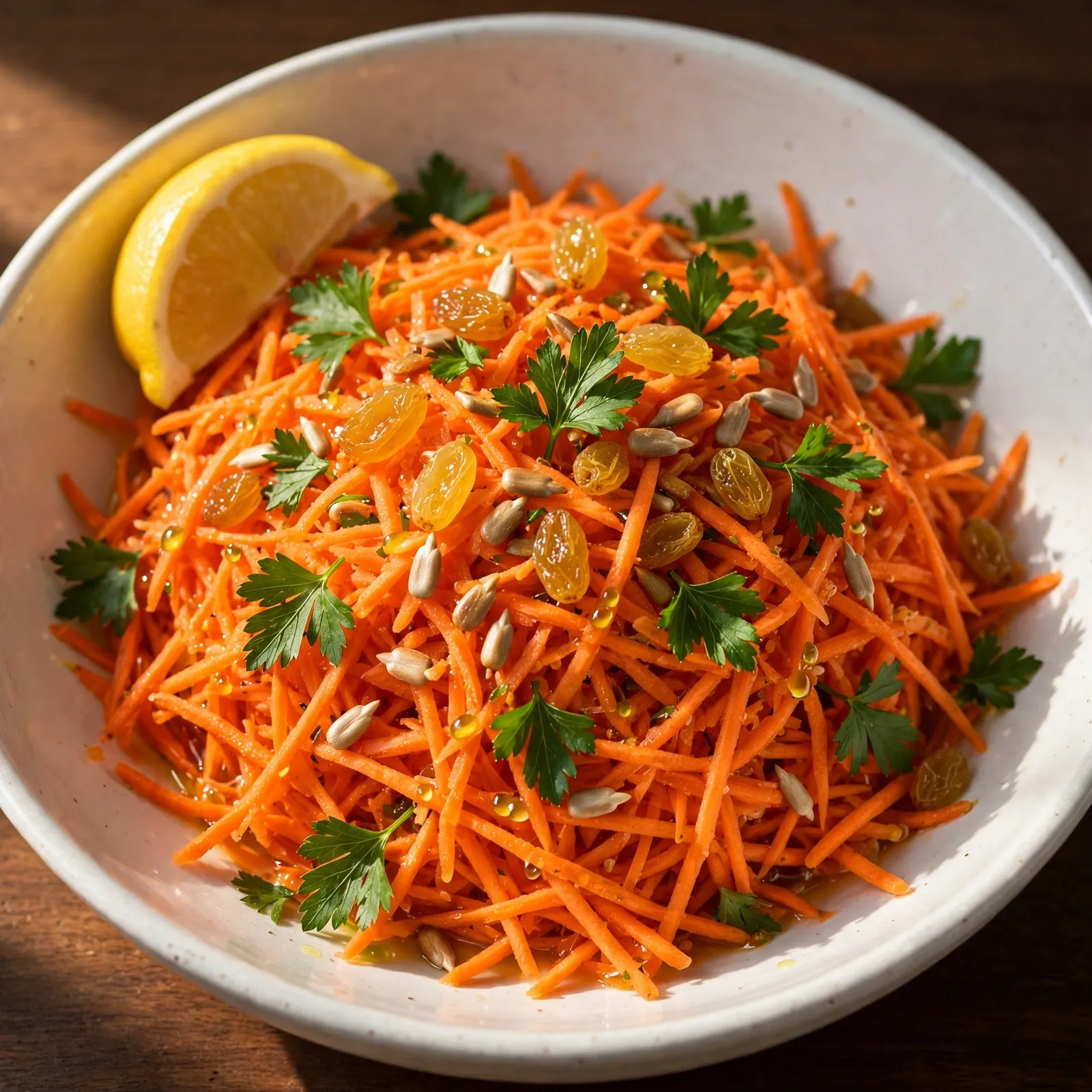
Fresh Carrot Salad — Crunchy Grated Carrots, Zesty Lemon Dressing
There’s a version of carrot salad that tastes like an afterthought: a pile of pre-shredded bagged carrots with bottled dressing poured over, served because something vegetable-adjacent needed to be on the table. Then there’s this version, where freshly grated carrots still have their snap and sweetness, the lemon and cumin dressing is bright and slightly warm, and the whole thing tastes like something you’d order at a café and then ask for the recipe. The difference is almost entirely in two decisions: grating the carrots yourself and making the dressing from scratch in about 3 minutes.
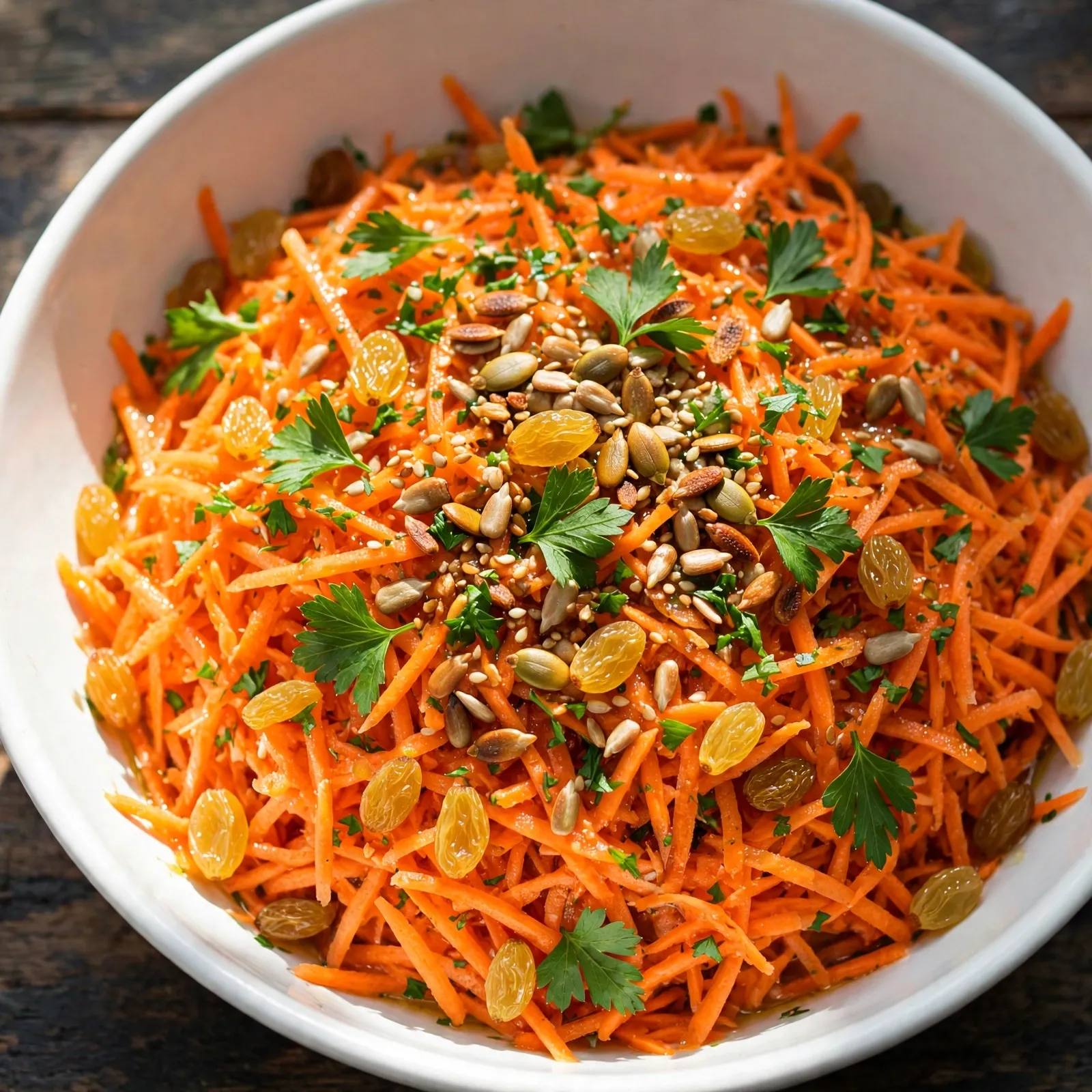
This carrot salad recipe uses freshly grated carrots tossed with a simple olive oil, lemon juice, and toasted cumin dressing, finished with fresh parsley, golden raisins for sweetness, and toasted seeds for crunch. It takes 15 minutes from start to finish, serves 4 as a side, and keeps well in the refrigerator for up to 3 days. It works alongside grilled chicken, stuffed into a wrap, served at a summer table, or eaten cold directly from the container the next day when it has absorbed the dressing more deeply and tastes even better.
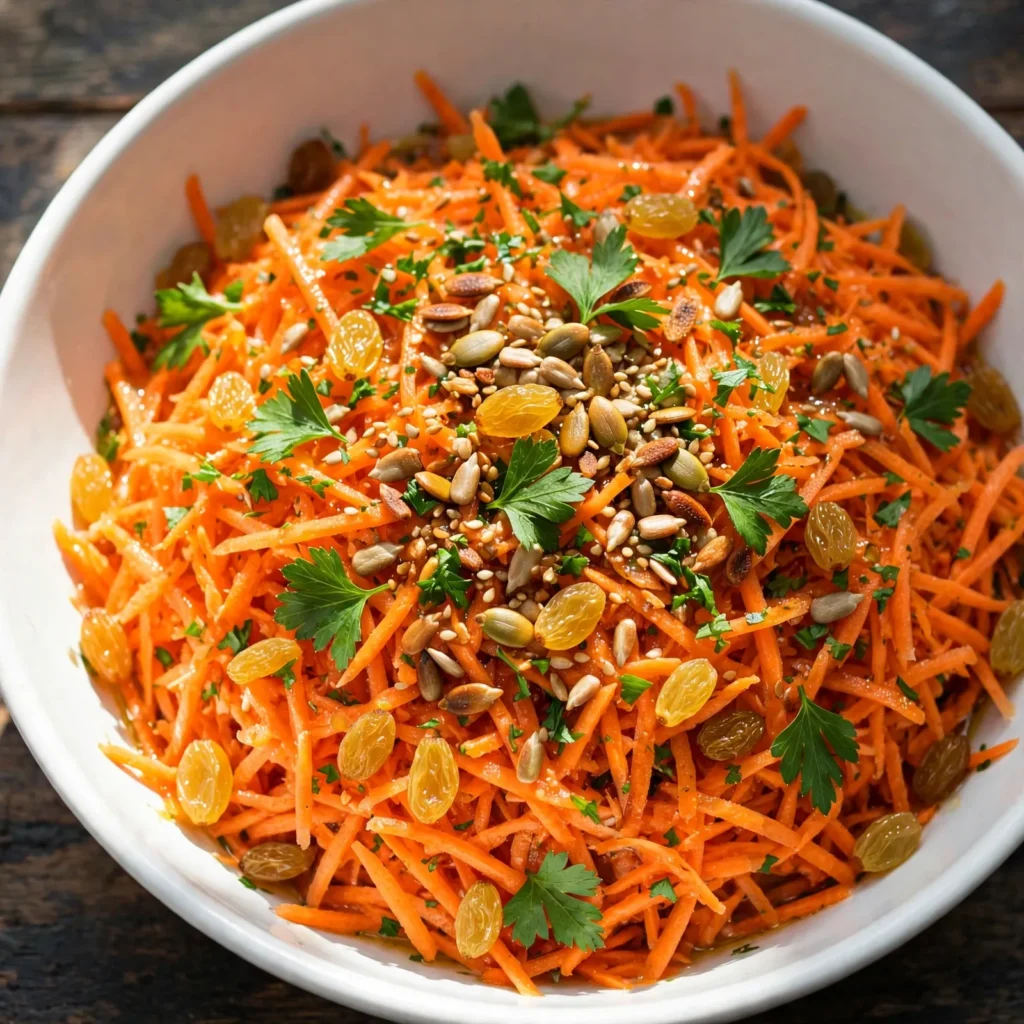
Why You’ll Love This Carrot Salad
- Ready in 15 minutes with no cooking required. Grate the carrots, mix the dressing, toss and serve; there is no step that requires heat, and the whole recipe fits comfortably into the prep time of whatever else you’re cooking alongside it.
- Better the next day. The carrots continue absorbing the lemon and cumin dressing overnight in the refrigerator; the flavors deepen and integrate in a way that makes the leftover version taste more fully developed than the fresh batch.
- Genuinely nutritious without tasting medicinal. Raw carrots retain their full beta-carotene content and natural sweetness; the olive oil in the dressing aids fat-soluble vitamin absorption without adding any heaviness.
- Adaptable in any direction. The base recipe is a reliable platform: add feta for saltiness, swap raisins for dried apricots, add a grain for more substance, or take it Moroccan-spiced or Asian-dressed with equal success.
- No salad spinner, no wilting. Grated carrots don’t wilt the way leafy greens do; the salad stays crunchy and presentable for hours after dressing, which makes it a practical choice for gatherings where the food needs to sit out.
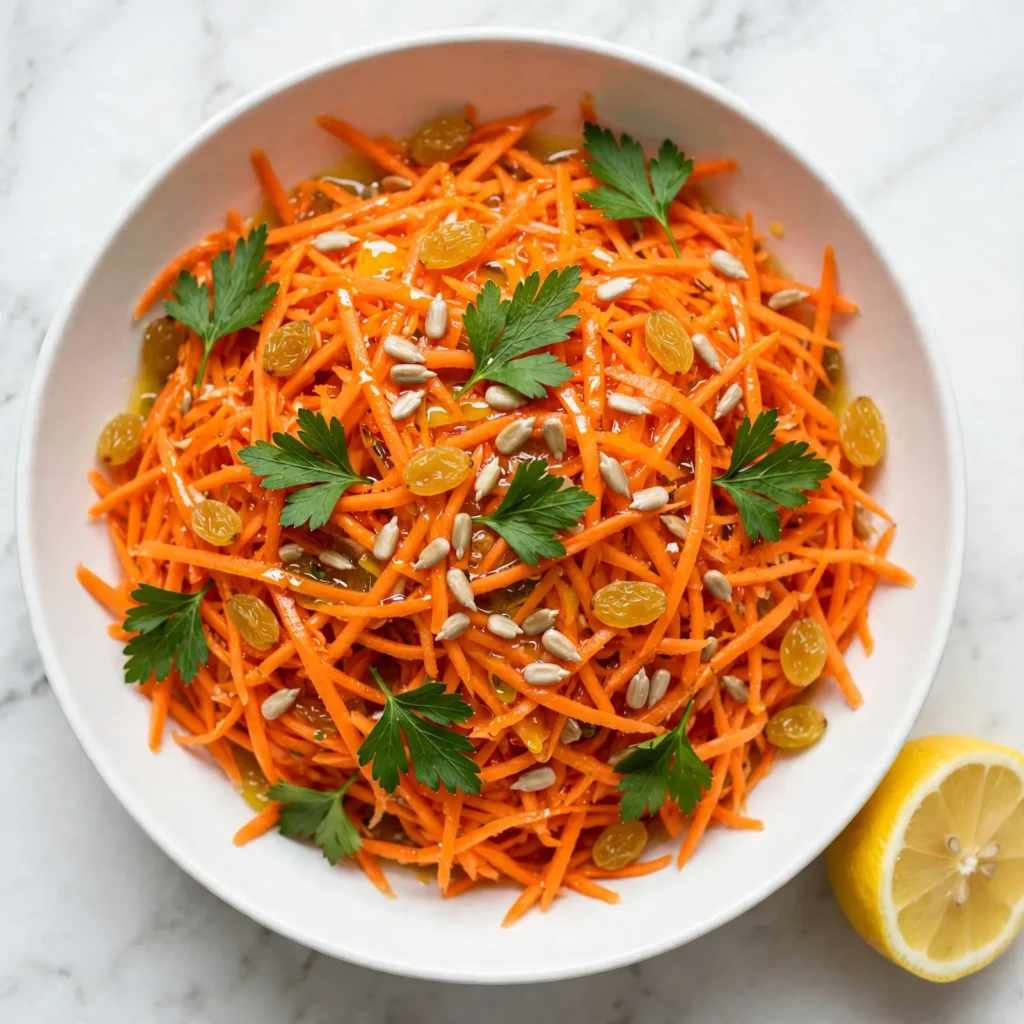
Ingredients You’ll Need
Recipe Timing
| Detail | Info |
|---|---|
| Servings | 4 as a side |
| Difficulty | Easy |
| Course | Side Dish, Salad |
| Cuisine | Mediterranean-inspired |
| Prep Time | 15 minutes |
| Cook Time | 0 minutes |
| Rest Time | 0 minutes |
| Total Time | 15 minutes |
For the carrots, freshly grated whole carrots are the only choice that produces the right texture and flavor. Pre-shredded bagged carrots have been sitting since processing, which dries out their surface, dulls their sweetness, and makes them slightly rubbery rather than crisp. A fresh carrot grated immediately before dressing retains its moisture, its natural bright sweetness, and its snap. Use medium or large carrots rather than very thin baby carrots; they hold up better on the large holes of a box grater and produce longer, more appealing strands.
The grating size matters. The large holes of a standard box grater produce strands of approximately 4 to 5mm that have enough body to be forked and chewed without feeling stringy. The fine holes produce a paste-like consistency rather than a salad texture; avoid them. A food processor with a shredding disk also works and saves time for large batches.
For the olive oil, use a good-quality extra virgin olive oil that you’d also use as a finishing oil. The dressing in this recipe is simple enough that the olive oil flavor is prominent; a flat, bitter supermarket oil produces a flat dressing, while a fruity, grassy extra virgin olive oil makes the dressing noticeably brighter.
For the cumin, toasting whole cumin seeds briefly in a dry pan before roughly grinding them produces a more vivid, aromatic flavor than pre-ground cumin from a jar. The toasting releases the essential oils in the seeds and converts some of their raw, earthy compounds into sweeter, more complex aromatic ones. It takes 90 seconds and the flavor difference in the dressing is immediately noticeable. If ground cumin is what’s available, use it; reduce the quantity to 1/2 teaspoon since ground cumin is more concentrated than freshly cracked.
The Carrots:
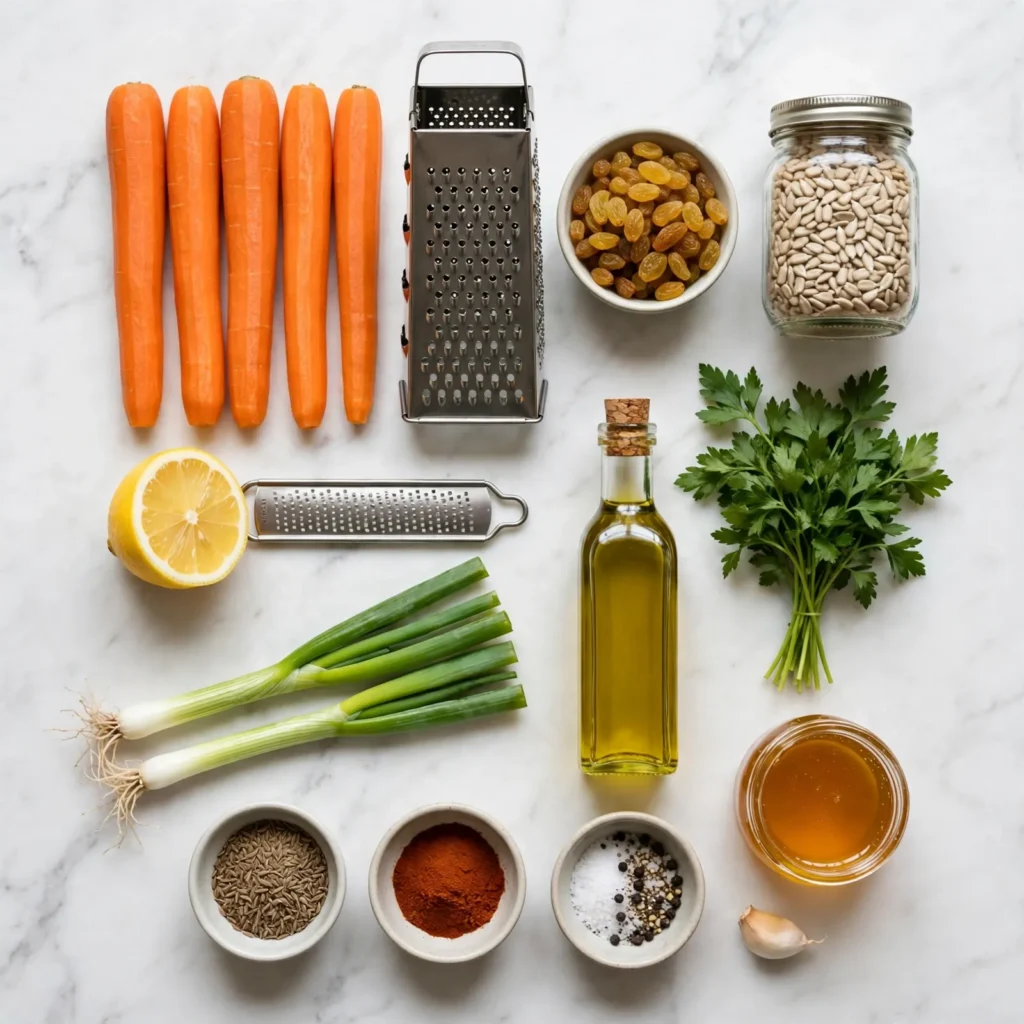
- 500g (about 1 lb, 4 to 5 medium) fresh whole carrots, peeled and grated on the large holes of a box grater — the entire base of the salad; freshness and immediate grating are the two non-negotiable decisions
- 3 tablespoons golden raisins — adds natural sweetness and a chewy contrast to the crisp carrots; standard raisins work but golden raisins have a milder, less acidic sweetness that suits the lemon dressing better
- 2 tablespoons toasted sunflower seeds or pumpkin seeds — for crunch and a mild nutty note
- 3 tablespoons fresh flat-leaf parsley, roughly chopped — adds color and a clean, slightly peppery freshness; flat-leaf has more flavor than curly parsley
- 2 green onions, thinly sliced — optional; adds a mild allium note without the sharpness of raw onion
The Lemon Cumin Dressing:
- 3 tablespoons extra virgin olive oil — the fat base of the dressing; carries the fat-soluble spice compounds
- 2 tablespoons fresh lemon juice (about 1 medium lemon) — the acid component; use fresh, never bottled; fresh lemon juice has a brightness that bottled doesn’t
- 1 teaspoon lemon zest — adds the aromatic, floral citrus layer that the juice alone misses
- 1 teaspoon cumin seeds, toasted in a dry pan and roughly crushed, or 1/2 teaspoon ground cumin — the dominant spice note; warm, earthy, slightly smoky
- 1 teaspoon honey — balances the lemon’s acidity; adds a subtle floral sweetness without making the dressing taste sweet
- 1 small garlic clove, finely grated on a microplane — provides a sharp, savory background without the heat of raw chopped garlic
- 1/4 teaspoon fine salt — seasons the dressing; taste after adding to the carrots and adjust
- 1/4 teaspoon freshly ground black pepper
- 1/4 teaspoon smoked paprika — optional; adds a very subtle warmth and deepens the dressing’s color slightly
Allergen and Dietary Disclosure
This carrot salad is naturally gluten-free, dairy-free, and egg-free as written. The seeds (sunflower or pumpkin) may be processed in facilities shared with tree nuts; verify the brand if nut allergies are a concern.
For nut allergy concerns: replace the seeds with toasted sesame seeds, which are in a separate allergen category, or simply omit the seeds entirely. The salad loses some crunch but remains complete.
For vegan: replace the honey in the dressing with an equal amount of pure maple syrup or agave nectar at the same quantity. Both dissolve easily into the dressing and provide a similar balancing sweetness.
For low-sugar: omit the golden raisins and reduce the honey to 1/2 teaspoon. The dressing’s acidity becomes slightly more prominent without the balancing sweetness; increase the olive oil by 1/2 tablespoon to compensate.
This recipe has not been tested in a certified allergen-free kitchen and cannot be guaranteed safe for any specific allergy.
Step-by-Step Directions
Step 1: Toast and Crack the Cumin
Place a small dry skillet over medium heat. Add the cumin seeds and shake the pan continuously for 60 to 90 seconds until the seeds darken slightly, turn a shade browner, and release a warm, nutty smell that fills the immediate kitchen area. Remove immediately from the heat and transfer to a cutting board or mortar; the residual heat of the pan will continue toasting them if left there. Crush roughly with the flat side of a knife, in a mortar with a pestle, or in a small spice grinder for 2 to 3 pulses; you want cracked and partially ground, not a fine powder. Small visible pieces in the dressing distribute more evenly through the carrots than a uniform dust.

Chef’s Note: The 90-second toasting window transforms cumin in a specific way. Raw cumin seeds contain compounds called cuminaldehyde and other volatile terpenoids in a bound, relatively low-volatility state. Heat causes these compounds to convert and release into a more aromatic, higher-volatility form; the roasted cumin smells noticeably more complex and less raw than untoasted seeds. The flavor contribution to the finished dressing is significant enough that this step is always worth the 90 seconds.
Step 2: Make the Dressing
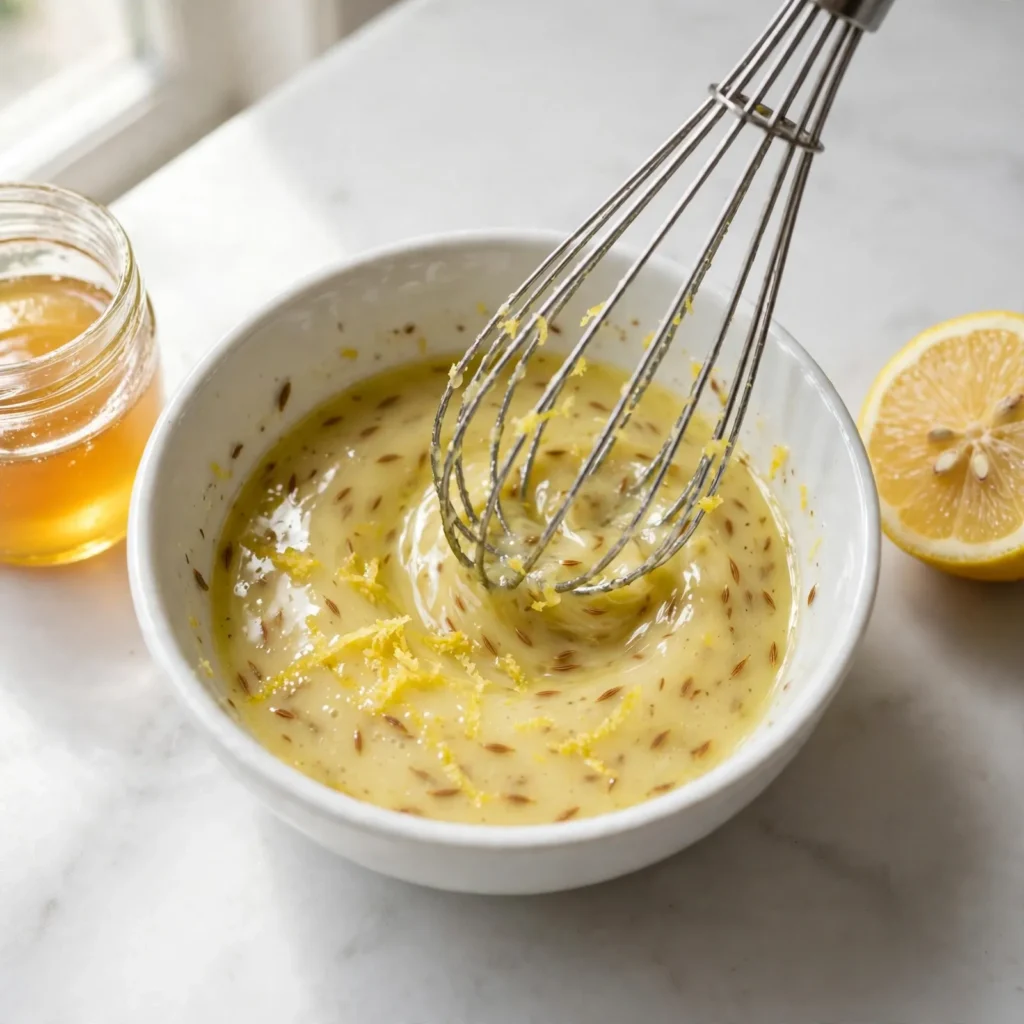
Combine the olive oil, fresh lemon juice, lemon zest, crushed toasted cumin, honey, grated garlic, salt, black pepper, and smoked paprika (if using) in a small bowl or jar. Whisk or shake until the oil and lemon juice are fully emulsified into a uniform, slightly viscous dressing; it should look opaque and pale yellow rather than separated into a floating oil layer. Taste the dressing before it touches the carrots; it should taste bright, slightly warm from the cumin, and just balanced between the lemon’s acidity and the honey’s sweetness. Adjust salt or lemon at this stage rather than after the salad is assembled.
Chef’s Note: Making the dressing first and tasting it in isolation is the most reliable way to achieve a well-seasoned salad. Once the dressing is on the carrots, adjusting is harder because the carrots dilute both the salt and the acid; what tasted perfectly seasoned in the dressing bowl often needs a small boost after being tossed with 500g of raw vegetables.
Step 3: Grate the Carrots
Peel the carrots and grate them on the large holes of a box grater directly over a large mixing bowl. Work from the thick end downward and rotate the carrot slightly with each pass to produce long, even strands rather than short, stubby pieces. Stop about 2cm from the thin tip of each carrot where the strands become too short to be useful. The grated carrots should look bright orange, glisten slightly with their natural moisture, and smell noticeably fresh and sweet.
If using a food processor with a shredding disk, process in batches and empty into the mixing bowl between batches. The food processor produces shorter, more uniform shreds than a box grater; the box grater produces longer strands that have slightly more visual appeal and a more varied texture.
Step 4: Dress and Toss the Salad
Pour the dressing over the grated carrots in the bowl. Add the golden raisins, most of the parsley (reserve a small handful for the top), and the green onions if using. Toss everything together with two forks or clean hands, lifting and turning the carrots from the bottom of the bowl upward until every strand is coated in the dressing and the raisins and parsley are evenly distributed throughout. Taste and adjust salt if needed.
Step 5: Finish and Serve
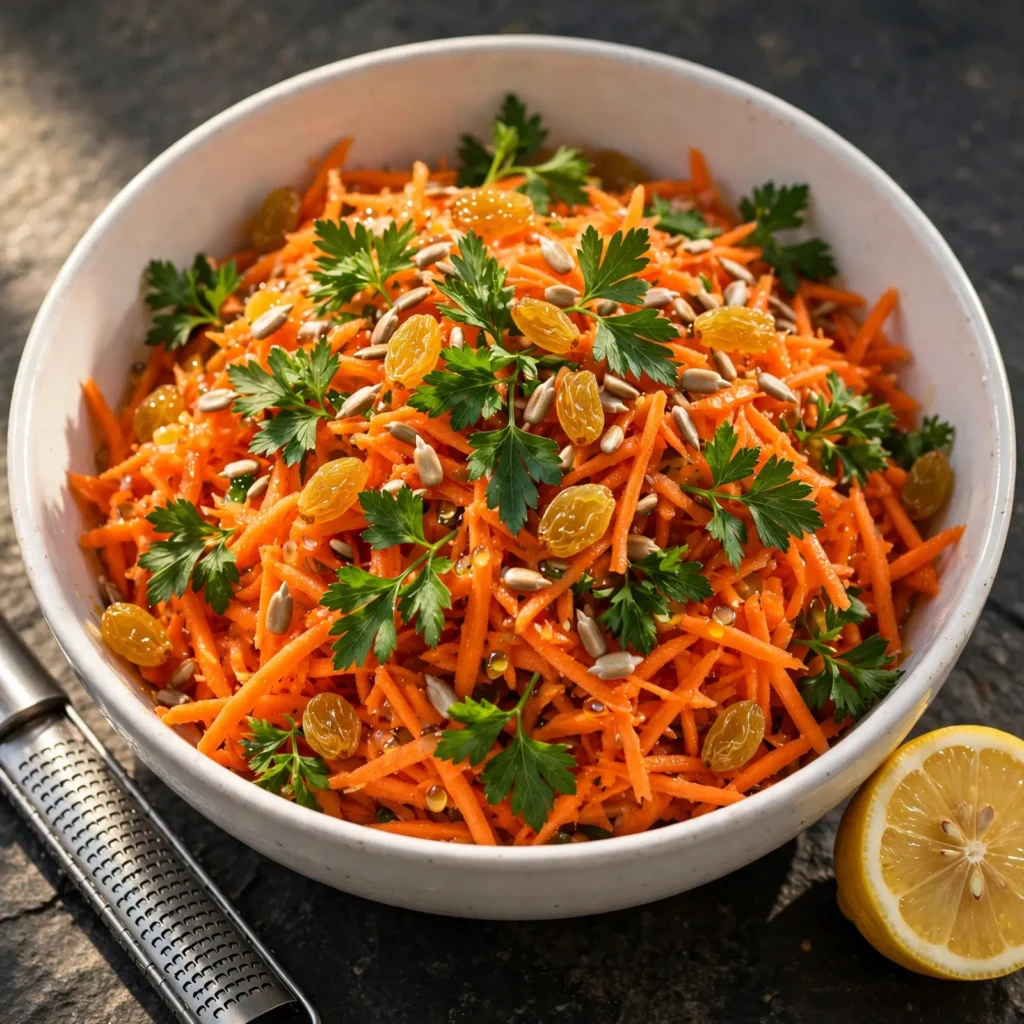
Transfer the dressed salad to a serving bowl. Scatter the reserved fresh parsley across the top, followed by the toasted seeds. Serve immediately for the freshest texture, or refrigerate for 20 to 30 minutes to let the dressing settle into the carrots; both approaches produce a satisfying result.
Chef’s Note: Adding the seeds at the very end rather than tossing them through the salad with the dressing keeps them visibly crunchy on the surface rather than becoming coated in dressing and softening before the salad is eaten. For a salad being made ahead, store the seeds separately and add them just before serving.
Common Mistakes and Troubleshooting
| Problem | Cause | Solution |
|---|---|---|
| Salad watery and pooling liquid at the bottom | Pre-shredded bagged carrots used, or carrots grated too far in advance | Always grate fresh whole carrots immediately before dressing; if grating ahead, spread on a paper towel for 5 minutes to drain excess moisture |
| Dressing tastes flat and one-dimensional | Cumin not toasted, lemon bottled rather than fresh, or too much olive oil | Toast cumin for the full 90 seconds; use only fresh lemon juice; balance with more lemon zest or an extra teaspoon of lemon juice |
| Salad too acidic and sharp | Too much lemon juice or garlic grated too coarsely | Add lemon juice in tablespoons and taste; grate garlic on a microplane for a milder, evenly distributed result |
| Seeds go soft before serving | Seeds tossed into the salad too early and absorbed the dressing | Always scatter seeds on top immediately before serving; store separately if making ahead |
| Carrots taste dull and slightly rubbery | Old pre-shredded carrots, or very large old carrots with a woody core | Use fresh medium-sized carrots; discard any with a hard pale center core |
| Raisins clump together | Not separated before adding or added when the bowl was still warm | Separate raisins with your fingers before adding; ensure the bowl and carrots are at room temperature |
Variations and Substitutions
- Moroccan-spiced carrot salad: Add 1/4 teaspoon of ground cinnamon and 1/4 teaspoon of ground ginger to the dressing alongside the cumin. Replace the golden raisins with finely diced dried apricots and add 2 tablespoons of toasted flaked almonds. This version has a warm, sweet-spiced character common in North African preparations and pairs particularly well with lamb or couscous.
- Carrot and chickpea salad: Add one 400g can of drained, rinsed chickpeas to the dressed carrot salad and toss through. The chickpeas add protein and make the salad substantial enough to serve as a light main course. Add an extra tablespoon of olive oil to the dressing to account for the increased volume. This version works well stuffed into pita bread with a spoonful of hummus.
- Asian-style carrot salad: Replace the lemon juice with 2 tablespoons of rice vinegar. Replace the olive oil with 2 tablespoons of toasted sesame oil. Replace the cumin with 1 teaspoon of freshly grated ginger. Add 1 tablespoon of soy sauce and 1 teaspoon of honey. Replace the parsley with fresh cilantro and the sunflower seeds with toasted sesame seeds. The result has a bright, tangy, sesame-forward flavor that pairs well with rice dishes or grilled fish.
- Carrot and feta salad: Crumble 80g of full-fat feta cheese over the finished salad. The salty, creamy feta contrasts the sweet carrots and bright dressing in a combination that makes the salad feel more substantial and dinner-party appropriate. Reduce the salt in the dressing to 1/8 teaspoon since the feta adds significant salt of its own.
- Carrot and orange salad: Add the segments of one medium orange (pith removed, segmented over the bowl to catch the juice) to the dressed salad along with the raisins. Replace 1 tablespoon of the lemon juice with an equal amount of fresh orange juice. The orange adds a sweet, juicy element that makes the salad feel lighter and more summery; this version is particularly good served with fish or alongside a grain bowl.
- Spicy harissa carrot salad: Add 1 teaspoon of harissa paste to the dressing before whisking. The harissa adds chili heat and a deep, slightly smoky pepper flavor that works well with the cumin and lemon. Start with 1/2 teaspoon if the heat level of your harissa is unknown; adjust upward to taste.
Serving Suggestions
- Serve alongside roasted or grilled chicken thighs as a bright, crunchy counterpoint to the rich, savory meat; the lemon and cumin in the carrot salad dressing echo seasoning choices that work naturally with chicken.
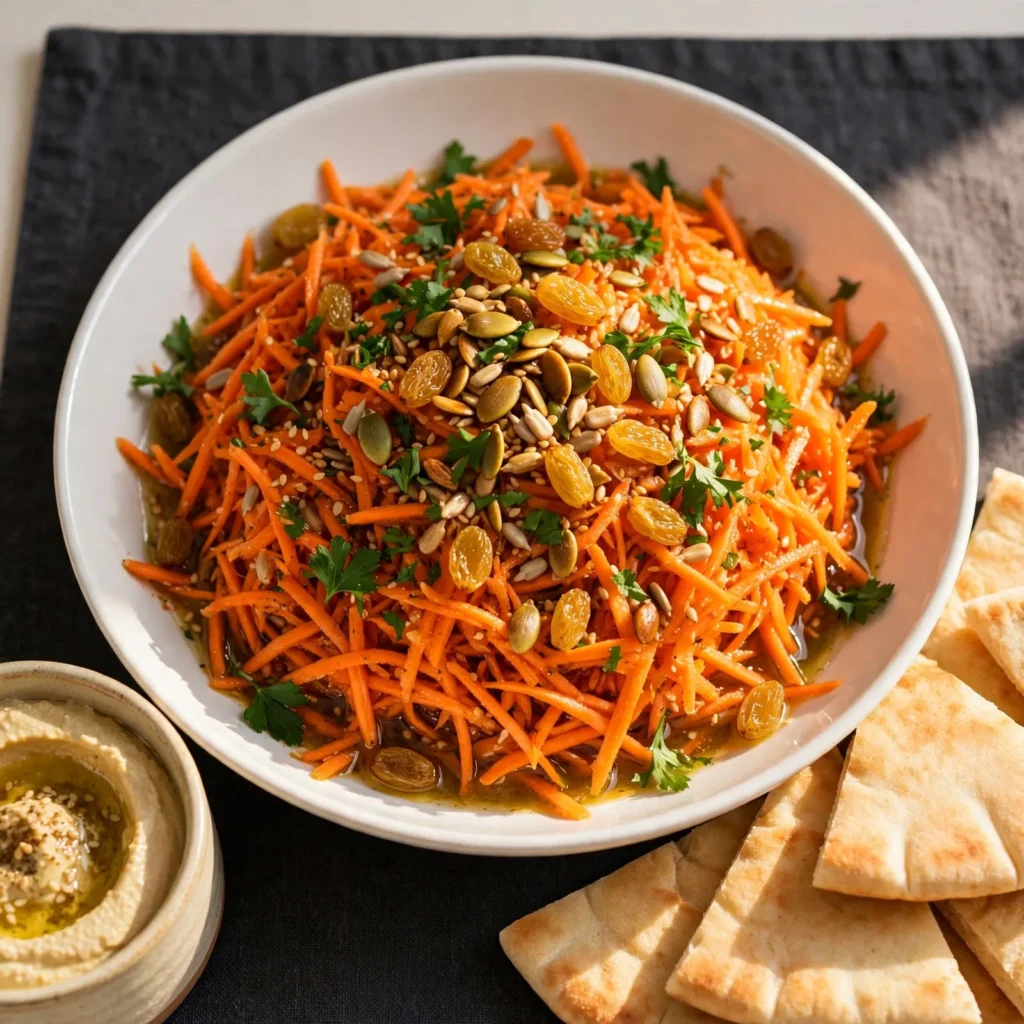
- Spoon into warm pita bread with a layer of hummus and a few slices of cucumber for a fast, satisfying lunch that requires no additional cooking.
- Serve as part of a mezze spread alongside other small plates: hummus, roasted red peppers, olives, and warm flatbread. The carrot salad provides brightness and crunch within a spread that might otherwise trend toward heavier, richer elements.
- Place a generous portion alongside a grain bowl of warm bulgur wheat or couscous, topped with a poached egg; the cold crunchy salad against warm grain and egg makes a balanced, textured complete meal.
- Serve cold, directly from the refrigerator, as a side for a summer barbecue where it can sit out without wilting for the full duration of the meal; its durability at room temperature makes it one of the most practical salads for outdoor dining.
- Pair with cold sparkling water with mint or a cold pressed carrot-ginger juice; both amplify the fresh vegetable character of the salad and provide a clean, refreshing contrast to the dressing’s warm spice notes.
Tips for the Best Results
- Grate the carrots immediately before dressing, not in advance. A carrot grated and left exposed to air for 15 minutes before dressing begins to dry at the cut surfaces and loses the moisture that gives the grated strands their characteristic glisten and crunch. Grate directly into the bowl, dress immediately, and the salad has the best possible texture.
- Taste the dressing before it touches the carrots and calibrate it deliberately. The dressing should taste confidently seasoned and slightly sharper than you’d want in the finished salad, because 500g of carrots dilutes its intensity significantly when tossed. A dressing that tastes “just right” in the bowl often tastes underseasoned on the finished salad; err toward a touch more lemon and salt than feels instinctively correct.
- Toast the cumin rather than skipping it. The difference between toasted and untoasted cumin in this dressing is audible: toasted cumin smells like roasted nuts when it hits the pan; raw cumin smells flat and slightly medicinal. The 90 seconds of active toasting, swirling the pan continuously to prevent burning, produces a dressing note that elevates the entire salad.
- Use a microplane for the garlic rather than mincing it. Minced garlic in a cold dressing applied to raw carrots retains its sharp, pungent raw garlic character in an uneven way; some bites have a concentrated sharp hit and others have none. Microplane-grated garlic disperses evenly through the dressing, producing a consistent background garlic note without any sharp patches.
- Let the salad rest for 15 to 20 minutes after dressing if time allows. Even a short rest allows the carrots to begin absorbing the lemon and cumin, softening just slightly from their raw state into a more cohesive salad texture. This brief rest is distinct from the overnight improvement; it’s simply the difference between a just-dressed salad and one that has had a few minutes to settle.
Storage Tips
Refrigerator
Dressed carrot salad keeps in the refrigerator in a sealed container for up to 3 days. The texture softens progressively as the carrots absorb the dressing, which most people find preferable to the just-dressed version; day 2 is genuinely the best day to eat it. Store without the seeds to keep them from softening; add freshly toasted seeds just before serving. If excess liquid pools at the bottom of the container during storage, drain it off and taste before adding a small drizzle of fresh olive oil and a squeeze of lemon to refresh the salad before serving.
Freezer
Carrot salad does not freeze well. The high water content of raw carrots means the cell walls rupture during freezing, producing a mushy, watery texture after thawing that is unpleasant and cannot be recovered. Freeze only the undressed grated carrots (tightly sealed, up to 2 months) if advance preparation is needed; thaw and dress fresh on the day of serving.
Reheating
Carrot salad is served cold or at room temperature and is never reheated. If the salad has been refrigerated and feels too cold for preference, allow it to sit at room temperature for 10 to 15 minutes before serving; this softens the olive oil back to its liquid state if it has partially solidified in the refrigerator and allows the flavor to be fully perceptible rather than muted by the cold.
Make-ahead note: The dressing can be made up to 3 days in advance and stored in a sealed jar in the refrigerator; shake vigorously before using as the oil and lemon will separate during storage. The carrots should be grated on the day of serving for the best texture; the full assembly takes 5 minutes with a pre-made dressing. For a completely make-ahead version, grate the carrots, dress, and refrigerate up to 24 hours ahead; add fresh parsley and seeds just before serving.
Nutrition Information
Per serving, approximately 1/4 of the recipe, with dressing:
| Nutrient | Amount |
|---|---|
| Calories | 185 kcal |
| Protein | 2g |
| Total Carbohydrates | 22g |
| Dietary Fiber | 4g |
| Total Sugar | 13g |
| Total Fat | 11g |
| Saturated Fat | 1.5g |
| Cholesterol | 0mg |
| Sodium | 210mg |
| Vitamin C | 14mg |
| Calcium | 50mg |
| Iron | 1.2mg |
| Potassium | 420mg |
Nutrition values are approximate and may vary based on carrot size, exact olive oil quantity absorbed, and additions.
Why This Recipe Works
The textural superiority of freshly grated whole carrots over pre-shredded bagged carrots has a specific physiological explanation. Carrots store much of their water content inside intact cellular vacuoles; when a carrot is freshly cut or grated, those cells rupture at the cut surface but the surrounding cells remain intact and fully hydrated. A just-grated carrot strand still contains nearly all its original moisture distributed through its intact internal cells, producing the characteristic crunch and succulence. Pre-shredded carrots, processed days earlier and stored in modified-atmosphere packaging, have had time for cell walls at the cut surfaces to dessicate and partially collapse; surface moisture evaporates and the strand develops the slightly dry, rubbery texture that makes pre-shredded carrot salads distinctly less appealing. The 3 to 4 minutes of grating is not a stylistic preference; it is the most direct improvement available to the recipe.
The fat in the dressing, specifically the extra virgin olive oil, serves a nutritional function beyond flavor and texture. Beta-carotene, the primary carotenoid in carrots responsible for their orange color and their precursor relationship to vitamin A, is fat-soluble rather than water-soluble. Raw carrots eaten without any dietary fat have significantly lower beta-carotene bioavailability than carrots consumed alongside fat, because the carotenoid molecules require lipid micelles (fat droplets) in the intestinal environment to be absorbed efficiently. The olive oil in the dressing isn’t merely seasoning; it creates the lipid environment that makes the beta-carotene in the carrots accessible to the body. Studies measuring carotenoid absorption have found that fat-dressed raw vegetable preparations absorb carotenoids at rates several times higher than identically prepared vegetables eaten without fat.
The dressing emulsification in this recipe, while simple, has a direct effect on how evenly the flavor distributes through the salad. An un-emulsified oil-and-lemon dressing separates as it’s poured over the carrots, with the denser lemon juice coating the bottom strands and the oil pooling at the surface. Whisking until emulsified produces a uniform suspension where every carrot strand receives an equivalent coating of both the fat (carrying the fat-soluble cumin compounds) and the acid (carrying the water-soluble lemon flavor compounds). The result is even seasoning throughout rather than the bottom of the bowl being tart and the top being oily.
Toasted cumin’s flavor advantage over raw cumin in a cold dressing is worth explaining precisely. Cumin seeds contain essential oils, particularly cuminaldehyde and cymene, in relatively bound, low-volatility states in the raw seed. When heat is applied during toasting, the seed structure opens and these volatile compounds are released and partially converted through pyrolysis into more complex aromatic molecules including 2-methoxyphenol and dimethylpyrazines, which are associated with toasted, nutty, slightly caramel-adjacent aromas. These compounds are highly volatile and disperse immediately into the surrounding dressing when the crushed toasted seeds are added, distributing the toasted flavor evenly. Raw cumin adds the same base compounds but at lower concentrations and without the additional pyrolysis products, producing a flatter, rawer spice note that doesn’t integrate as smoothly into the lemon-honey dressing.
I’ve tested this carrot salad with three dressing bases: plain lemon-only, honey-lemon, and the honey-lemon-cumin version in this recipe. The plain lemon version is sharp, bright, and one-dimensional; it tastes like dressed carrots without a developed flavor profile. The honey-lemon version adds balance but still lacks depth; without the spice note, the dressing reads as sweet and acidic without complexity. The honey-lemon-cumin version produces a dressing with three distinct flavor dimensions: the brightness of the lemon, the warm earthiness of the toasted cumin, and the floral sweetness of the honey, which together produce a result that tastes like a considered, developed dressing rather than an improvised one.
Frequently Asked Questions
Can I make carrot salad ahead of time?
Yes, and it’s one of the most practical salads to make ahead. The fully dressed carrot salad keeps in the refrigerator for up to 3 days; the flavor actually improves on day 2 as the carrots absorb the lemon and cumin dressing more deeply. The one adjustment for making ahead: store the toasted seeds separately and add them just before serving to prevent them from softening in the dressing during storage. The parsley can be added the day before; it wilts slightly but remains flavorful.
Why is my carrot salad watery?
Excess water in carrot salad comes almost always from pre-shredded bagged carrots rather than freshly grated ones. Bagged shredded carrots sit in their own expressed moisture during storage and release it into the salad when dressed. If using fresh whole carrots, grate them immediately before dressing; grating more than 15 minutes before assembling allows the cut surfaces to release moisture into the bowl. If the salad still pools liquid, spread the grated carrots on a clean kitchen towel for 3 to 4 minutes before dressing to absorb the surface moisture.
What can I substitute for the golden raisins?
Several alternatives work well at the same 3-tablespoon quantity. Finely diced dried apricots add a slightly tarter, more complex sweetness and a golden-orange color that blends beautifully with the carrots. Dried cranberries add tartness and color contrast. Small fresh pomegranate seeds add both sweetness and a visual burst of deep red with a fresh, juicy pop rather than a chewy one. Medjool dates, pitted and roughly chopped, add a deeper, caramel-like sweetness that pairs well with the Moroccan-spiced variation.
How do I know when the cumin seeds are properly toasted?
Two simultaneous signals confirm properly toasted cumin: the seeds should have darkened from their raw tan color to a medium brown, and the kitchen should smell distinctly nutty and warm rather than the flat, raw smell of the unheated seeds. The whole process takes 60 to 90 seconds in a dry pan at medium heat with continuous swirling. If the seeds smell sharp, acrid, or like something burning, they’ve gone past the ideal point; start a fresh teaspoon. Properly toasted cumin smells warm and almost like roasted nuts; improperly toasted smells bitter.
Is carrot salad gluten-free?
Yes, this recipe is naturally gluten-free as written. Every core ingredient, including the carrots, olive oil, lemon, cumin, honey, garlic, parsley, raisins, and seeds, is inherently gluten-free. If adding any variation ingredients, verify those individually. The only potential variable for strict celiac sufferers is the seeds; some brands process sunflower or pumpkin seeds in facilities shared with wheat-containing products, so look for a certified gluten-free seed brand if this is a concern.
Can I use a food processor instead of a box grater?
Yes. A food processor with a shredding disk handles large batches faster than a box grater and produces uniform shreds. The strands are shorter and slightly more compact than box-grated carrots; the texture of the finished salad is comparable but slightly less layered visually. For 500g of carrots the food processor takes about 2 minutes; the box grater takes about 4 to 5 minutes. Either method produces a salad that’s significantly better than pre-shredded bagged carrots.
How long do dressed carrots last?
Dressed carrot salad keeps well in a sealed container in the refrigerator for up to 3 days. Unlike leafy green salads that wilt and become unpleasant within hours of dressing, grated carrots hold their structure through the lemon’s acidity without collapsing. The texture softens progressively from day 1 to day 3; day 1 is the crunchiest and day 3 is the most deeply flavored. The salad is not suitable for freezing. Undressed grated carrots kept in a sealed container in the refrigerator for up to 1 day before dressing produce a result very close to immediately-dressed carrots.
Conclusion
Carrot salad is one of those recipes where the improvement from doing two things properly, grating fresh carrots and making the dressing from scratch, is so immediate and so obvious that it becomes one of the most regularly repeated dishes in a rotation. The 15-minute time investment produces something that holds up in the refrigerator for 3 days, travels well, sits out without wilting, and pairs with almost everything.
The version here is a starting point more than a fixed formula. The dressing template, olive oil plus an acid plus a warm spice, transfers to almost any direction: Asian, Moroccan, Middle Eastern, or simply clean and herbed. Make the base recipe a few times until it’s automatic, and the variations follow naturally from there.
If you loved this recipe, save it to your easy salads and healthy side dishes Pinterest board so you can find it easily later. For more recipes and daily food inspiration, follow TheCookingVibes on Pinterest.
Fresh Carrot Salad
Ingredients
Equipment
Method
- Place cumin seeds in a small dry skillet over medium heat. Swirl continuously for 60 to 90 seconds until darkened and fragrant. Transfer immediately to a board or mortar and crush roughly; do not grind to a fine powder.
- Combine olive oil, fresh lemon juice, lemon zest, crushed cumin, honey, grated garlic, salt, pepper, and smoked paprika in a small bowl. Whisk until fully emulsified into a uniform pale yellow dressing. Taste and adjust salt and lemon.
- Peel the carrots and grate immediately on the large holes of a box grater directly into a large mixing bowl. Stop 2cm from the thin tip of each carrot.
- Pour the dressing over the grated carrots. Add golden raisins, most of the parsley, and green onions. Toss with two forks or clean hands until every strand is coated and the mix-ins are evenly distributed throughout. Taste and adjust salt.
- Transfer to a serving bowl. Scatter reserved parsley and toasted seeds on top. Serve immediately or refrigerate 15 to 20 minutes for a slightly more integrated flavor.
Notes
- Always grate whole fresh carrots immediately before dressing; pre-shredded bagged carrots produce a watery, rubbery salad.
- Store seeds separately when making ahead; add just before serving to keep them crunchy.
- The dressed salad keeps 3 days refrigerated; day 2 is the best eating day for depth of flavor.
- Allow the salad to sit at room temperature for 10 minutes before serving if refrigerated, to allow the olive oil to return to its liquid state.