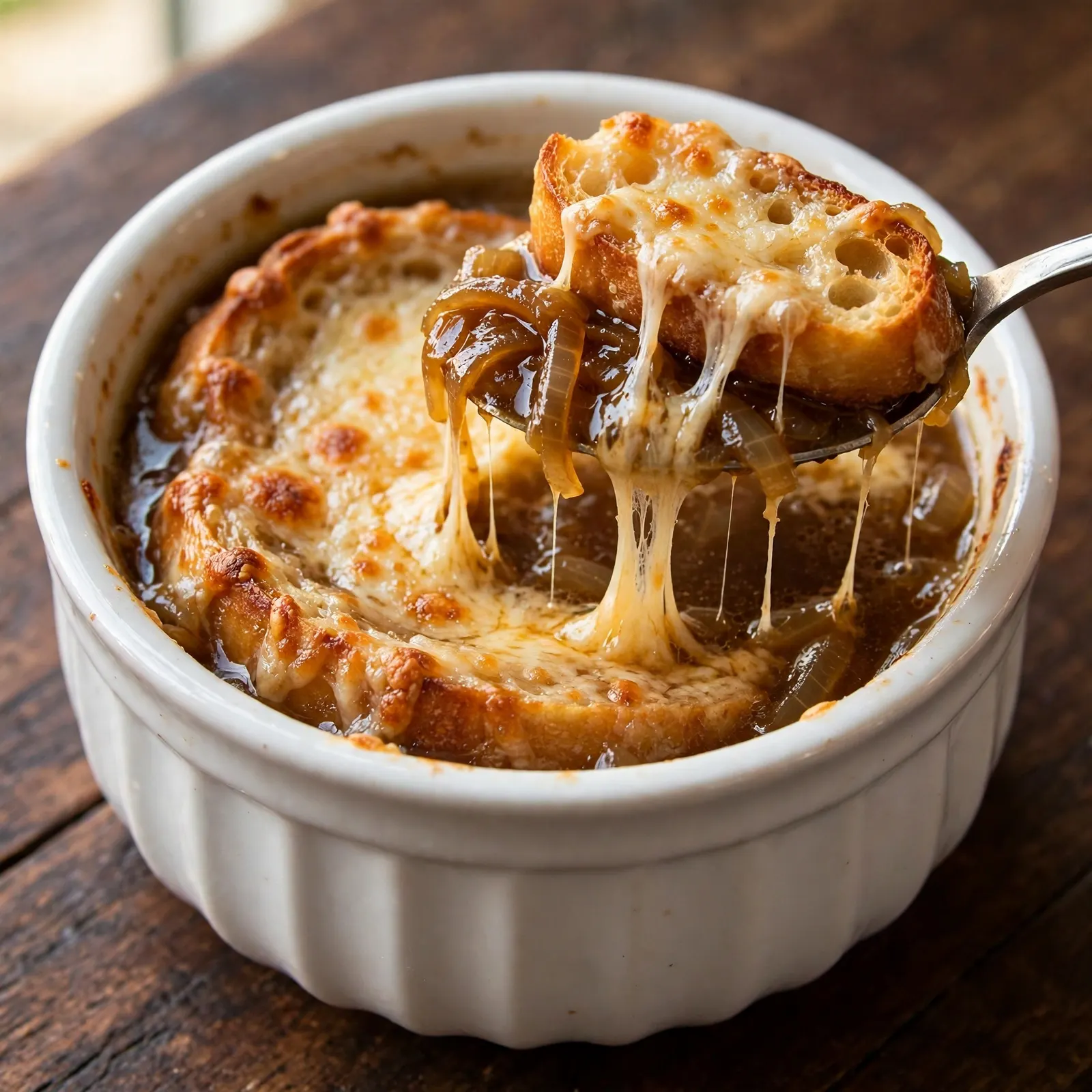
Classic French Onion Soup — Deeply Caramelized, Rich Broth, Bubbling Cheese
Stand at the stove for 45 minutes stirring a pot of sliced onions in butter, and something remarkable happens. The onions go from sharp and eye-watering to golden, then amber, then a deep mahogany brown, and the smell in the kitchen shifts from raw allium to something sweet, almost nutty, with a depth that doesn’t resemble the original vegetable at all. That transformation, the actual caramelization of the onion’s natural sugars, is what separates genuine French onion soup from the pale, flat imitation made by onions cooked for 10 minutes.
This French onion soup recipe builds on properly caramelized onions simmered in a rich beef broth base, ladled into oven-safe crocks, topped with thick-cut toasted bread, and covered in a thick layer of Gruyère cheese that broils into a bubbling, golden-brown crust. It takes about 90 minutes with very little active work beyond the initial onion cooking, serves 4, and produces a bowl that tastes genuinely restaurant-quality. The caramelized onion step cannot be rushed; everything else in the recipe is straightforward.
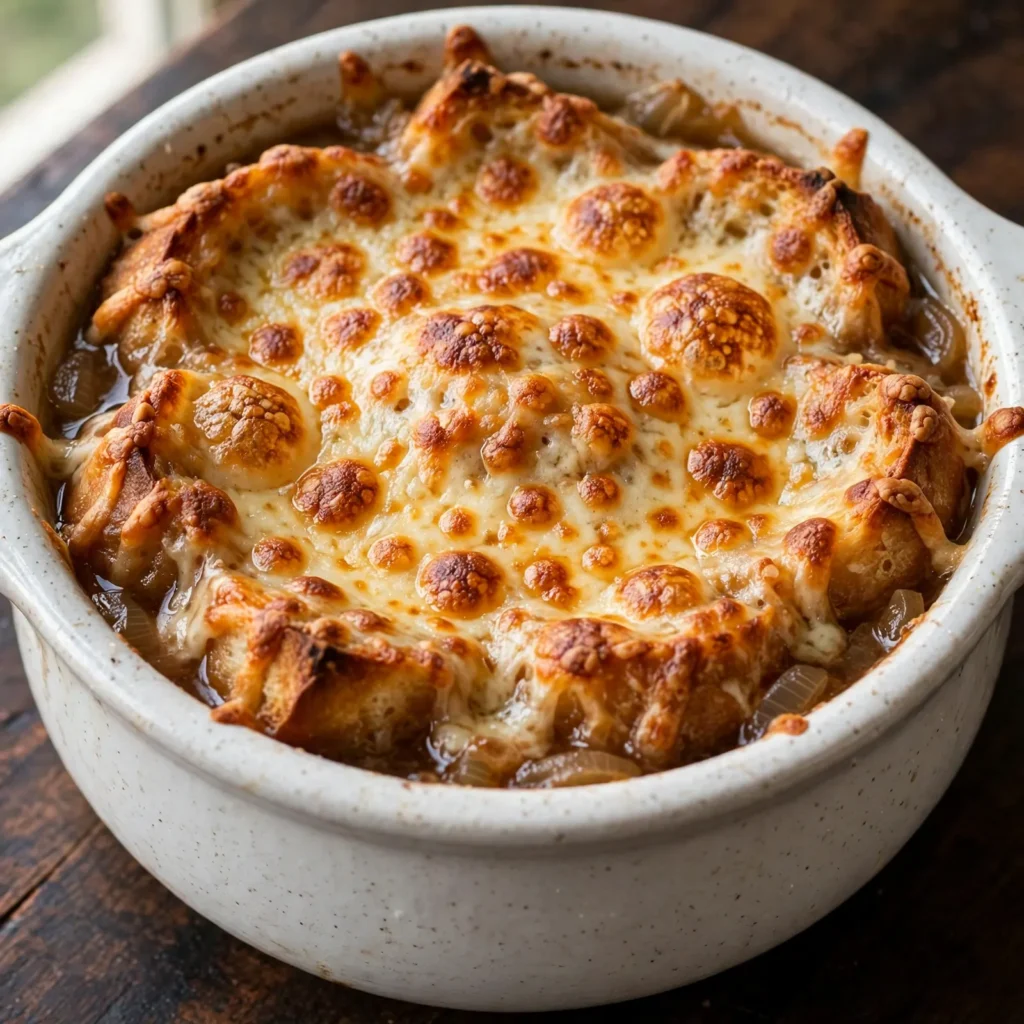
Why You’ll Love This French Onion Soup
- Onions that actually taste caramelized. The full 40 to 50-minute caramelization process produces onions with a deep, almost jammy sweetness and a complex, savory depth that 10 or 15 minutes of cooking simply cannot produce; the flavor difference between rushed and properly caramelized onions is the entire difference between a good and a forgettable bowl.
- Cheese crust that’s genuinely thick and bubbling. Using a full 60 to 70g of Gruyère per bowl, grated from a block and applied generously, produces a crust that bubbles under the broiler into a thick, golden-brown layer rather than the thin, barely-melted film that results from a smaller cheese quantity.
- Broth that tastes built rather than poured. Simmering the caramelized onions in beef broth for 20 minutes before the soup goes into the crocks allows the broth to absorb the concentrated onion flavor and develop a depth and body that plain broth poured over onions never achieves.
- Make-ahead in stages. The caramelized onions and broth keep for 5 days in the refrigerator, which means the 45-minute active work can be done on a different day from the assembly and broiling, splitting a 90-minute recipe into two easy stages.
- Unmistakably impressive presentation. The individual crocks arriving at the table with their bubbling cheese crusts look like a deliberate effort, which makes French onion soup one of the most effective dinner-party starters for the amount of work it actually requires.
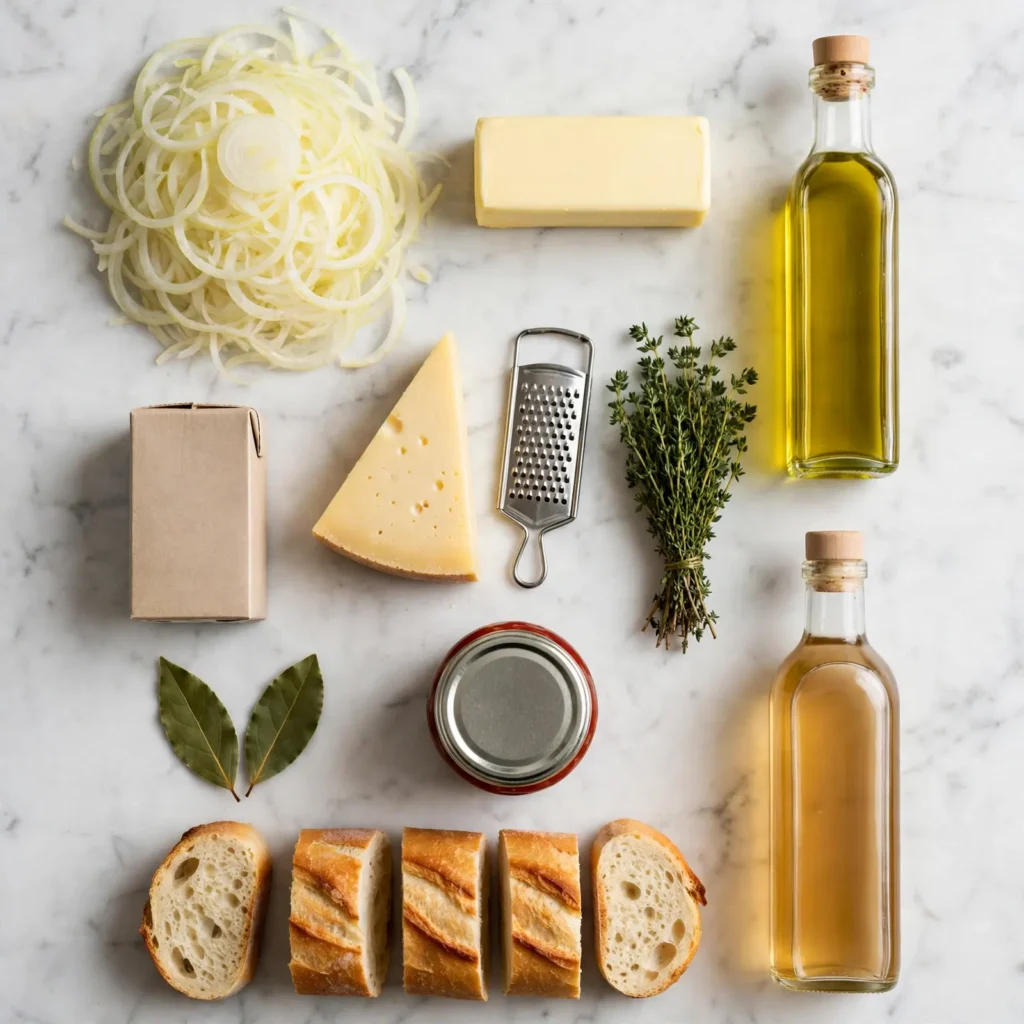
Ingredients You’ll Need
Recipe Timing
| Detail | Info |
|---|---|
| Servings | 4 |
| Difficulty | Moderate |
| Course | Starter, Main Course |
| Cuisine | French |
| Prep Time | 15 minutes |
| Cook Time | 70 minutes (50 min caramelizing + 20 min simmering) |
| Rest Time | 5 minutes |
| Total Time | 90 minutes |
For the onions, yellow onions are the classic and best choice for French onion soup. They have a high sugar content that caramelizes predictably and produces the deep amber color and sweetness that defines the soup. White onions caramelize adequately but produce a slightly sharper, less mellow flavor in the finished soup. Red onions produce a distinctly different, more astringent flavor that doesn’t suit the French onion tradition. You’ll need approximately 1.2 to 1.4 kg of whole onions before peeling; they shrink dramatically during the caramelization process, collapsing from a pot overflowing with raw onion to about 400g of deeply browned, concentrated caramelized onion by the time they’re done.
For the cheese, Gruyère is the specific choice for this recipe rather than mozzarella or Swiss. Gruyère melts into a fluid, stretchy layer that browns deeply under the broiler without separating into a greasy pool. It has a nutty, slightly sharp flavor that complements the sweet caramelized onion without overpowering it. Always buy a block and grate it yourself; pre-shredded Gruyère is coated in anti-caking starch that resists melting smoothly and produces a slightly grainy, uneven crust.
For the beef broth, use a good-quality low-sodium beef broth. The broth is the second major flavor component in the soup after the caramelized onions; a flat, thin broth produces a flat soup regardless of how well the onions were cooked. If good beef broth isn’t available, a combination of 600ml of vegetable broth with 1 tablespoon of soy sauce and 1 teaspoon of tomato paste produces a reasonable depth substitute.
For the bread, a baguette or thick-cut sourdough are both ideal. Stale or day-old bread is better than fresh; it toasts more crisply and absorbs the broth below the cheese crust without disintegrating. Slices should be cut 2 to 2.5cm thick; thinner slices dissolve into the broth before the cheese sets, thicker slices remain too bread-like and don’t absorb the soup properly.
- 1.2 kg (about 2.5 lbs) yellow onions (about 5 to 6 medium), peeled, halved, and thinly sliced into half-moons — the soul of the soup; the quantity seems extreme but they reduce to a fraction of their raw volume after 45 minutes of cooking
- 3 tablespoons unsalted butter — the primary cooking fat for the onions; butter’s milk solids contribute to the golden color developing on the onion surfaces during caramelization
- 1 tablespoon olive oil — combined with the butter to raise the smoke point and prevent the butter’s milk solids from burning before the onions have softened
- 1/2 teaspoon fine salt — added with the onions at the start; draws moisture from the onions rapidly and accelerates the initial softening stage
- 1 teaspoon light brown sugar — optional but useful for onion varieties that caramelize slowly; a small amount accelerates the final deepening of color without making the soup taste sweet
- 2 tablespoons all-purpose flour — added once the onions are fully caramelized; thickens the broth slightly and gives the soup a slightly more substantial body
- 1 tablespoon tomato paste — adds a subtle acidity and depth that rounds the sweetness of the caramelized onions and enriches the broth color
- 1 tablespoon apple cider vinegar — replaces the brightness that a small amount of cooking acid would provide; added as the onions finish caramelizing, it lifts the deep, jammy flavor and adds a subtle fruitiness that keeps the soup from tasting flat
- 1 litre (about 4 cups) low-sodium beef broth — the liquid base; simmered with the caramelized onions so it absorbs their concentrated flavor
- 1 teaspoon fresh thyme leaves (or 1/2 teaspoon dried thyme) — the classic French herb companion to caramelized onions; adds a subtle earthy note
- 2 bay leaves — removed before serving; add a faint, clean herbal depth to the broth during simmering
- Salt and freshly ground black pepper — season carefully at the end since the broth concentrates during simmering
For Assembly:
- 4 slices baguette or sourdough, cut 2 to 2.5cm thick — the bread platform for the cheese crust
- 240g (about 2 1/2 cups) Gruyère cheese, freshly grated from a block — approximately 60g per bowl; the essential cheese for an authentic bubbling crust
- 1 tablespoon olive oil or melted butter — for brushing the bread before toasting
Allergen and Dietary Disclosure
This French onion soup contains dairy (butter and Gruyère cheese) and gluten (all-purpose flour used to thicken the broth, and the baguette or sourdough bread used for the crust). It is naturally egg-free.
For gluten-free: replace the all-purpose flour with a certified gluten-free 1:1 flour blend at the same quantity, or use 1 tablespoon of cornstarch dissolved in 2 tablespoons of cold broth before whisking it into the soup. Use a certified gluten-free bread for the toasts. The method stays identical; the soup body and crust texture are very close to the standard version.
For dairy-free: replace butter with a good vegan butter alternative and use a dairy-free Gruyère-style cheese. Dairy-free melting cheeses vary significantly in how they brown; keep the broiler at the standard distance but watch closely after the first 2 minutes since some dairy-free cheeses brown faster than Gruyère.
For vegetarian: replace the beef broth with a combination of 800ml of strong vegetable broth and 200ml of unseasoned mushroom broth. Add 1 tablespoon of soy sauce to the broth for added depth and umami that compensates for the savory richness beef broth naturally provides. The method stays unchanged.
This recipe has not been tested in a certified allergen-free kitchen and cannot be guaranteed safe for any specific allergy.
Equipment Needed
- Large heavy-bottomed pot or Dutch oven, 5 to 6 quart — essential for caramelizing onions. A wide, heavy base distributes heat evenly across the onion surface, preventing hot spots that burn individual onion pieces while others remain undercooked. A thin-bottomed pot concentrates heat unevenly and produces onions that scorch at the bottom of the pile before the top layers have softened.
- Four oven-safe soup crocks or bowls, approximately 300 to 350ml capacity — wide, squat crocks with at least 3cm of space between the soup surface and the rim are ideal; this space allows the cheese crust to bubble and puff during broiling without flowing over the edge. Standard deep soup bowls without ceramic handles are a workable alternative but less heat-resistant.
- Baking sheet — for placing the crocks on during broiling. Individual ceramic crocks get extremely hot under the broiler; a baking sheet underneath allows you to move all four at once safely without handling each scalding crock separately.
- Wooden spoon or heat-resistant silicone spatula — for stirring the onions throughout the caramelization process. Metal utensils scrape the bottom of the pan aggressively and can lift the forming fond too early; a wooden spoon allows gentle, controlled scraping that redistributes the caramelized bits back into the onion mass rather than fragmenting them.
- Broiler-safe sheet pan — for toasting the bread slices before placing them on the soup. Toasting the bread separately before placing it over the soup is what keeps it from dissolving into the broth during the broiling step.
Step-by-Step Directions
Step 1: Slice the Onions
Peel all the onions and halve them through the root end. Lay each half flat on the cutting board and slice thinly from root to tip, producing half-moon slices approximately 3mm thick. Consistent thickness is important because thicker pieces take longer to cook than thinner ones and produce uneven caramelization where some slices are done and others are still partially raw. If you’re doing this by hand rather than with a mandoline, aim for consistent 3mm slices across the entire batch.
The full volume of sliced raw onions looks enormous in the pot; they’ll reduce to roughly 25 to 30% of their original volume by the time they’re properly caramelized.
Step 2: Begin Caramelizing the Onions
Melt the butter and olive oil together in the large Dutch oven over medium heat until the butter is fully melted and beginning to shimmer. Add all the sliced onions at once; the pot will look extremely full. Add the fine salt immediately and toss the onions to coat them in the butter and oil. Cover the pot with a lid and cook for 10 to 12 minutes, stirring every 3 to 4 minutes, until the onions have wilted dramatically, released a significant amount of moisture, and reduced to roughly half their original volume. They should look soft, pale, and glossy at this stage but not yet colored.

Chef’s Note: Covering the pot for the first 10 minutes accelerates the moisture release from the onions, which is the stage that takes the most time in many recipes. The salt pulls moisture through osmosis from the onion cells, and the steam trapped under the lid recirculates back onto the onion surface, maintaining enough moisture to prevent burning while the onions soften. This covered initial stage shaves 10 to 15 minutes off the total caramelization time.
Step 3: Slowly Caramelize to Deep Amber
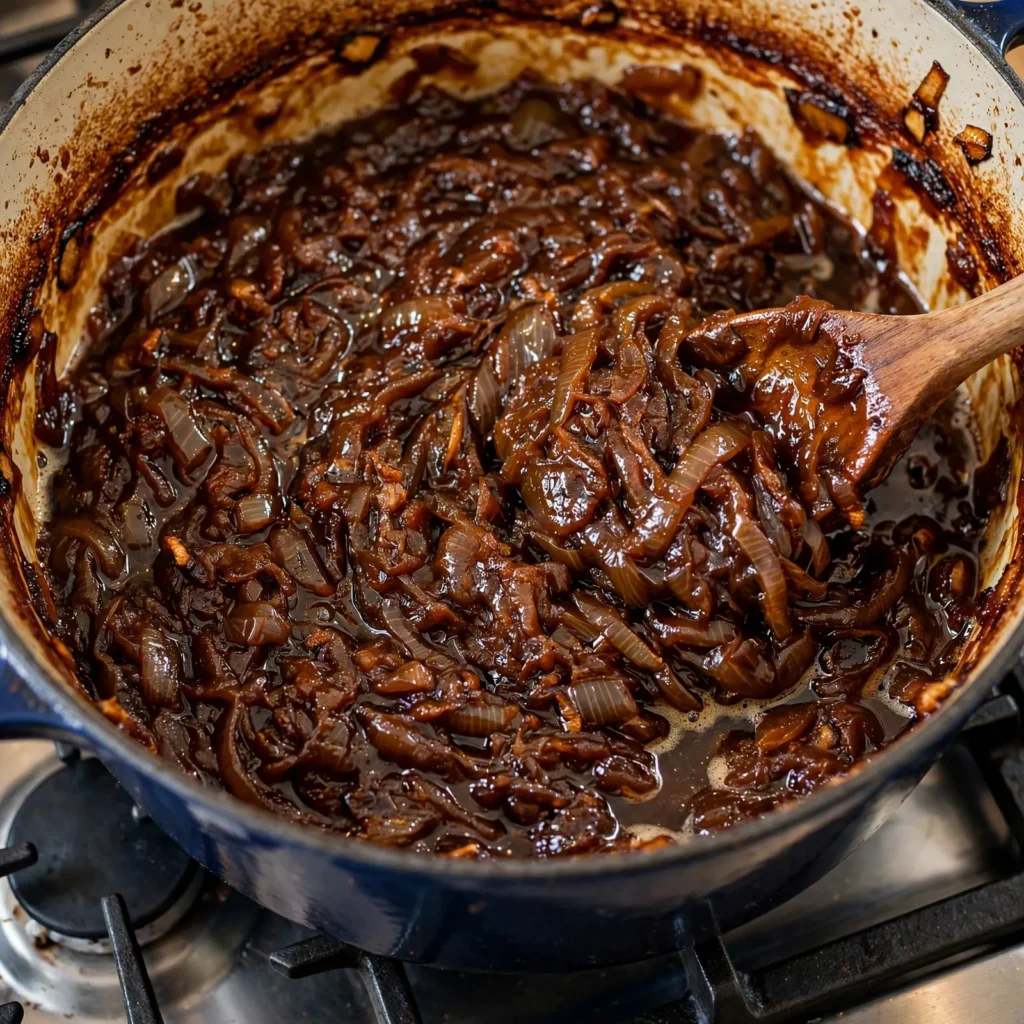
Remove the lid, reduce the heat to medium-low, and continue cooking the onions uncovered for 35 to 45 minutes, stirring every 5 to 6 minutes with a wooden spoon. The onions should be progressing through a visible color change: from pale and glossy at 10 minutes, to light golden at 20 minutes, to a warmer amber at 30 minutes, to a deep, concentrated mahogany-brown at 40 to 45 minutes. Each time you stir, scrape the bottom of the pot to incorporate the darkening fond developing there back into the onion mass; this fond carries concentrated caramelized flavor and should be absorbed into the onions rather than allowed to build up and burn.
If the onions are sticking or darkening too fast at any point, add 2 to 3 tablespoons of water to the pot and stir vigorously; the water loosens the fond and gives the onions a few more minutes before the next sticking cycle. This is normal and part of the process rather than a problem.
When the onions are a rich, deep amber-brown with a concentrated, jam-like consistency and smell intensely sweet and savory, they’re ready. Taste one; it should taste almost honey-sweet with a deep savory background rather than sharp or pungent.
Step 4: Add the Flour, Tomato Paste, and Vinegar
Sprinkle the flour evenly over the caramelized onions and stir constantly for 2 minutes until the flour coats the onions and disappears into the fat, turning the mixture into a thick, slightly pasty consistency. The flour at this stage should smell faintly of cooked wheat rather than raw starch; this is the brief roux that will thicken the broth. Add the tomato paste and stir it through for 60 seconds until it caramelizes against the pan’s base into a brick-red color. Pour the apple cider vinegar directly into the pot and stir for 30 seconds; it will sizzle and deglaze any remaining fond from the base of the pan.
Chef’s Note: The apple cider vinegar at this stage does two things simultaneously. Its acidity dissolves the last of the caramelized fond from the base of the pot, carrying all that concentrated flavor into the final soup. And its fruity sharpness provides a clean, bright counterpoint to the deep sweetness of the caramelized onions, preventing the finished soup from tasting one-dimensionally sweet even with such a large quantity of reduced onion.
Step 5: Add Broth and Simmer
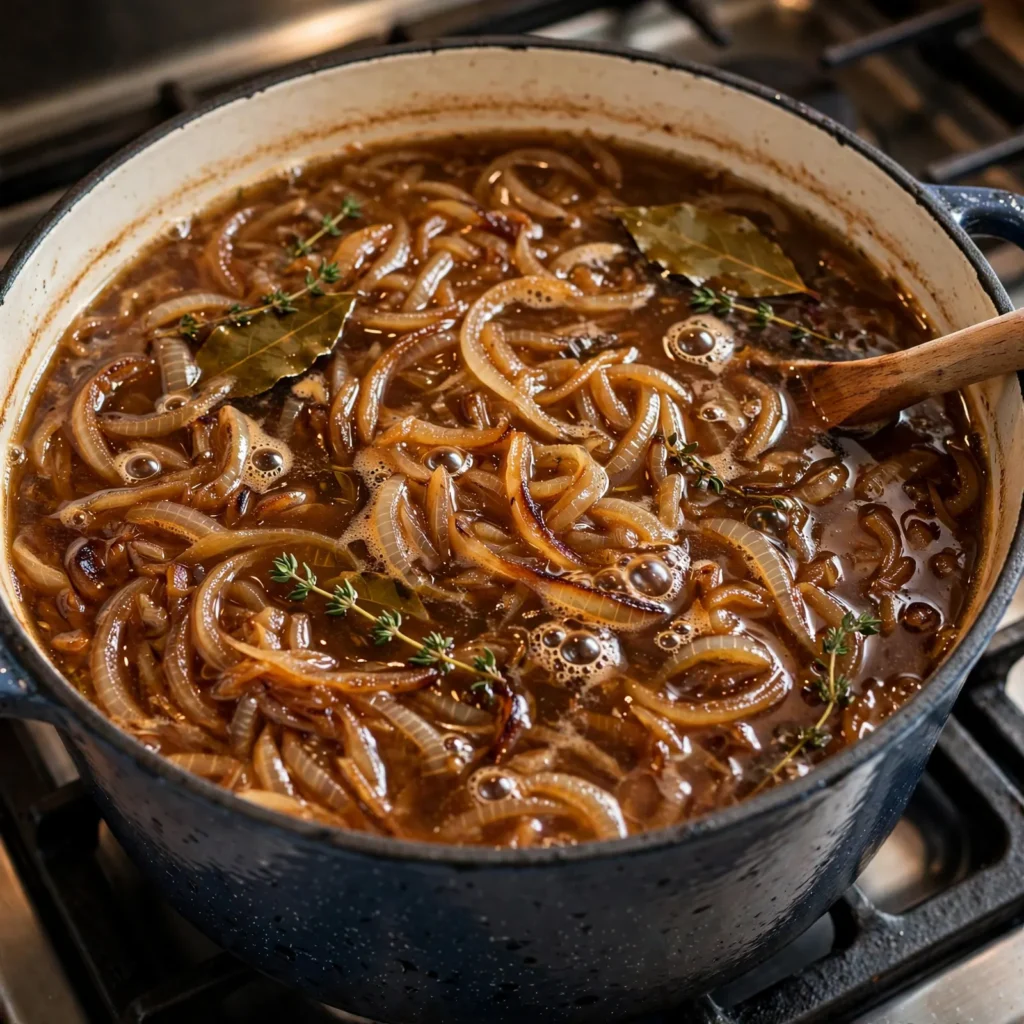
Pour the beef broth into the pot in a steady stream, stirring as you pour to incorporate it smoothly with the flour-coated onion mixture. Add the thyme and bay leaves. Bring the soup to a gentle boil over medium-high heat, then reduce to medium-low. Simmer uncovered for 18 to 20 minutes, stirring occasionally, until the broth has thickened slightly from the flour, deepened to a rich dark amber color, and absorbed the concentrated sweetness and depth from the caramelized onions. Taste carefully; season with salt and black pepper. Remove the bay leaves. The soup should taste complete at this point: deeply savory, slightly sweet from the onions, and rich in the broth rather than thin and sharp.
Step 6: Toast the Bread
While the soup simmers, brush the bread slices on both sides with olive oil or melted butter. Arrange them on a baking sheet and toast under the broiler for 2 to 3 minutes per side until both surfaces are deeply golden and the bread has dried out enough to be rigid rather than flexible. Alternatively, toast in a toaster until golden and firm. The bread must be genuinely crispy before going onto the soup; soft bread placed directly on the broth dissolves into the liquid rather than maintaining a platform for the cheese crust.
Step 7: Assemble and Broil
Preheat the broiler to high. Ladle the hot soup into the four oven-safe crocks, filling each to about 1.5cm below the rim. Place one or two toasted bread slices on top of the soup in each crock, pressing them gently so they sit flat on the surface of the liquid. They will float; this is normal. Distribute the grated Gruyère generously across the bread in each crock, covering the toast and extending the cheese slightly over the edges of the crock so it seals against the rim. Each crock should receive approximately 60g of cheese: a thick, generous layer rather than a sparse scattering.
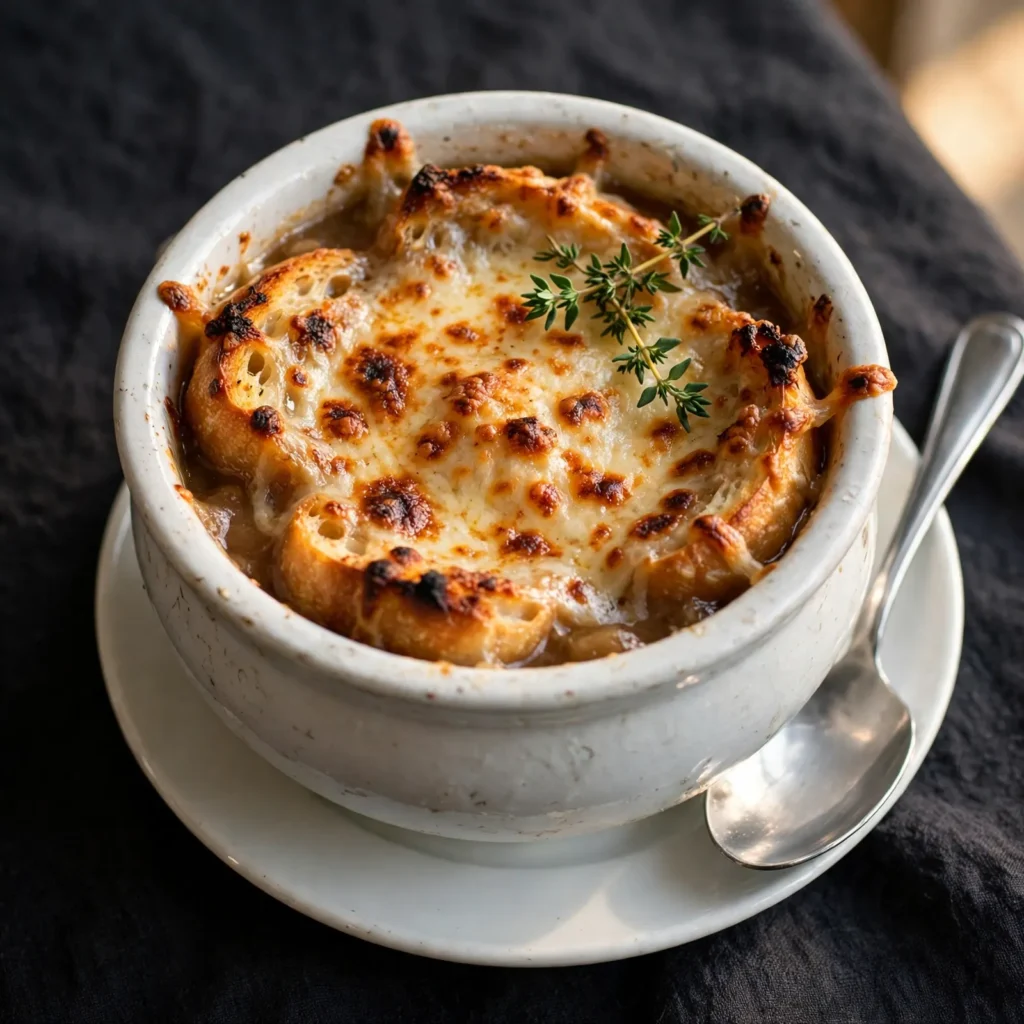
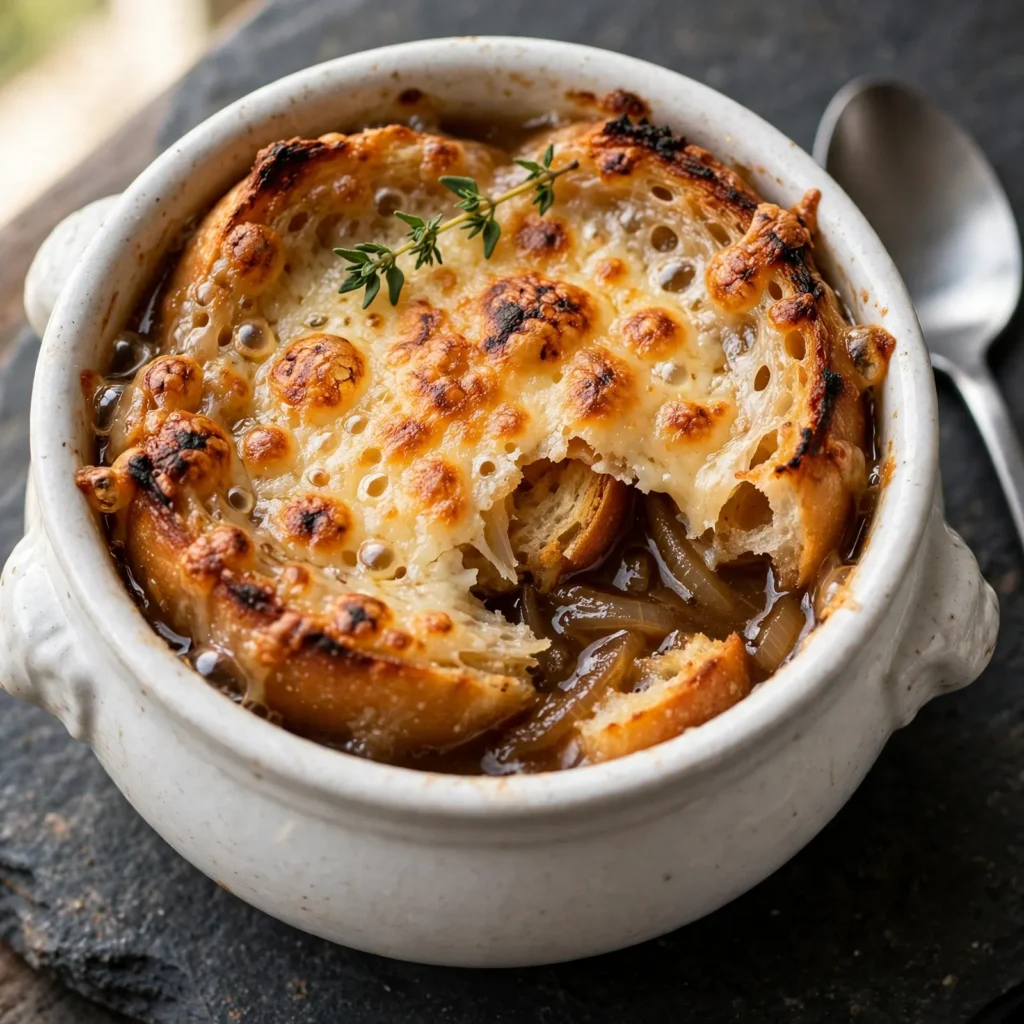
Place the crocks on the baking sheet and position them on the oven’s upper rack, 8 to 10cm below the broiler element. Broil for 3 to 5 minutes until the cheese is completely melted, visibly bubbling across the entire surface, and deeply golden-brown to amber with some slightly charred spots at the highest points of the crust. Watch continuously from the 3-minute mark; the transition from perfectly golden to overdone happens in under 60 seconds under a hot broiler.
Chef’s Note: The cheese needs to extend to the rim of each crock for a specific structural reason: when the cheese melts and bubbles against the crock’s rim, it seals the crust against the edge, creating a closed surface that traps the steam from the hot soup below. This produces the characteristic bubbling, puffed crust rather than a flat melted sheet. Cheese placed only over the bread and not to the rim produces a flat, separated crust.
Common Mistakes and Troubleshooting
| Problem | Cause | Solution |
|---|---|---|
| Onions pale and bland rather than deeply caramelized | Insufficient cook time, or heat too high causing burning before caramelization | Allow the full 40 to 50 minutes at medium-low; add small amounts of water if onions stick or darken too fast |
| Broth too thin and watery | Flour not cooked long enough before liquid was added, or not enough simmering time | Cook the flour in the onions for a full 2 minutes; simmer the finished soup uncovered for the full 18 to 20 minutes |
| Cheese not browning under broiler | Broiler not preheated, or crocks placed too far from the element | Always preheat the broiler for 5 minutes; position crocks 8 to 10cm from the element |
| Bread dissolves into broth before cheese sets | Bread not toasted firmly enough before assembly, or too thin | Toast bread until genuinely rigid and golden; use slices 2 to 2.5cm thick |
| Soup tastes flat and one-dimensional | Onions not caramelized deeply enough, or broth quality poor | The caramelization is irreplaceable; use good-quality low-sodium beef broth; deglaze with apple cider vinegar |
| Crocks overflow during broiling | Filled too close to the rim, or too much bread used | Leave at least 1.5cm below the rim before adding bread; use one slice per crock for most sized crocks |
Variations and Substitutions
- Vegetarian French onion soup: Replace beef broth with a mixture of 800ml of vegetable broth and 200ml of mushroom broth, plus 1 tablespoon of soy sauce and 1 teaspoon of tomato paste for depth. The umami from the soy sauce and the earthy depth from the mushroom broth together produce a finished soup that’s noticeably richer than plain vegetable broth would provide. The method stays completely unchanged.
- Provolone and Gruyère blend: Replace one third of the Gruyère with an equal weight of aged provolone. Provolone adds a slightly sharper, more pungent note to the crust and melts to a similar stretch and flow as Gruyère. The crust browns slightly faster under the broiler than pure Gruyère; start checking at the 2.5-minute mark.
- Onion trio version: Use a combination of two parts yellow onion, one part shallots, and one part sweet white onion. Shallots caramelize faster and produce a more intensely sweet flavor than yellow onion alone; adding them to the blend produces a more complex, layered sweetness in the finished soup without changing the method or timing.
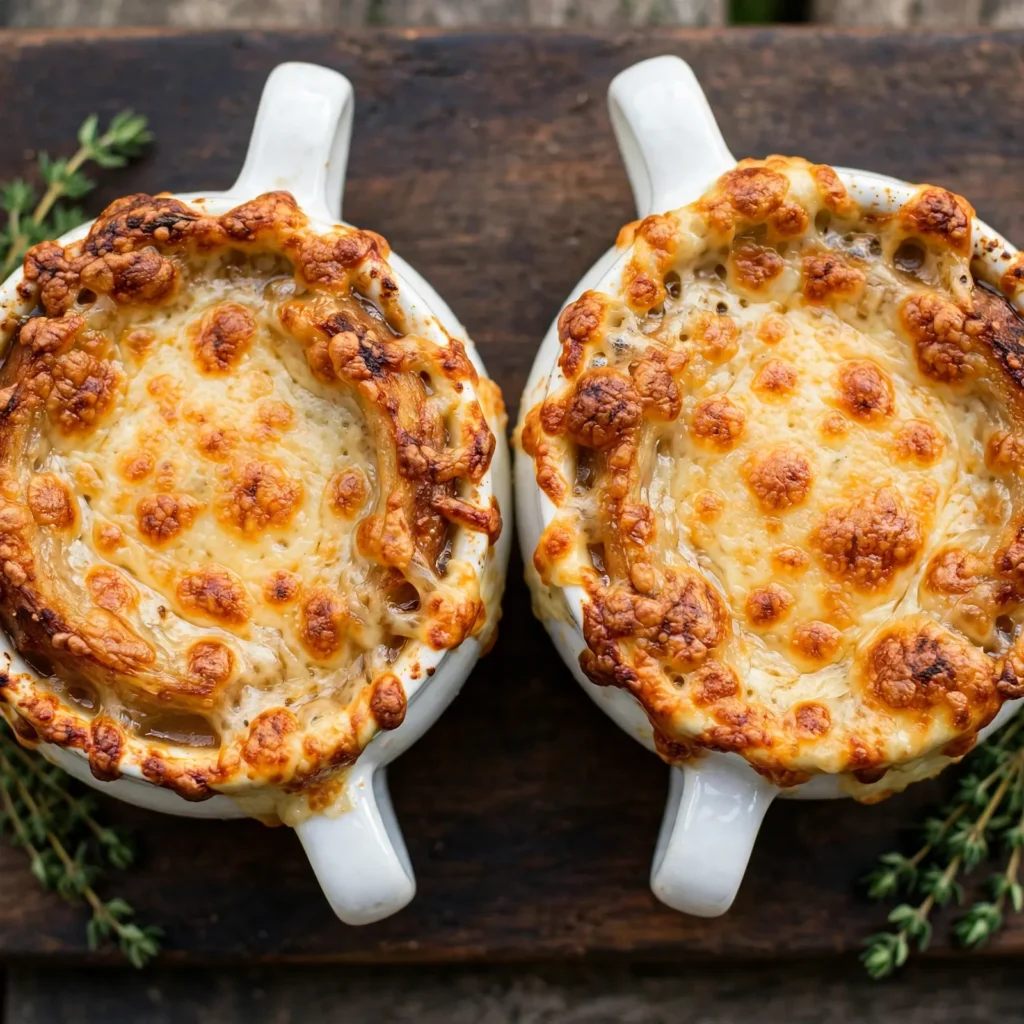
- Individual cast iron skillet version: Ladle the soup into oven-safe individual cast iron skillets instead of ceramic crocks. The cast iron retains heat more aggressively than ceramic and the cheese browns faster; reduce the broiling time to 2 to 3 minutes and check every 30 seconds from the 2-minute mark. The visual is more rustic and dramatic than the traditional crock presentation.
- Spiced version: Add 1/4 teaspoon of ground nutmeg and a very small pinch of ground cloves to the broth with the thyme. Both spices are traditional warming additions in many French regional variations and add a subtle aromatic depth that makes the soup taste slightly more complex without being identifiable as spiced.
- Gluten-free version: Use a certified gluten-free 1:1 flour blend for the roux step and certified gluten-free bread for the toasts. The grating and broiling technique stays identical. Gluten-free bread toasts slightly differently; watch it under the broiler and toast until it’s genuinely rigid and dry before placing on the soup.
Serving Suggestions
- Serve directly from the broiler to the table while the cheese is still actively bubbling. French onion soup’s defining moment is the first spoonful that breaks through the cheese crust and pulls a long stretch of Gruyère up from the bowl; this only happens while the cheese is hot and fluid. A soup that has rested for 10 minutes has a set, less dramatic crust.
- Place each crock on a small plate or folded cloth napkin before carrying to the table; the ceramic gets extremely hot during broiling and requires an insulating layer both for safety and to protect the table surface.
- A crisp green salad dressed simply with lemon and olive oil alongside balances the richness of the cheese and broth. The acidity from the lemon dressing makes each spoonful of the rich soup taste fresher and prevents the meal from feeling heavy.
- For a dinner party, serve as a starter before a simple main course of roasted chicken or a straightforward steak. The soup is rich and filling but not so substantial that it prevents appetite for what follows; a 250 to 300ml serving is the right starter portion.
- Provide a small teaspoon alongside the soup spoon for the first few minutes of eating; some people prefer to work the cheese crust loose from the edges with a teaspoon before using the soup spoon to eat through the layers. This is a matter of personal preference rather than technique.
- Pair with cold sparkling water with lemon as the most neutral choice alongside the intense flavors of the soup; the bubbles and mild acidity refresh the palate between bites of the rich cheese and sweet onion broth.
Tips for the Best Results
- Commit to the full caramelization time and don’t try to speed it up. Many recipes claim 20 minutes is sufficient for caramelized onions. It isn’t. At 20 minutes the onions are soft and golden; at 40 to 45 minutes they are genuinely caramelized, deeply amber, and concentrated into a completely different flavor profile. The difference in the finished soup is not subtle; it is the entire point of the recipe. If you don’t have 45 minutes for the onions, choose a different recipe.
- Use real Gruyère grated from a block. Pre-shredded cheese of any kind is coated in cellulose or potato starch to prevent clumping in the bag. Those coatings melt at different temperatures than the cheese itself and produce a slightly grainy, uneven crust rather than the smooth, stretchy, deeply browned Gruyère crust that defines the soup. Two minutes of grating makes a visible and tasteable difference.
- Toast the bread until completely rigid. The bread’s job in French onion soup is to act as a platform that keeps the cheese crust elevated above the broth during broiling. Soft bread that hasn’t been toasted properly collapses into the broth within 2 minutes of contact, leaving the cheese floating directly on the soup surface rather than suspended on a firm base.
- Season the broth before the crocks are filled. The soup cannot be seasoned after the cheese crust sets; getting the salt level right in the pot before assembly is the only opportunity. Taste the broth, season it assertively, and taste again. The cheese adds some saltiness during broiling, so err slightly toward under-salted in the pot rather than over.
- Don’t lift the broiler door to check until the 3-minute mark. Every time the broiler door opens, the temperature drops and the cheese crust formation is interrupted. Set a timer for 3 minutes, then watch continuously through the oven window or with the door slightly ajar from that point. The cheese goes from golden to over-browned in under 60 seconds under a preheated broiler.
Storage Tips
Refrigerator
The soup base, without the bread and cheese, keeps in the refrigerator for up to 5 days in a sealed container. The caramelized onions continue to develop flavor in the broth during storage, and the soup genuinely improves between day 1 and day 2. Refrigerate the caramelized onion and broth mixture separately from any assembled crocks; once assembled and broiled, the bread softens rapidly and the cheese sets into a rubbery layer that doesn’t reheat well. Always assemble and broil fresh from the stored soup base.
Freezer
The soup base freezes very well for up to 3 months. Cool completely, freeze in individual portion-sized containers so you can thaw only what’s needed, and label clearly. The caramelized onions hold their flavor and texture through freezing better than most soup ingredients because their high sugar content acts as a mild cryoprotectant. Thaw overnight in the refrigerator before reheating. The bread and cheese assembly should always be made fresh on the day of serving; frozen assembled crocks do not reheat well.
Reheating
The stored soup base reheats best on the stovetop. Pour into a saucepan over medium heat, stirring every 2 minutes, and bring to a steady simmer for 5 to 7 minutes from refrigerator temperature. Add a small splash of broth if the soup has thickened during storage. Once hot, ladle into crocks, add the fresh bread and cheese, and broil as directed. Microwave reheating works for the broth component at 70% power in 90-second intervals but is not suitable once the bread and cheese have been assembled.
Make-ahead note: French onion soup is ideal for advance preparation because the most time-consuming step, caramelizing the onions, can be completed entirely in advance. Make the full soup base through step 5 up to 5 days ahead and refrigerate. On the evening of serving, reheat the base, toast the bread, and assemble the crocks; the total active time on the day is under 20 minutes.
Nutrition Information
Per serving, approximately one crock (1/4 of the recipe), with one slice of baguette toast and 60g of Gruyère:
| Nutrient | Amount |
|---|---|
| Calories | 480 kcal |
| Protein | 22g |
| Total Carbohydrates | 42g |
| Dietary Fiber | 4g |
| Total Sugar | 14g |
| Total Fat | 24g |
| Saturated Fat | 13g |
| Cholesterol | 62mg |
| Sodium | 720mg |
| Vitamin C | 16mg |
| Calcium | 580mg |
| Iron | 2.4mg |
| Potassium | 520mg |
Nutrition values are approximate and may vary based on broth brand, bread choice, cheese quantity, and portion sizes.
Why This Recipe Works
The flavor transformation that occurs during onion caramelization is one of the most dramatic in cooking, and understanding it explains why time cannot be substituted with temperature in this recipe. Yellow onions contain approximately 6 to 8% total sugars, primarily fructose and glucose, along with hundreds of sulfur-containing flavor compounds responsible for their raw pungency. As the onions are heated in butter over medium-low heat, two concurrent processes occur. Moisture evaporates first from the surface and then gradually from the cellular interior, concentrating the remaining sugars and flavor compounds into a smaller and smaller mass. When the temperature at the onion surface exceeds approximately 160°C (320°F) as the moisture content drops sufficiently, the sugars begin to undergo caramelization: thermal decomposition into hundreds of new flavor compounds including furans, pyrones, and diacetyl, producing the characteristic toffee-like sweetness and amber color. Simultaneously, the sulfur compounds in the onion undergo heat-driven volatilization and chemical transformation, reducing from the sharp, pungent raw compounds into softer, sweeter, mellow aromatics. At medium-low heat, this entire progression takes 40 to 50 minutes; at higher heat, the surface caramelizes before the interior has softened, producing unevenly cooked onions with burnt edges and still-pungent centers.
The flour-based roux cooked briefly into the caramelized onions before the broth is added thickens the finished soup through starch gelatinization. When the broth is added and the soup heats, the starch granules in the flour swell and gelatinize, trapping water molecules and producing a slightly viscous, coating liquid rather than a thin broth. The difference in the finished soup is immediately noticeable: the roux-thickened version coats the spoon and produces a more substantial, body-forward texture while a flour-free version tastes thinner and feels watery on the palate even with the same quantity of caramelized onions.
Gruyère produces an ideal broiled cheese crust for two specific reasons related to its composition. First, Gruyère has a relatively high fat content (approximately 32% in the finished cheese) with a fat structure that remains fluid and stretchy rather than separating into oil and protein solids when heated. This is why Gruyère melts into a smooth, stretchy sheet rather than breaking into an oily mess under the broiler. Second, Gruyère contains sufficient milk sugars and amino acids to undergo Maillard browning rapidly under the broiler’s high radiant heat, producing the deep golden-amber color and the complex, slightly nutty flavor of the browned crust. Cheeses with lower fat content or different protein structures don’t produce the same combination of even melting and deep browning in the 3 to 5 minutes that a broiler provides.
The apple cider vinegar added to the caramelized onions before the broth serves a specific flavor function beyond simple deglazing. Caramelized onions, at the end of their 40 to 50-minute cook, have a very deep, intensely sweet flavor with a pH that has risen slightly from the original raw onion because the sulfur compounds, which are mildly acidic, have volatilized during cooking. The apple cider vinegar restores acidity to the concentrated onion mass, which amplifies the perception of all the other flavor compounds present by providing a contrast point. A small amount of acidity makes sweet flavors taste more vivid and complex rather than flat; this is the same principle behind adding lemon to a sweet dessert to make it taste more fully flavored. In practice, the finished soup tastes noticeably brighter and more complete with the vinegar step than without it.
I’ve made this soup both with and without the covered initial stage for the onions, and the time difference is measurable. Covering the pot for the first 10 to 12 minutes creates a steam environment that heats the onions from all surfaces simultaneously and draws the maximum moisture out of the cellular structure rapidly. Without the cover, the same moisture release takes an additional 15 to 20 minutes as the exposed top layer of onions dries while the compressed layers beneath take longer to release their liquid. The covered approach produces fully softened, moisture-released onions in under 12 minutes that are ready to begin caramelizing; the uncovered approach at the same heat setting requires 25 to 30 minutes to reach the same starting point for caramelization.
Frequently Asked Questions
Can I make French onion soup ahead of time?
Yes, and it’s one of the most practical recipes for advance preparation. Make the full soup base through the simmering step, cool, and refrigerate for up to 5 days. The flavor improves on days 2 and 3 as the onion continues to permeate the broth. On the day of serving, reheat the base on the stovetop, toast fresh bread, and assemble the crocks before broiling. The total active work on the day is under 20 minutes. Never assemble and store the finished crocks with bread and cheese; always assemble and broil fresh.
Why are my onions not turning dark brown?
Most onions-aren’t-caramelizing problems come down to heat being too low or too high, or the cook time being genuinely insufficient. Too low and the moisture never fully evaporates enough for the browning reactions to begin. Too high and the surface burns while the interior remains partially raw. The correct heat is medium to medium-low: the onions should be actively sizzling and steaming rather than sitting silently, but not popping or browning within the first 15 minutes. If you are at the 30-minute mark and the onions are only pale gold, raise the heat very slightly. The full amber-brown color requires at least 40 minutes of total cooking.
Can I substitute Swiss cheese for Gruyère?
You can, but the result is noticeably different. Standard Swiss cheese (Emmental) has a milder, sweeter flavor than Gruyère and melts to a similar fluid consistency, but it lacks Gruyère’s nutty depth and doesn’t brown quite as deeply under the broiler, producing a paler crust. If Gruyère is unavailable, Comté is the closest substitute with a very similar flavor profile and browning behavior. Aged Emmental produces a better result than standard Swiss; look for a block that’s been aged for at least 3 months.
How do I know when the caramelized onions are ready?
Properly caramelized onions should be a deep, rich amber-brown, reduced to roughly 25 to 30% of their original raw volume, and so soft they fall apart when pressed with the back of a spoon rather than retaining any firmness. The most reliable test is taste: a properly caramelized onion tastes intensely sweet, almost honey-like, with a savory, deep background and none of the sharpness or pungency of raw onion. If any sharpness or raw onion taste remains, the onions need more time. The smell in the kitchen should be deeply sweet and slightly nutty rather than sharp or acrid.
Is French onion soup gluten-free?
The standard recipe contains gluten from two sources: the all-purpose flour added to thicken the broth, and the baguette or sourdough used for the toast. To make a fully gluten-free version, replace the flour with a certified gluten-free 1:1 flour blend or 1 tablespoon of cornstarch dissolved in cold broth, and use certified gluten-free bread for the crouton. The broth and all other ingredients are naturally gluten-free. Verify the Gruyère brand if strict gluten-free certification is required, though natural aged cheese is inherently gluten-free.
Why does my cheese crust not bubble properly?
Two things prevent proper bubbling. First, the crocks may be placed too far from the broiler element; at 15 to 20cm below the element the cheese melts slowly and evenly without bubbling. At 8 to 10cm, the radiant heat is intense enough to melt and begin bubbling the cheese within 2 minutes. Second, the cheese may not be extending to the rim of the crock. When cheese is applied only over the bread and doesn’t touch the rim, the edges of the cheese can dry out before the center has fully melted, producing a flat, matte crust rather than the characteristic puffed, bubbling result. Ensure the cheese reaches and lightly overlaps the crock rim on all sides.
Can I make this in a large baking dish instead of individual crocks?
Yes, for a family-style presentation. Ladle the soup into a large oven-safe baking dish, arrange the toasted bread slices across the surface, and cover completely with the grated Gruyère. Broil at the same distance from the element for 4 to 6 minutes until the cheese is fully golden. This method works well for a casual dinner but loses the individual crock presentation that makes the soup feel special. Each person uses a ladle to serve themselves and breaks through the shared cheese crust, which produces a different but equally satisfying experience.
Conclusion
French onion soup is worth making properly, and making it properly means one thing above everything else: giving the onions the full 40 to 50 minutes they need. That time investment is the recipe. Everything after it, the flour, the broth, the bread, the Gruyère under the broiler, is straightforward and forgiving. The caramelization is not.
Once you understand what properly caramelized onions look, smell, and taste like, this soup becomes one of the most reliable impressive things you can make. The technique transfers directly to other dishes, the make-ahead base keeps for nearly a week, and the assembly and broiling on the day takes less time than setting the table.
If you loved this recipe, save it to your soup recipes and French bistro dinners Pinterest board so you can find it easily later. For more healthy recipes and daily food inspiration, follow TheCookingVibes on Pinterest.

Classic French Onion Soup
Ingredients
Equipment
Method
- Melt butter and olive oil in a large Dutch oven over medium heat. Add all sliced onions and fine salt. Toss to coat in the fat. Cover and cook 10 to 12 minutes until onions have wilted and released significant moisture, stirring every 3 to 4 minutes.
- Remove lid. Reduce heat to medium-low. Cook uncovered 35 to 45 minutes, stirring every 5 to 6 minutes and scraping the bottom to incorporate the forming fond. Cook until the onions are deeply amber-brown, concentrated, and smell intensely sweet. Add 2 to 3 tablespoons water if the onions stick before achieving deep color.
- Sprinkle flour evenly over the caramelized onions. Stir constantly for 2 minutes until the flour disappears into the fat. Add tomato paste and stir for 60 seconds until brick-red. Add apple cider vinegar and stir for 30 seconds, scraping the base.
- Pour in beef broth in a steady stream while stirring. Add thyme and bay leaves. Bring to a gentle boil, then reduce to medium-low. Simmer uncovered 18 to 20 minutes. Remove bay leaves. Season with salt and black pepper.
- Brush bread slices on both sides with olive oil or butter. Toast under the broiler 2 to 3 minutes per side until rigid and golden on both surfaces.
- Preheat broiler to high. Ladle hot soup into four oven-safe crocks, leaving 1.5cm below the rim. Place one or two toasted bread slices on each. Distribute grated Gruyère (about 60g per crock) generously across the bread and over the crock rims.
- Place crocks on a baking sheet. Broil on the upper rack 8 to 10cm from the element for 3 to 5 minutes until the cheese is bubbling, deeply golden-brown, and slightly charred at peaks. Watch from the 3-minute mark. Rest 5 minutes before serving.