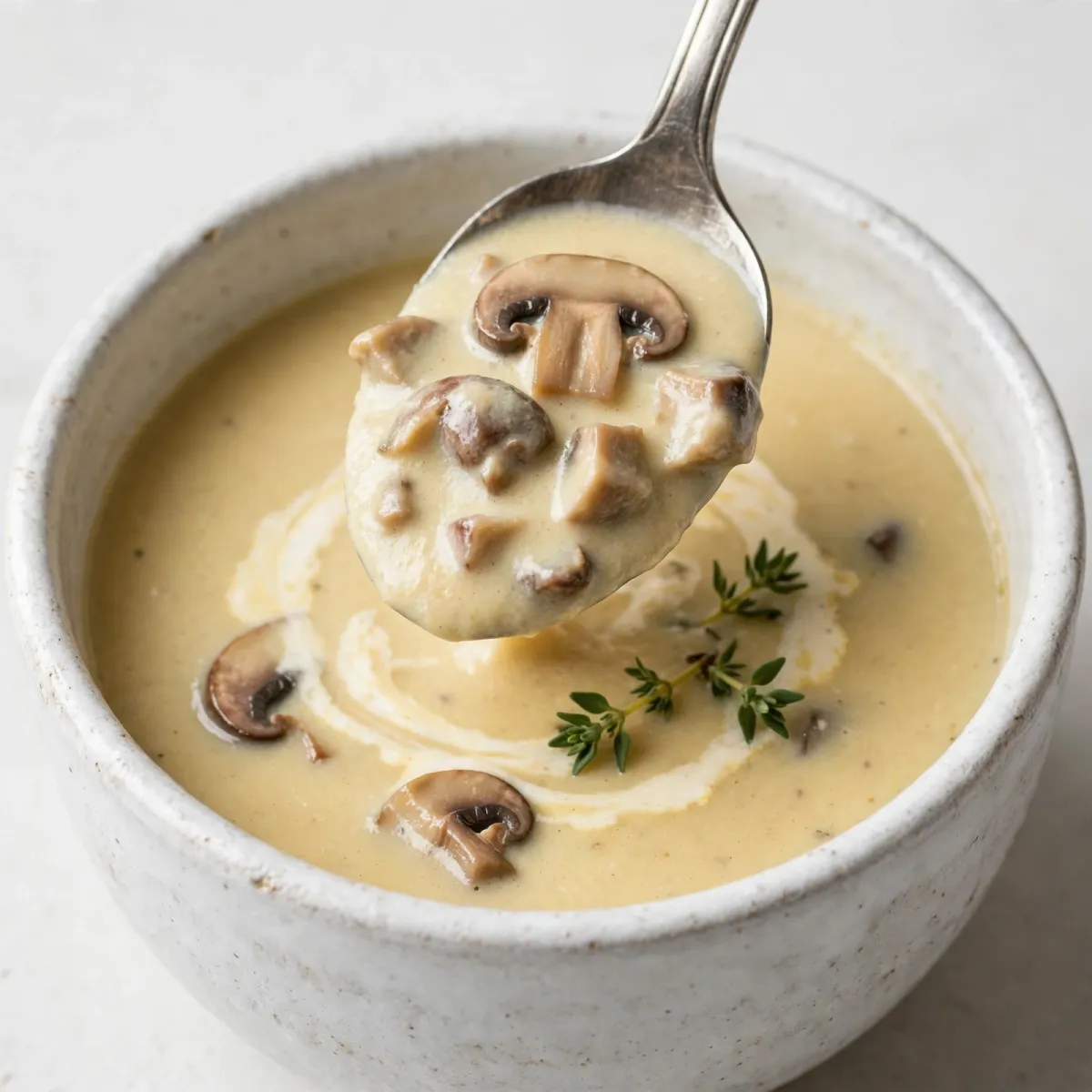
Creamy Mushroom Soup — Rich Earthy Broth, Velvety Texture
The kind of mushroom soup worth making starts with mushrooms that have been left alone in a hot pan long enough to actually brown rather than steam. That distinction matters enormously: a pale, moisture-releasing mushroom in a cream soup produces something that tastes like mushroom-flavored water thickened with cream, while a golden-brown, caramelized mushroom produces a soup with a deep, nutty, almost meaty depth that fills the kitchen with a smell that makes people wander in from other rooms asking what’s cooking.
This creamy mushroom soup recipe uses a mix of cremini and shiitake mushrooms for layered flavor, cooked in two stages to develop deep caramelization before the broth and cream are added. Caramelized onions, fresh thyme, and garlic build the aromatic base, and a portion of the soup is blended while the rest remains chunky, producing the ideal texture: velvety and thick with visible mushroom pieces in every spoonful. It serves 4 to 6, takes 45 minutes, and works as a dinner starter or a full meal with bread alongside.
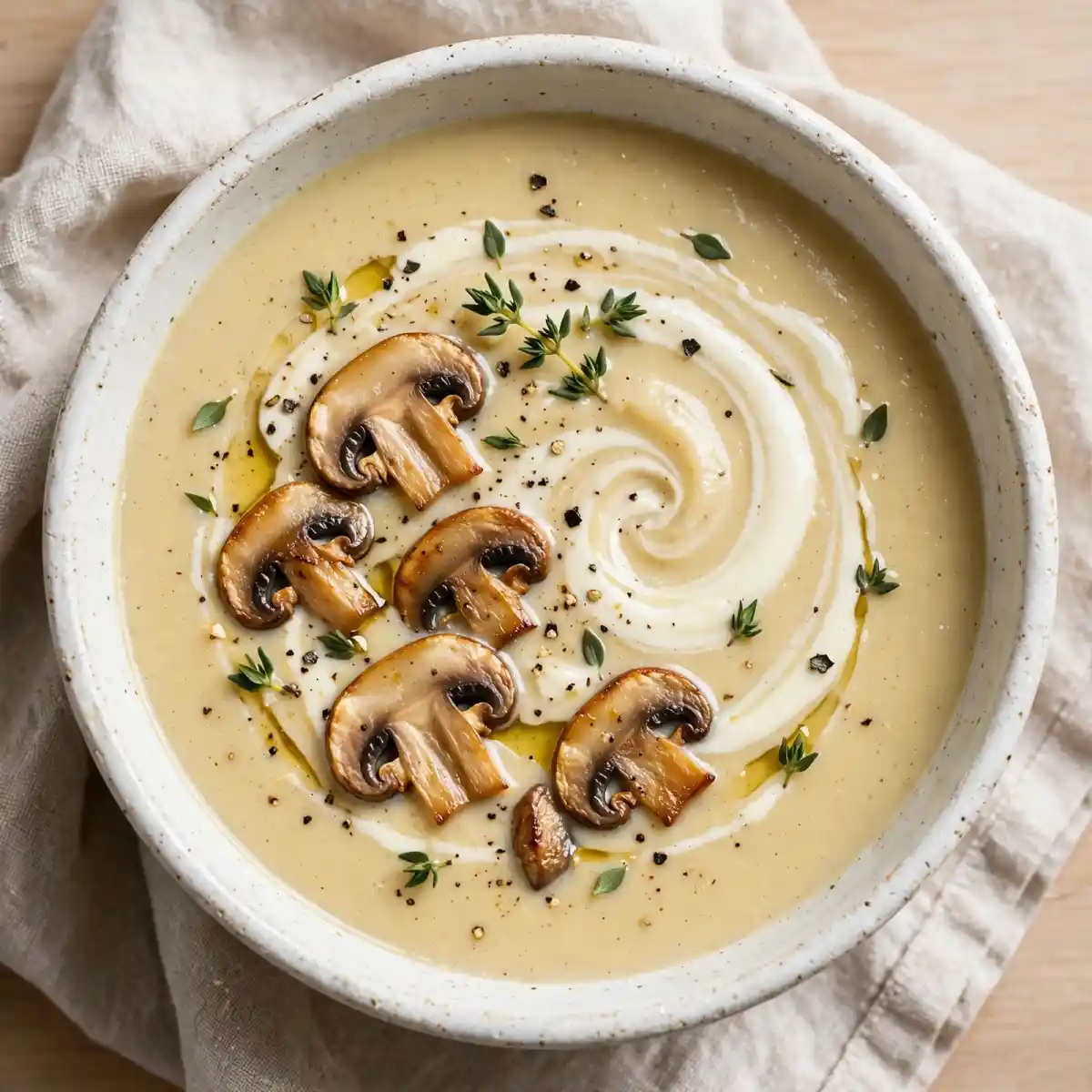
Why You’ll Love This Creamy Mushroom Soup
- Deep, complex mushroom flavor from proper caramelization. Cooking the mushrooms in two stages, first at high heat in batches until genuinely golden-brown, then simmering in broth, produces a Maillard-browned depth that pale steamed mushrooms cannot approximate.
- Texture that’s velvety without being uniformly smooth. Blending only 60 to 70% of the soup leaves visible mushroom pieces in every bowl; the blended portion provides the silky, thick base while the remaining pieces give each spoonful something to bite into.
- Rich without being heavy. The cream goes in at the end in a measured amount; combined with the starch from the blended mushrooms and onions, it produces a soup that coats the spoon without feeling dense or overly rich.
- One pot, genuine weeknight practicality. Everything happens in a single heavy-bottomed pot; the mushroom caramelization, the aromatic base, the broth simmer, and the cream finish all use the same vessel.
- Flexible with mushroom varieties. The cremini and shiitake combination produces the best depth, but any mixture of mushrooms produces a noticeably better result than a single variety alone because each type contributes different aromatic compounds.
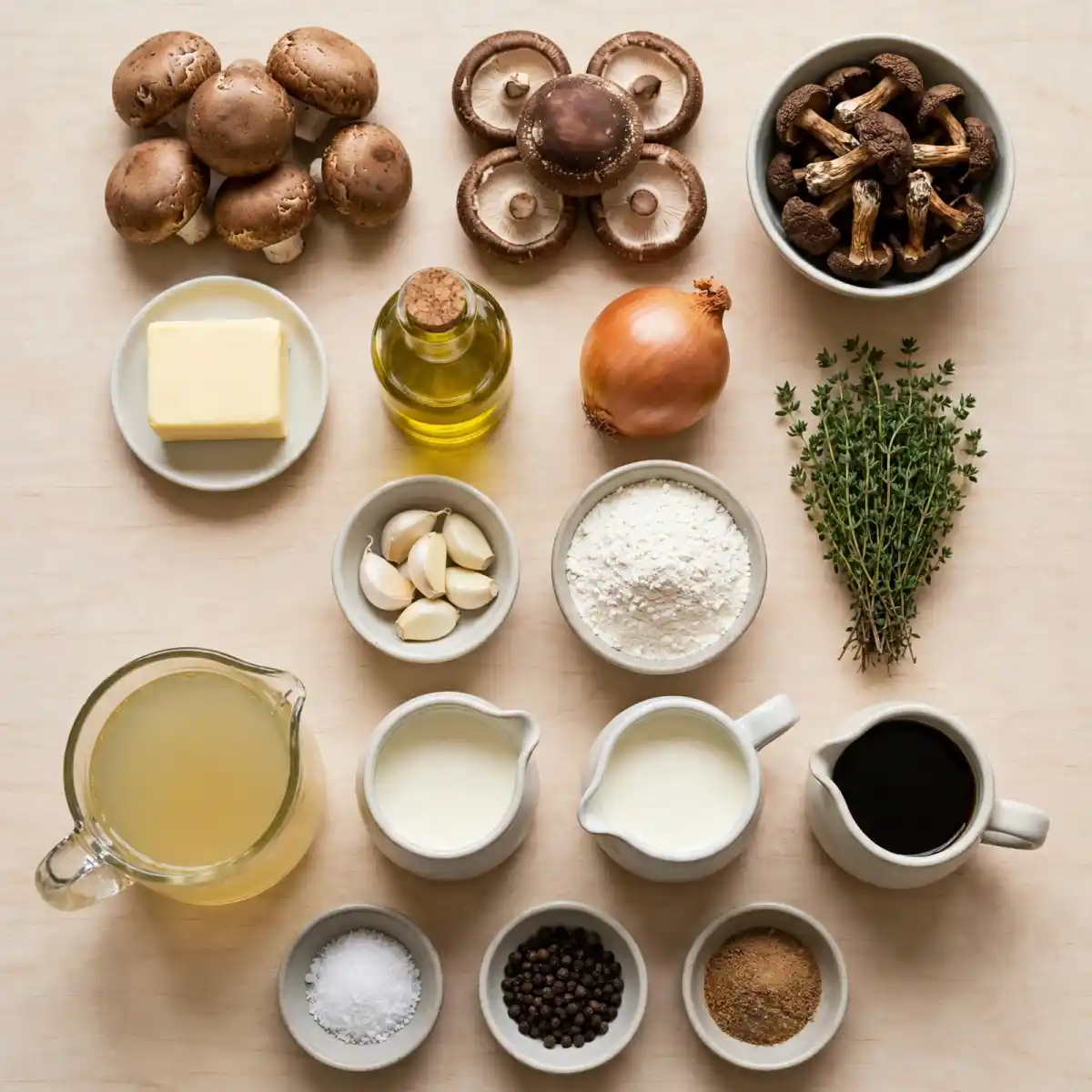
Ingredients You’ll Need
Recipe Timing
| Servings | 4 to 6 |
| Difficulty | Easy |
| Course | Starter, Main Course |
| Cuisine | European-American |
| Prep Time | 15 minutes |
| Cook Time | 30 minutes |
| Rest Time | 0 minutes |
| Total Time | 45 minutes |
For the mushrooms, the combination of cremini and shiitake is chosen for specific reasons. Cremini mushrooms (also labeled as baby bella or brown mushrooms) have a mild, earthy flavor and a firm texture that holds its shape after caramelization; they provide the soup’s body. Shiitake mushrooms contain glutamate-rich compounds including lentinan and eritadenine that produce a distinctly meaty, savory depth absent from cremini alone. Using 70% cremini and 30% shiitake balances their contributions without the shiitake overpowering the soup’s overall flavor. If shiitake isn’t available, all cremini with 1 teaspoon of soy sauce added to the broth replicates most of the umami depth.
For the onions, yellow onions are preferred over white for this recipe because their slightly higher sugar content produces better caramelization in the preliminary sauté stage, developing a sweet-savory depth that becomes the aromatic backbone of the blended portion of the soup. White onions work but produce a slightly sharper, less rounded flavor.
For the cream, heavy whipping cream at 35% fat produces the most stable, richest result. It can be added to the hot soup without curdling because the starch from the blended mushroom portion stabilizes the cream-broth emulsion. Full-fat coconut cream is a direct substitute for a dairy-free version and integrates smoothly.
For dried mushrooms (optional but recommended), 15g of dried porcini mushrooms reconstituted in 240ml of hot water and strained adds an intensely earthy, concentrated mushroom note that deepens the entire soup’s flavor. Use the strained soaking liquid in place of an equal amount of the vegetable broth.
- 500g (about 5 1/2 cups) cremini mushrooms, wiped clean and sliced 5mm thick — the primary body and flavor base; never rinse mushrooms under water before sautéing; use a damp cloth or dry brush
- 170g (about 2 cups) shiitake mushrooms, stems removed and caps sliced 5mm thick — the umami depth layer; stems are woody and unpleasant in texture, remove them before slicing
- 15g dried porcini mushrooms, soaked in 240ml hot water for 20 minutes (optional) — concentrated earthy depth; strain the soaking liquid before adding to the soup
- 60g (4 tablespoons) unsalted butter, divided — provides the fat for mushroom caramelization and the aromatic sauté; divided because the mushrooms are cooked in batches
- 1 tablespoon olive oil — combined with butter to raise the smoke point during the high-heat mushroom sear
- 1 large yellow onion, finely diced — the aromatic base that gets blended into the soup’s thick base
- 4 garlic cloves, finely minced — added after the onion softens; mellows from sharp to sweet during the simmer
- 1 tablespoon fresh thyme leaves, stripped from the stems — the primary herb; added with the garlic; thyme’s slightly floral, earthy character is the defining herbal note of classic mushroom soup
- 1 teaspoon fresh rosemary, finely chopped — optional; adds a slightly piney, resinous note that pairs well with the mushrooms’ earthiness; use sparingly
- 2 tablespoons all-purpose flour — stirred into the onion and mushroom base before broth is added; creates a light roux that gives the soup its body beyond what the blended mushrooms alone provide
- 960ml (4 cups) low-sodium vegetable broth — the primary cooking liquid; low-sodium allows seasoning control; subtract 240ml and replace with the strained porcini soaking liquid if using dried mushrooms
- 180ml (3/4 cup) heavy whipping cream — added in the final minutes; provides richness and smooths the blended base into a velvety texture
- 1 teaspoon soy sauce — a background umami amplifier; adds savory depth without being identifiable; use a gluten-free variety if needed
- 1/2 teaspoon fine salt — adjust at the end based on the broth’s sodium level
- 1/4 teaspoon freshly ground black pepper
- Small pinch of freshly grated nutmeg — a traditional soup note; adds sweet-woody warmth
For serving:
- A swirl of heavy cream — optional visual finish
- Fresh thyme sprigs or flat-leaf parsley — for garnish
- Freshly cracked black pepper
Allergen and Dietary Disclosure
This creamy mushroom soup contains dairy (butter and heavy cream) and gluten (all-purpose flour used as a thickener; soy sauce if the standard variety is used). It is naturally egg-free and nut-free as written.
For gluten-free: replace the all-purpose flour with a certified gluten-free 1:1 baking flour or with 1.5 tablespoons of cornstarch mixed with 3 tablespoons of cold broth before adding to the pot. Use a certified gluten-free soy sauce or tamari at the same quantity.
For dairy-free: replace the butter with a vegan butter block or a good-quality neutral oil for the sauté, and the heavy cream with full-fat coconut cream or a good-quality oat-based cooking cream. Full-fat coconut cream integrates very smoothly into the blended soup base and produces a comparably rich texture; there is a very subtle coconut note in the finished soup, though the earthy mushroom flavor typically dominates it.
For vegan: apply both substitutions above. The soup is naturally vegan once butter and dairy cream are removed; ensure the vegetable broth is certified vegan.
This recipe has not been tested in a certified allergen-free kitchen and cannot be guaranteed safe for any specific allergy.
Equipment Needed
- Large 4 to 5-quart heavy-bottomed pot or Dutch oven — heavy walls distribute heat evenly and prevent the mushrooms from burning during the high-heat sauté stage; a thin-bottomed pot creates hot spots that scorch the mushrooms before they can caramelize. The same pot handles all stages from the mushroom sear through the broth simmer.
- Immersion (stick) blender — for blending a portion of the soup directly in the pot without the mess and risk of transferring hot liquid to a countertop blender. If only a countertop blender is available, allow the soup to cool for 10 minutes before blending and fill the blender only halfway; always hold the lid down firmly with a folded cloth when blending hot liquid to prevent pressure build-up from blowing the lid off.
- Slotted spoon or spider strainer — for removing the first batch of caramelized mushrooms from the pot before the second batch goes in; the slotted spoon drains the cooking fat back into the pot rather than removing it with the mushrooms.
Step-by-Step Directions
Step 1: Soak the Dried Porcini (If Using)
Place the dried porcini mushrooms in a small heatproof bowl and pour 240ml of just-boiled water over them. Leave to soak for at least 20 minutes until fully rehydrated and very soft. Lift the mushrooms out with a fork, squeeze gently, and roughly chop them. Strain the soaking liquid through a fine mesh sieve or paper towel-lined strainer into a measuring cup; it should look dark brown and smell intensely earthy. Set both the chopped mushrooms and the strained liquid aside.

Chef’s Note: The porcini soaking liquid is one of the most concentrated, flavorful cooking liquids available without any active work; it contains soluble glutamates, nucleotides, and aromatic compounds that leach out of the mushroom during rehydration and produce an almost stock-like intensity. Using it in place of an equal amount of vegetable broth contributes an earthy, woodsy depth to the finished soup that fresh mushrooms alone can’t replicate regardless of quantity. The straining step is essential; porcini soaking liquid contains fine grit that settles to the bottom of the bowl.
Step 2: Caramelize the Mushrooms in Batches
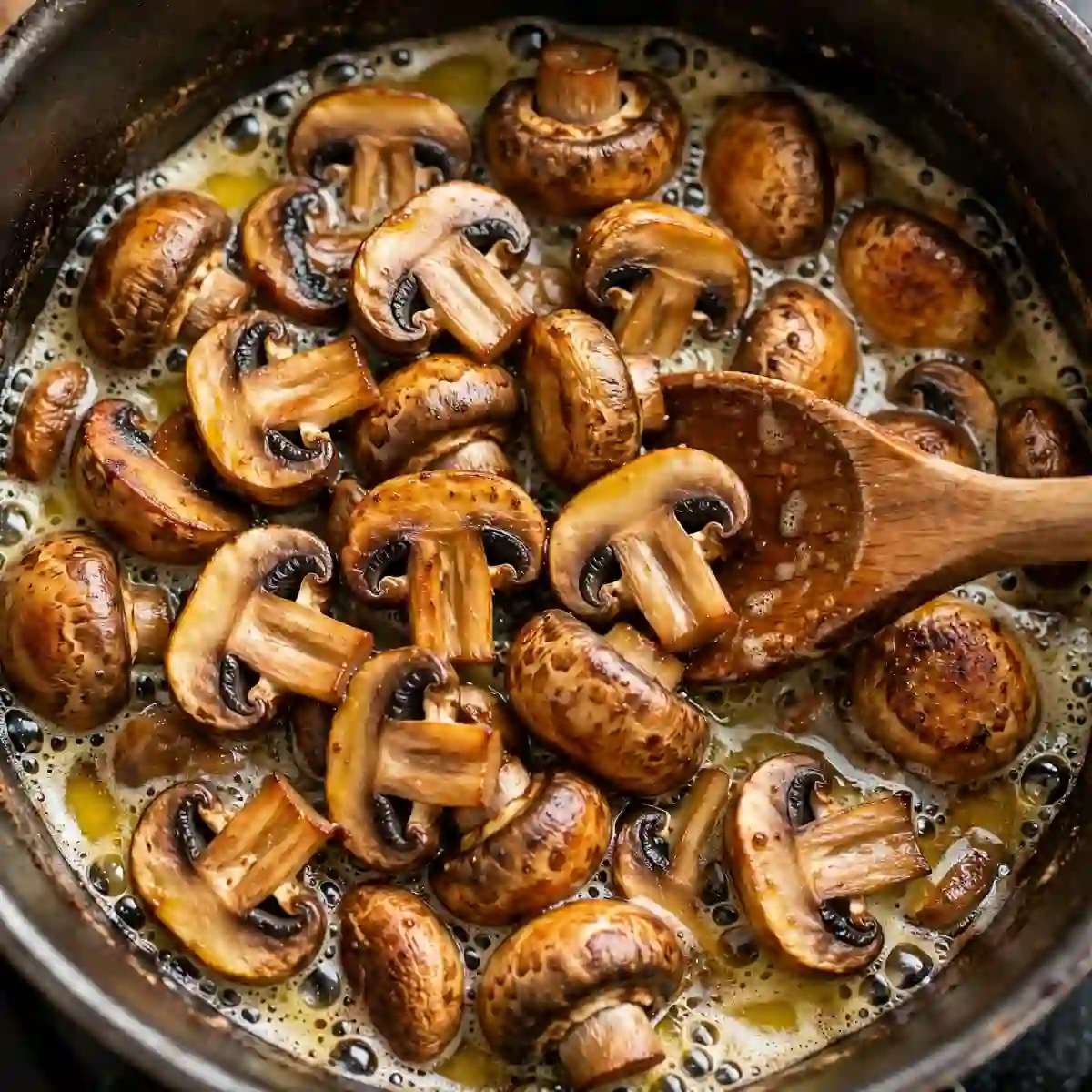
Heat 1.5 tablespoons of the butter and the tablespoon of olive oil in the heavy-bottomed pot over medium-high heat until the butter foams and the foam subsides. Add half of the sliced cremini and all of the shiitake mushrooms in a single layer without crowding. Resist the urge to stir for the first 2 minutes; the mushrooms need sustained contact with the hot pan base to develop browning rather than steam. After 2 minutes, stir once and cook for another 2 to 3 minutes until most surfaces are golden-brown and the mushrooms smell nutty and caramelized rather than raw and wet. The mushrooms should look reduced to about half their original volume and smell noticeably different from raw mushrooms.
Remove with a slotted spoon to a bowl, leaving the fat in the pot.
Add another 1.5 tablespoons of butter and the remaining cremini mushrooms. Repeat the same process, cooking undisturbed for 2 minutes then stirring and cooking until golden-brown. Add the rehydrated chopped porcini (if using) in the last 60 seconds of this second batch and toss briefly to warm through. Remove everything to the same bowl as the first batch.
Chef’s Note: Cooking the mushrooms in two batches rather than all at once is not an optional step; it’s the entire technique. When too many mushrooms are added to the same pan at once, they release their moisture simultaneously and the temperature at the pan base drops below the threshold needed for Maillard browning. The mushrooms steam in their own liquid rather than searing, producing pale, rubbery pieces with a flat, one-dimensional flavor. Two batches keep the temperature high enough for each piece to develop proper browning.
Step 3: Soften the Aromatics
Reduce the heat to medium. Add the remaining 1 tablespoon of butter to the pot. Add the finely diced onion and stir to coat it in the remaining mushroom-infused fat. Cook for 6 to 7 minutes, stirring every 90 seconds, until the onion has completely softened and turned a pale golden color at the edges; it should look translucent throughout with no white, opaque centers remaining.
Add the minced garlic and fresh thyme leaves. Cook for 60 seconds, stirring continuously, until the raw garlic smell softens and the thyme becomes very fragrant; the combination should smell almost floral and savory at the same time.
Step 4: Add Flour and Build the Broth Base
Sprinkle the all-purpose flour evenly over the softened onion and garlic. Stir continuously for 90 seconds until the flour coats the onions in a slightly dry, paste-like layer and the raw flour smell has cooked out. The mixture will look slightly dry at the edges; this is correct.
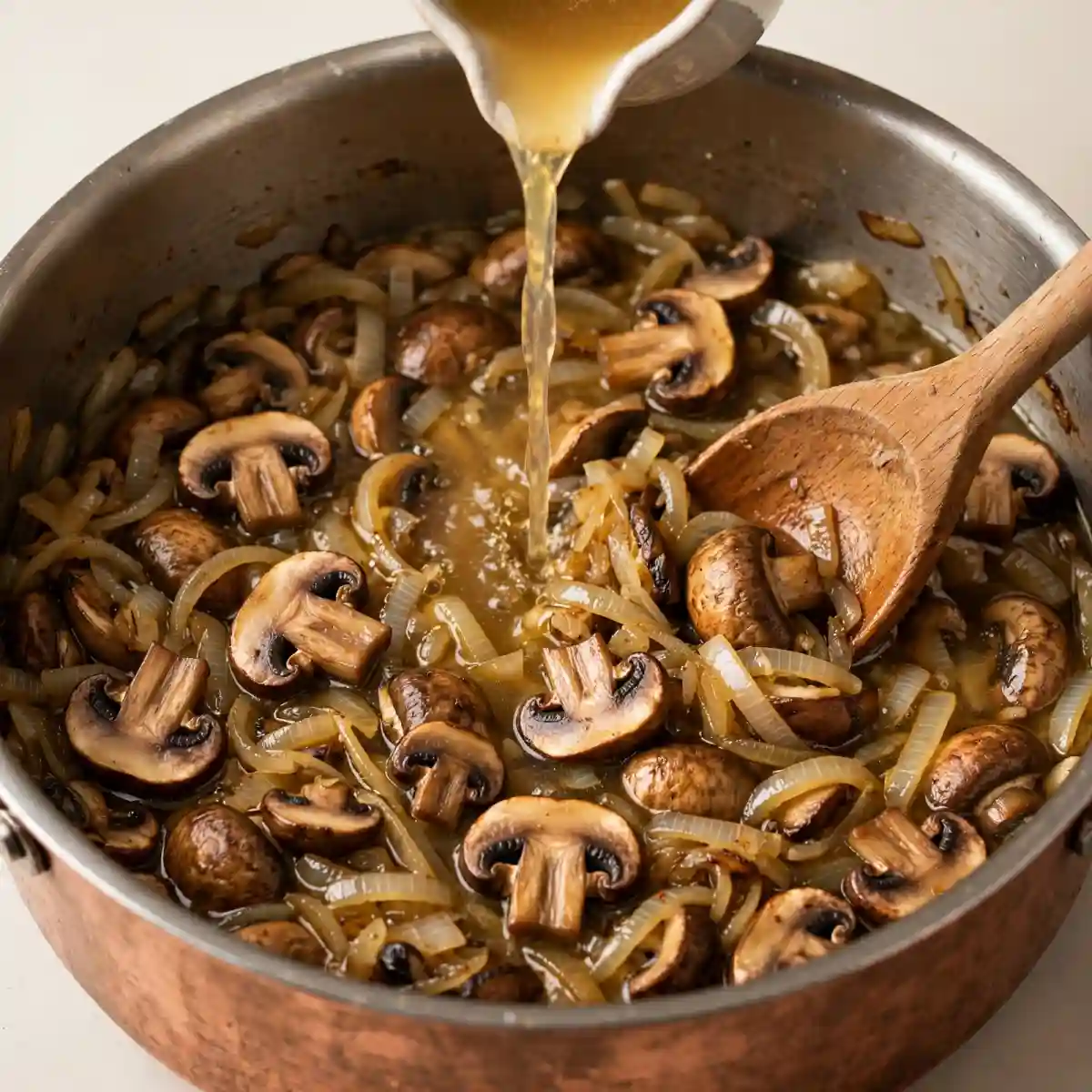
Pour in the vegetable broth in a slow, steady stream while stirring constantly to prevent lumps from forming as the flour hydrates. If using dried porcini, add the strained soaking liquid now as part of the total liquid volume. Stir vigorously to scrape any browned bits from the pot base into the liquid; those browned bits carry concentrated caramelized flavor.
Add back all the caramelized mushrooms, including any resting juices from the bowl. Add the soy sauce, salt, pepper, and grated nutmeg. Bring to a steady simmer over medium heat, stirring occasionally.
Chef’s Note: Cooking the flour in the butter and onions for the full 90 seconds is what prevents the finished soup from tasting raw and starchy. Raw flour has a distinctive flat, slightly chalky flavor from its ungelatinized starch; cooking it in fat for 90 seconds at medium heat begins the starch gelatinization and produces a neutral, clean thickening agent rather than one that imparts a floury character to the finished soup.
Step 5: Simmer and Partial Blend
Simmer the soup over medium-low heat for 10 to 12 minutes, stirring every few minutes, until the mushrooms are very tender throughout when pressed with the back of a spoon and the broth has reduced and thickened slightly.
Remove the pot from the heat. Using the immersion blender, blend 60 to 70% of the soup’s volume by inserting the blender into one area of the pot and running it in that section for 20 to 30 seconds, then moving to an adjacent section and repeating. Leave the remaining 30 to 40% of the soup unblended; this preserves visible mushroom pieces in the finished soup. Alternatively, scoop out 60 to 70% of the soup into a blender, blend until smooth, and return it to the pot.
The partially blended soup should look thicker and more cohesive throughout, with visible mushroom pieces still present and the broth a creamy, uniform pale brown color.
Step 6: Stir in the Cream and Finish
Return the pot to low heat. Pour the heavy cream into the blended soup in a steady stream while stirring. Heat gently for 2 to 3 minutes, stirring occasionally, until the cream is fully integrated and the soup is steaming throughout but not boiling; bringing cream soup to a full boil can cause the cream to separate.
Taste and adjust the seasoning with additional salt, pepper, and a small extra splash of soy sauce if the soup needs more savory depth. The finished soup should taste deeply earthy, slightly rich, and well-rounded rather than sharp or one-dimensionally savory.
Serve immediately in warm, wide bowls.
Common Mistakes and Troubleshooting
| Problem | Cause | Solution |
|---|---|---|
| Mushrooms steaming rather than browning | Too many mushrooms in the pan at once, or heat too low | Cook in two batches at medium-high heat; don’t stir for the first 2 minutes of each batch |
| Soup thin and watery | Not enough flour, or broth not simmered long enough to reduce | Use the full 2 tablespoons of flour; simmer for the full 10 to 12 minutes before blending |
| Soup tastes flat despite full ingredient list | Mushrooms not properly caramelized, or soy sauce omitted | The caramelization step is non-negotiable for depth; soy sauce amplifies the soup’s savory quality significantly |
| Cream separated and soup looks curdled | Cream added to soup that was at a full boil | Add cream with the heat at low, never at a simmer; stir continuously after adding |
| Grainy or lumpy texture after blending | Flour not fully cooked into the roux, or blending too briefly | Cook flour for the full 90 seconds; blend the designated portion for a full 30 seconds until completely smooth |
| Soup too thick | Too much blending, or broth reduced too aggressively | Add extra vegetable broth 60ml at a time while stirring over low heat until the desired consistency is reached |
Variations and Substitutions
- Wild mushroom soup: Replace the shiitake entirely with a mixed wild mushroom blend, using whatever combination of oyster, maitake, chanterelle, or horn of plenty mushrooms is available. Wild mushrooms have more varied aromatic compounds than cultivated varieties and produce a more complex, forest-floor earthiness in the finished soup. The method is identical; wild mushrooms often brown slightly faster than cremini so watch the first batch carefully.
- Roasted garlic mushroom soup: Replace the 4 raw garlic cloves with a full head of roasted garlic, squeezed from its papery skins directly into the softened onion base. Roasted garlic’s sweet, deeply caramelized flavor produces a noticeably milder, more complex garlic note than raw minced garlic and makes the soup taste as though it cooked for far longer than it did.
- Truffle mushroom soup: Add 1 to 1.5 teaspoons of truffle oil stirred in after the cream at the very end of cooking; truffle oil’s aromatic compounds degrade quickly at heat, so it must be added off heat or at the lowest possible temperature. Use sparingly; truffle oil is very assertive and 1 teaspoon per batch is enough to perfume the entire pot.
- Vegan mushroom soup: Replace butter with 60g of a good-quality vegan butter block or neutral oil, and the heavy cream with one 400ml can of full-fat coconut cream. Use certified vegan vegetable broth and ensure the soy sauce is vegan-certified. The finished texture is very close to the dairy version; the flavor is slightly different due to the coconut fat’s unique aromatic profile but the mushroom depth carries the soup.
- Chunky mushroom soup (no blend): Skip the partial blending step entirely. Use the flour and simmering steps to thicken the broth, and add an extra half tablespoon of flour to compensate for the missing starch contribution from the blended mushrooms. The result is a chunkier, more rustic bowl with whole mushroom pieces in a thickened but non-velvety broth; some people strongly prefer this texture, especially when serving the soup as a main course with thick bread.
- Barley mushroom soup: Add 150g of pearl barley to the pot alongside the broth and simmer for 35 to 40 minutes rather than the standard 10 to 12 minutes until the barley is tender and swollen. Skip the blending step; the barley adds its own thickening starch and the soup becomes a hearty, filling main course. This version is best served the same day since barley continues absorbing liquid during refrigerator storage and the soup thickens considerably by the next day.
Serving Suggestions
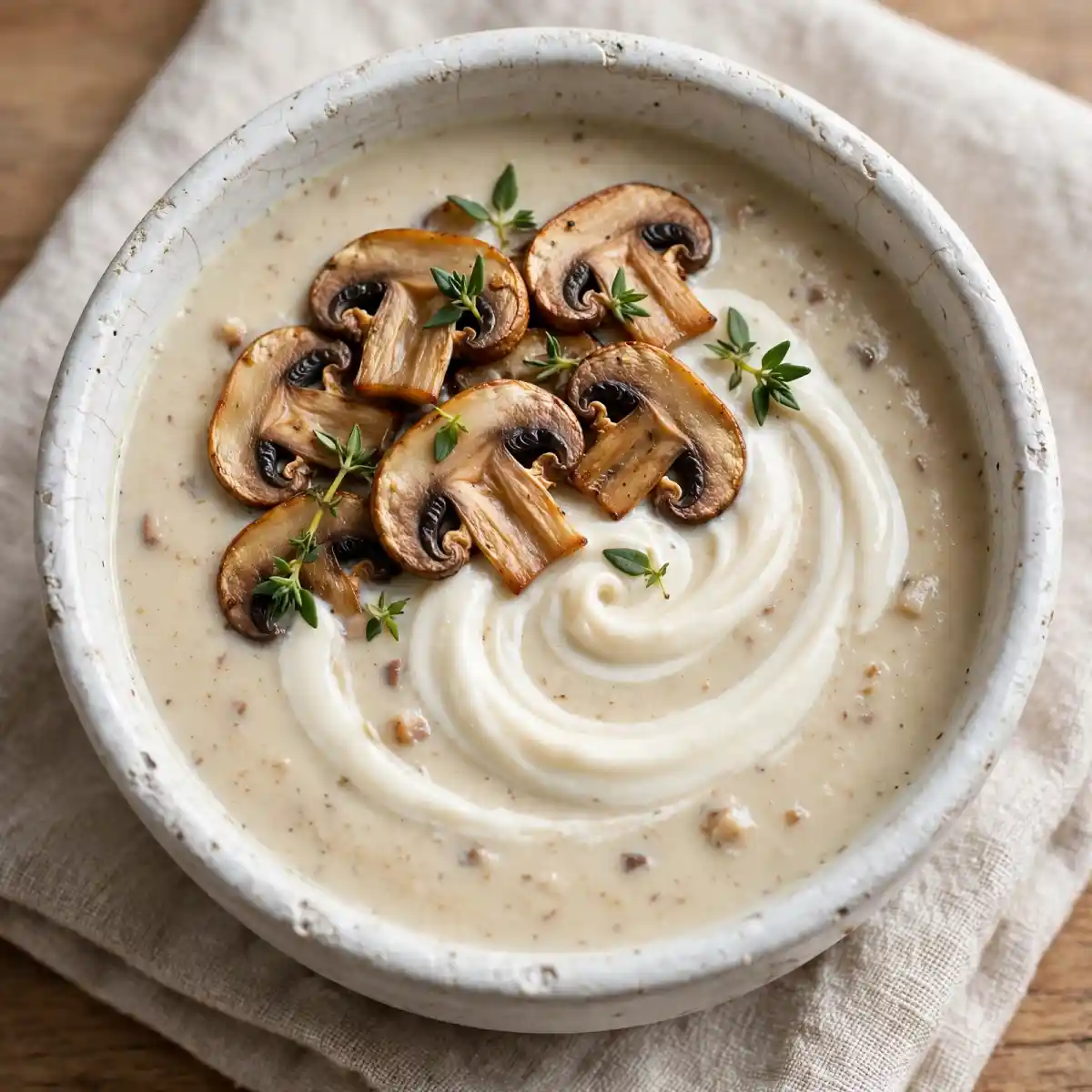
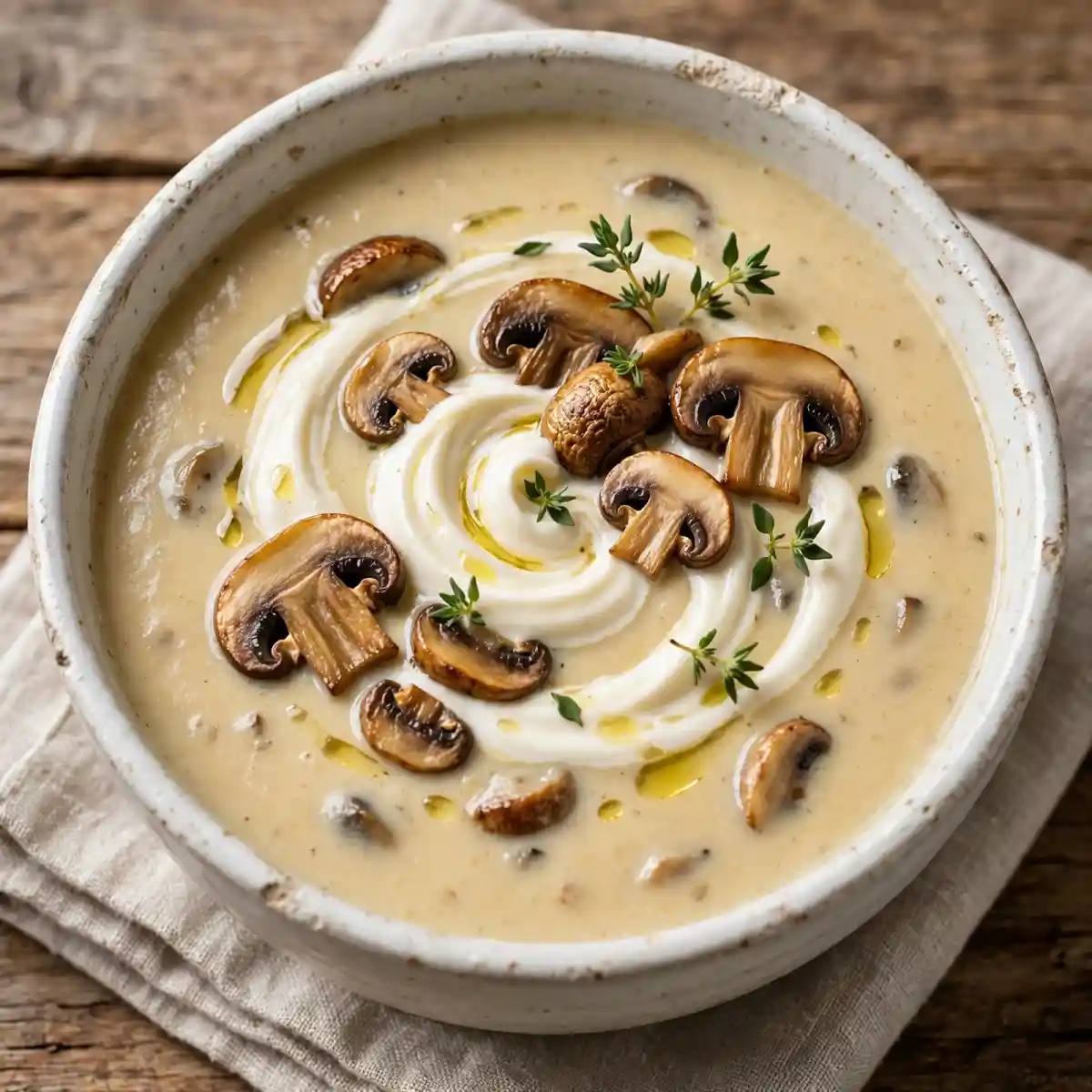
- Serve in wide, shallow bowls with a thin swirl of cream poured from a spoon at the center and a fresh thyme sprig pressed gently into the surface; this two-second finishing touch transforms the visual from a plain brown bowl into something that looks deliberately composed.
- A thick slice of crusty sourdough bread or a warm garlic flatbread alongside is the natural pairing; mushroom soup’s earthy richness is designed to be accompanied by bread for dipping, and a good cream-enriched mushroom broth in the bottom of the bowl is worth preserving specifically for that.
- Serve as a first course before a simple roasted chicken or herb-crusted lamb for a dinner party; the soup’s earthy, umami richness sets the savory tone without competing with a main course protein because its flavor is complete and distinct rather than being a reduced version of anything.
- For a full meal, ladle the soup over a small mound of cooked farro or pearl barley placed in the center of the bowl; the grain provides starchy body, the soup acts as the sauce, and the combination is satisfying enough to need nothing else.
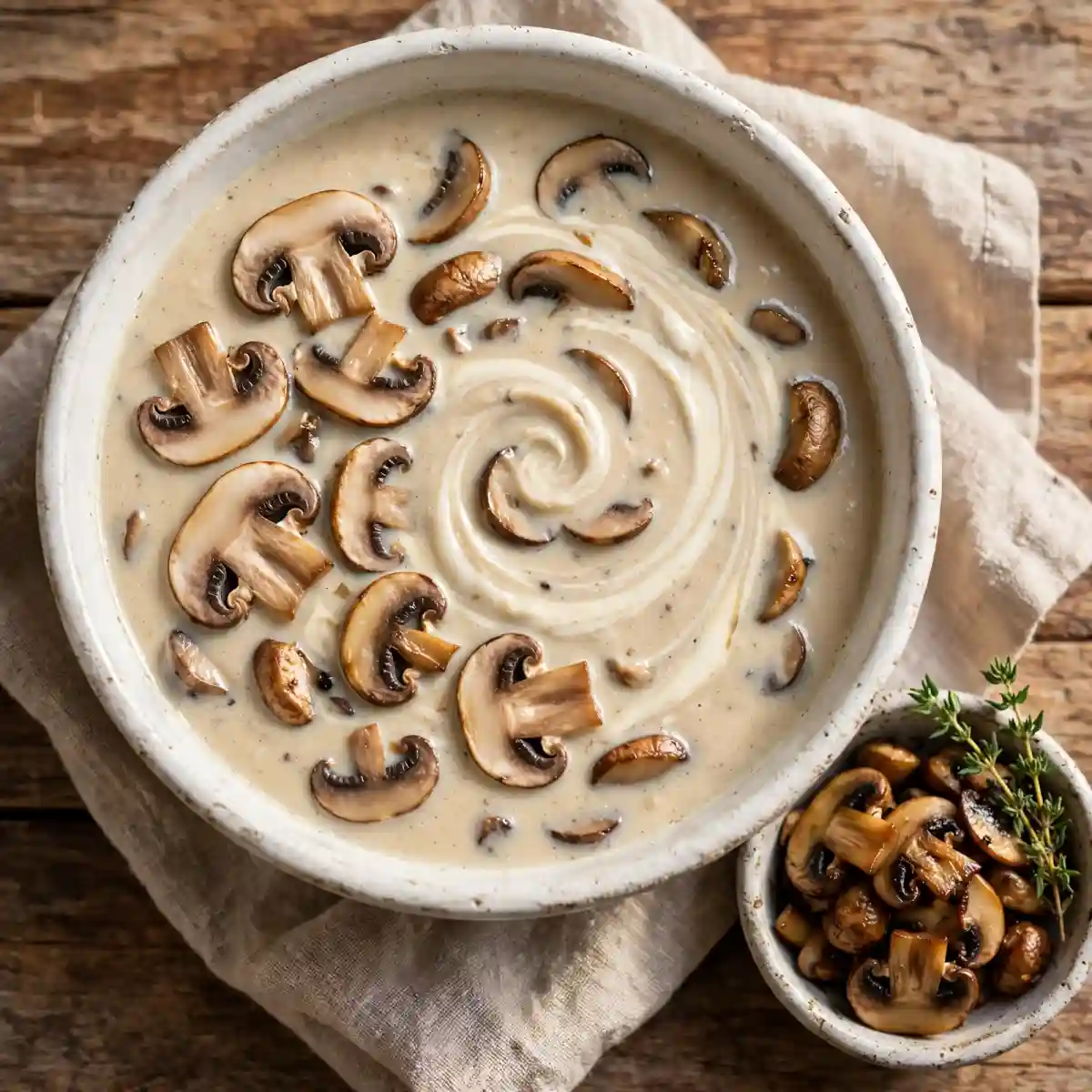
- Top each bowl with a small amount of sautéed mushroom slices that were reserved specifically for garnish before the main batch went into the soup; the contrast of the texturally crisp, separately sautéed mushroom against the smooth, velvety blended soup base makes the earthy mushroom flavor more vivid.
- Pair with hot black tea or a cold pressed apple juice; both provide a clean, slightly tannic or tart contrast to the cream soup’s richness without overpowering the mushroom’s earthy character.
Tips for the Best Results
- Don’t wash the mushrooms under running water. Mushrooms are porous and absorb water readily; washed mushrooms enter the hot pan already saturated with surface moisture, which steams off before any browning can begin and dramatically extends the time needed to reach caramelization. A quick wipe with a damp cloth or a soft dry brush removes any visible grit without moisture absorption, and the heat of the pan during cooking kills any surface bacteria that concerns people about not washing.
- Cook the mushrooms until genuinely golden-brown, not just until wilted. The color change from pale grey to warm golden-brown is the visible indicator that the Maillard reaction has occurred and the aromatic depth compounds have formed. If the mushrooms look pale grey and have released a lot of liquid into the pan, the heat is too low; increase it and wait for the liquid to evaporate before the browning begins.
- Use the porcini soaking liquid. The 20 minutes spent rehydrating dried porcini produces a soaking liquid that contributes more concentrated mushroom flavor per tablespoon than any commercially available mushroom broth. Strain it carefully to remove grit, reduce the vegetable broth by the same volume, and use it; the depth improvement in the finished soup is immediately noticeable.
- Blend partially, not completely. A fully blended mushroom soup loses its textural identity and tastes closer to a cream of mushroom in a can than something made from scratch. The 30 to 40% of unblended mushrooms preserved in the soup provide both visible evidence of real mushrooms and a textural contrast that makes each spoonful more satisfying than a smooth, uniform puree.
- Season after blending and cream addition, not before. Both the blending process and the cream addition change the soup’s perceived saltiness; a correctly seasoned pre-blend soup often needs additional salt after blending because the texture change reduces how the salt interacts with the taste receptors. Taste the finished soup after the cream is fully integrated and season to that final version.
Storage Tips
Refrigerator
Mushroom soup keeps in the refrigerator in a sealed container for up to 4 days. The soup thickens considerably during storage as the blended mushroom starch and flour continue absorbing the broth; this is normal and reverses on reheating with a splash of broth or water. The flavor actually deepens slightly after 24 hours in the refrigerator as the mushroom aromatics continue distributing through the creamy base. Store without the garnish; add fresh thyme and cream swirl when reheating and serving.
Freezer
Cream-based mushroom soup can be frozen for up to 2 months, with a texture caveat: the cream often separates during the freeze-thaw cycle, and the blended mushroom portion can become slightly grainy after thawing. To minimize this, freeze the soup before the cream is added; reheat the base, bring to a low simmer, and stir in fresh cream when serving. The soup base without cream freezes cleanly and reheats to nearly the same texture as fresh. If freezing the fully assembled soup, reheat on the stovetop at medium-low with vigorous stirring and a splash of cream; the emulsion usually re-integrates with stirring.
Reheating
Stovetop reheating at medium-low produces the best result. Add the refrigerated soup to a saucepan with 3 to 4 tablespoons of vegetable broth or water per serving, stirring gently over medium-low heat for 5 to 6 minutes until steaming throughout. Never bring cream soup to a full boil on reheating; sustained boiling causes the cream to separate and the soup’s texture to break. Microwave reheating at 60% power in 90-second intervals with stirring between works adequately for a single portion; add a tablespoon of water before microwaving to prevent surface drying.
Make-ahead note: Mushroom soup is an excellent make-ahead first course for dinner parties. Make the full recipe up to 2 days ahead, refrigerate, and reheat gently on the stovetop with a small splash of broth added per serving. The flavors improve during refrigerator storage, and what required 45 minutes of active cooking on the first day reheats in under 10 minutes on serving day.
Nutrition Information
Per serving, approximately 1/5 of the recipe:
| Nutrient | Amount |
|---|---|
| Calories | 285 kcal |
| Protein | 7g |
| Total Carbohydrates | 20g |
| Dietary Fiber | 3g |
| Total Sugar | 5g |
| Total Fat | 20g |
| Saturated Fat | 12g |
| Cholesterol | 55mg |
| Sodium | 540mg |
| Vitamin C | 4mg |
| Calcium | 55mg |
| Iron | 1.8mg |
| Potassium | 520mg |
Nutrition values are approximate and may vary based on mushroom variety, cream fat content, and broth sodium level.
Why This Recipe Works
The flavor depth of a properly made mushroom soup depends almost entirely on the Maillard reaction during the initial mushroom sauté. Mushrooms contain free amino acids and reducing sugars in their cellular structure; when mushroom surfaces reach approximately 140 to 150°C in a dry or near-dry hot pan, these compounds react to produce hundreds of new aromatic molecules including pyrazines (toasted, nutty notes), furanones (caramelized, slightly sweet notes), and sulfur-containing compounds (savory, umami-adjacent notes) that are entirely absent from raw or steamed mushrooms. These are the compounds responsible for the smell that fills a kitchen during proper mushroom caramelization; they dissolve into the cooking fat, transfer into the broth during the simmer, and produce the deep, complex flavor that distinguishes from-scratch mushroom soup from any canned equivalent.
Cooking mushrooms in batches rather than all at once is a temperature management decision based on the specific heat capacity of water. Fresh mushrooms contain 90 to 92% water by weight; when too many are added simultaneously to a hot pan, the total mass of released moisture exceeds the pan’s thermal capacity to maintain high surface temperatures, dropping the pan base below the 140°C threshold needed for Maillard browning. The mushrooms steam in their own released liquid at approximately 100°C until the moisture evaporates, by which point the Maillard window has often passed and the mushrooms are already past their ideal searing stage. Two batches maintain the temperature differential needed for each piece to brown properly.
The partial blending technique produces a texture that neither fully blended nor fully chunky soup can achieve. Blending 60 to 70% of the soup volume releases the gelatinized starch from the cooked mushroom cells into the liquid base, increasing its viscosity and producing a smooth, velvety-feeling broth phase. The remaining 30 to 40% of whole mushroom pieces provides the textural contrast that tells every palate the soup was made with real mushrooms; the brain registers both the smooth base and the firm pieces simultaneously, producing a more complex eating experience than uniform puree or plain chunky broth. The flour added in the roux provides additional starch-based thickening that stabilizes the texture during reheating; without it, a fully mushroom-starch-thickened soup can thin considerably when reheated as the starch molecules partially depolymerize.
Soy sauce’s role in this recipe is as a glutamate amplifier rather than a flavoring agent. Mushrooms contain natural glutamic acid (the free amino acid responsible for the umami taste sensation) at concentrations of approximately 100 to 180mg per 100g of fresh cremini and significantly higher in shiitake and porcini. Soy sauce contains fermented glutamate at concentrations many times higher; a small addition raises the total glutamate level in the soup without adding any identifiable soy flavor at the 1-teaspoon-per-batch level. The result is a soup that tastes savory and complex in a way that additional salt or mushrooms alone cannot produce; the umami sensation fills the palate in a broader, more satisfying way than salty-only seasoning.
The cream addition’s timing and temperature matter because cream is an emulsion of fat droplets in water, stabilized by milk proteins. At temperatures above 85 to 90°C, with the agitation of a full simmer, the fat droplets can coalesce and the protein stabilizers can denature, producing visible pools of separated fat at the soup’s surface. Added to a hot but non-boiling soup (70 to 80°C) over low heat with steady stirring, the cream’s fat droplets disperse evenly through the aqueous broth phase rather than coalescing; the flour-and-mushroom starch already present in the blended base provides additional emulsification support by physically surrounding the fat droplets and stabilizing their dispersion. The result is a silky, uniform cream-enriched broth rather than a greasy, separated one.
I’ve made this recipe with single-variety mushroom batches (all cremini, all shiitake, all oyster) to compare against the two-variety combination at the same total mushroom weight. The all-cremini version was pleasant but one-dimensional; the all-shiitake version was intensely savory but slightly medicinal-tasting without the cremini’s milder earthiness to balance it. The 70:30 cremini-to-shiitake combination produced a more rounded, complex result than either alone, specifically because the two varieties’ different aromatic compound profiles complement rather than duplicate each other.
Frequently Asked Questions
Can I make mushroom soup ahead of time?
Yes, and the flavor genuinely improves after 24 hours in the refrigerator as the mushroom aromatics distribute more fully through the creamy base. Make the full recipe up to 2 days ahead, cool completely, and refrigerate in a sealed container. Reheat on the stovetop at medium-low with a splash of vegetable broth added per serving to restore the consistency. For the cleanest freezer storage, make the soup without the cream, freeze the base for up to 2 months, and add fresh cream when reheating.
Why does my mushroom soup taste bland?
Bland mushroom soup almost always traces back to the mushrooms not being properly caramelized during the initial sauté. If the mushrooms went into the pan all at once, they released moisture and steamed instead of browning; the Maillard flavor compounds never formed. The soup will taste flat regardless of how much salt or other seasoning is added. The fix for future batches is to cook in two batches at medium-high heat and wait for genuine golden-brown color before proceeding. Adding the porcini soaking liquid, the soy sauce, and all three mushroom varieties produces the deepest base regardless of technique.
Can I use canned mushrooms instead of fresh?
Technically yes, but the result is significantly different. Canned mushrooms are already cooked and have lost most of their aromatic volatile compounds during the canning process; they can’t be caramelized to produce Maillard browning because they contain too much residual moisture and their cell structure is already broken down. If fresh mushrooms aren’t available, dried mushrooms reconstituted in hot water produce a far better result than canned; the reconstitution produces both mushroom pieces and a flavorful soaking liquid. Canned mushrooms work in a pinch but produce a noticeably thinner, less complex soup.
How do I make mushroom soup without cream?
Replace the heavy cream with one of three options depending on your preference. Full-fat coconut cream at the same 180ml quantity produces the richest, most comparable texture. Whole milk mixed with 1 tablespoon of cornstarch (whisked together before adding) produces a lighter, less rich result. Plain, unsweetened oat milk at the same quantity produces an adequately creamy, dairy-free result with a mild oat note that most people don’t detect against the mushrooms’ strong earthy flavor. All three go in at the same stage and at the same low heat to prevent separation.
Is mushroom soup gluten-free?
The standard recipe is not gluten-free because it uses all-purpose flour as a thickener and standard soy sauce which often contains wheat. To make it fully gluten-free, replace the flour with 1.5 tablespoons of cornstarch mixed with 3 tablespoons of cold broth before adding to the pot, and use certified gluten-free tamari in place of the soy sauce. All other ingredients including mushrooms, onion, garlic, thyme, broth, cream, butter, and spices are naturally gluten-free. Verify the vegetable broth label if strict compliance is needed.
What’s the best way to reheat mushroom soup without breaking the cream?
Always reheat cream-based mushroom soup over medium-low heat with the addition of 2 to 4 tablespoons of vegetable broth or water per serving, stirring gently and continuously. Never bring it to a boil; sustained high heat separates the cream’s fat from its water phase and produces a greasy, broken texture that is difficult to reverse. If the cream has partially separated during reheating, remove the pot from the heat and stir vigorously with a spatula in broad circular strokes; the emulsion usually re-integrates as the temperature drops slightly.
Can I use a regular blender instead of an immersion blender?
Yes, with important safety steps. Allow the soup to cool for 10 minutes after simmering. Fill the blender only halfway; hot liquid expands when blended and an overfilled blender can force the lid off and cause serious burns. Hold the blender lid down firmly with a folded cloth throughout blending. Blend in 20-second pulses rather than continuously; each pause allows pressure to equalize. Work in two batches if the soup volume requires it, returning each blended portion to the pot before blending the next.
Conclusion
Mushroom soup’s reputation for being either excellent or disappointing comes down almost entirely to one decision: whether the mushrooms are cooked at high enough heat in small enough batches to genuinely brown. Everything else in the recipe, the blending technique, the cream, the porcini soaking liquid, the soy sauce, all of it builds on that foundation. Get the caramelization right and the rest of the recipe follows naturally.
The make-ahead advantage makes this a genuinely practical choice for dinner parties and weeknight meal prep in equal measure. The 45 minutes of active work produces 4 days of refrigerator life and flavors that only improve with time, which is a better return than most soups offer.
If you loved this recipe, save it to your easy soup recipes and comfort food dinner board so you can find it easily later. For more healthy recipes and daily food inspiration, follow TheCookingVibes on Pinterest.
Creamy Mushroom Soup
Ingredients
Equipment
Method
- If using dried porcini, soak in 240ml of just-boiled water for 20 minutes. Lift out, squeeze, roughly chop. Strain soaking liquid through a fine sieve and set both aside.
- Heat 1.5 tablespoons of butter and all the olive oil in a large heavy-bottomed pot over medium-high until butter foam subsides. Add half the cremini and all the shiitake in a single layer. Cook undisturbed 2 minutes, then stir and cook 2 to 3 more minutes until genuinely golden-brown and nutty-smelling. Remove with a slotted spoon.
- Add another 1.5 tablespoons of butter to the same pot. Repeat with remaining cremini, adding rehydrated porcini in the last 60 seconds if using. Remove all mushrooms to the same bowl.
- Reduce heat to medium. Add remaining 1 tablespoon butter. Add diced onion; cook 6 to 7 minutes until fully softened and pale golden. Add garlic and thyme; cook 60 seconds until fragrant.
- Sprinkle flour over the onions; stir continuously for 90 seconds until raw flour smell is gone. Pour vegetable broth in a slow stream while stirring, adding porcini soaking liquid if using. Scrape the pot base. Add back all mushrooms plus any resting juices. Add soy sauce, salt, pepper, and nutmeg. Simmer over medium-low for 10 to 12 minutes until mushrooms are very tender.
- Using an immersion blender, blend 60 to 70% of the soup until smooth, leaving visible mushroom pieces in the remaining portion.
- Return to low heat. Add heavy cream in a steady stream while stirring. Heat 2 to 3 minutes until steaming throughout; do not boil. Taste and adjust seasoning. Serve immediately with cream swirl and thyme garnish.
Notes
- Never wash mushrooms under water; wipe clean with a damp cloth to prevent moisture absorption that inhibits browning.
- Cook mushrooms in two batches at medium-high heat; crowding causes steaming instead of browning and results in a flat, one-dimensional flavor.
- The porcini soaking liquid is optional but adds significant depth; strain carefully to remove grit before adding.
- Blend only 60 to 70% of the soup; partial blending preserves visible mushroom texture while creating a velvety base.
- Allergens: Contains dairy (butter, heavy cream) and gluten (all-purpose flour, standard soy sauce). Naturally egg-free and nut-free.
- Use GF flour and tamari for gluten-free; vegan butter and coconut cream for dairy-free. This recipe has not been tested in a certified allergen-free kitchen and cannot be guaranteed safe for any specific allergy.
- Nutrition values are approximate and may vary based on mushroom variety, cream fat content, and broth sodium level.