

Easy Arroz Con Leche (Creamy, Cinnamon-Spiced, Classic)
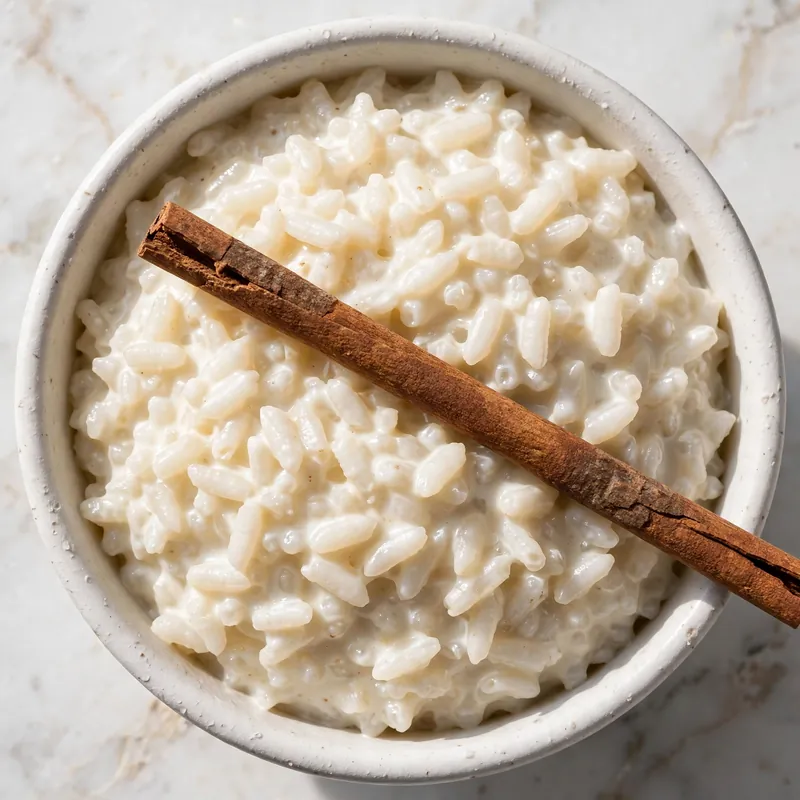
There is something about the smell of cinnamon and warm milk reducing slowly in a pot that feels immediately like comfort, before you have even tasted a single spoonful. Arroz con leche produces that smell. The rice swells slowly in the milk, the cinnamon stick releases its warmth into the liquid, and by the time the pot thickens into a creamy, lightly sweet pudding, the kitchen has taken on that particular quality that makes people wander in from other rooms to see what is cooking.
This arroz con leche recipe follows the classic stovetop method: short-grain white rice cooked first in water to soften, then finished in whole milk with sugar, a cinnamon stick, and a strip of lemon zest. The result is a rice pudding that is creamy without being heavy, warmly spiced without being overwhelming, and lightly sweet in the way that makes a second bowl easy to justify. It works as a dessert, a cold-weather breakfast, or an afternoon snack, and it keeps beautifully in the fridge for four days.

Table of Contents
- Why You’ll Love This Arroz Con Leche
- Ingredients You’ll Need
- Allergen and Dietary Disclosure
- Step-by-Step Directions
- Common Mistakes and Troubleshooting
- Variations and Substitutions
- Serving Suggestions
- Tips for the Best Results
- Storage Tips
- Nutrition Information
- Why This Recipe Works
- Frequently Asked Questions
- Conclusion
Why You’ll Love This Arroz Con Leche
- Simple pantry ingredients, no special equipment. White rice, whole milk, sugar, cinnamon, and lemon zest. Everything you need is likely already in your kitchen, and the entire process happens in one saucepan.
- Genuinely creamy without any cream. Whole milk alone, reduced slowly over low heat, creates a rich, coating consistency that feels indulgent. The starch released from the rice as it cooks does the thickening naturally.
- The cinnamon is noticeable, not decorative. A whole cinnamon stick simmered in the milk for 30 minutes infuses the pudding with warmth throughout rather than the flat, dusty note you get from stirring ground cinnamon into cold milk.
- Serves warm or cold. Freshly made and still warm from the pot, it is loose and pourable. Refrigerated overnight, it firms up into a spoonable, denser pudding. Both versions are good for different reasons.
- Scales up effortlessly. Double the recipe in the same pot with no change in technique. Arroz con leche is one of the most reliable large-batch desserts you can make.
Ingredients You’ll Need
Recipe Timing
| Detail | Info |
|---|---|
| Servings | 6 |
| Difficulty | Easy |
| Course | Dessert, Breakfast |
| Cuisine | Latin American, Spanish |
| Prep Time | 5 minutes |
| Cook Time | 35 minutes |
| Total Time | 40 minutes |
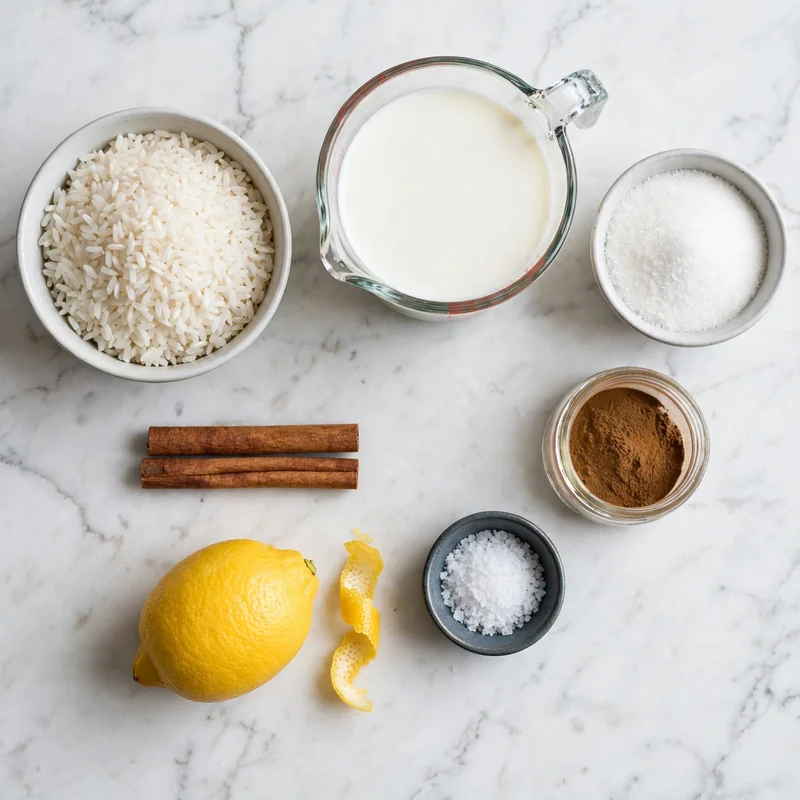
The most important ingredient decision in this recipe is the rice. Short-grain white rice, such as Valencia or Arborio, releases more starch as it cooks than long-grain varieties, which is what produces the thick, creamy pudding consistency. Long-grain rice like basmati stays firmer and releases less starch, giving you a thinner, grainier result that misses the texture that defines a proper arroz con leche. If short-grain is unavailable, medium-grain white rice is the next best option.
For the milk, use whole milk rather than reduced-fat or skimmed. The fat content in whole milk is what allows the pudding to reduce into a creamy, coating consistency rather than a thin, watery one. If the milk you have is full-fat and fresh, the pudding will be noticeably better than one made with anything lighter.
The cinnamon stick matters more than the ground cinnamon dusted on top. A good-quality Ceylon cinnamon stick is more delicate and aromatic than Cassia cinnamon; either works but the Ceylon version produces a subtler, cleaner warmth in the finished pudding.
- 1 cup (200g) short-grain white rice. The starch in the rice thickens the milk into a pudding as cooking progresses. Rinse before using to remove surface starch that would make the pudding gluey rather than creamy.
- 2 cups (480ml) water. Used to par-cook the rice before the milk goes in. Starting in water prevents the milk from scorching before the rice has had a chance to begin softening.
- 1 litre (4 cups) whole milk. The primary liquid. It reduces by about a third during cooking, concentrating the flavor and creating the creamy consistency. Don’t substitute with lower-fat milk.
- 1/2 cup (100g) granulated sugar. Added after the milk, not at the start. Sugar added too early can slightly interfere with how the milk reduces. A half cup gives a lightly sweet result; add up to 2 tablespoons more if you prefer it sweeter.
- 1 whole cinnamon stick. Simmered in the milk for the full cooking time to infuse warmth throughout. Remove before serving.
- 1 strip of lemon zest (about 5cm / 2 inches), yellow part only. Peel it with a vegetable peeler, taking only the yellow layer and avoiding the bitter white pith. The lemon adds a subtle brightness that prevents the pudding from tasting heavy or flat.
- 1/4 teaspoon fine sea salt. A small amount sharpens the sweetness and makes the cinnamon flavor more distinct. Don’t skip it.
- Ground cinnamon, for serving. Dusted over each bowl just before serving. It adds visual contrast and a top note of spice that complements the slow-infused warmth from the whole stick.
Allergen and Dietary Disclosure
This recipe contains dairy (whole milk).
For a dairy-free and vegan version, replace the whole milk with full-fat coconut milk or a 50/50 blend of coconut milk and oat milk. Full-fat coconut milk reduces to a similarly creamy consistency and adds a mild coconut character that pairs naturally with the cinnamon. Use oat milk alone and the pudding will be thinner and less rich, though still pleasant.
For a lower-sugar version, reduce the granulated sugar to 1/3 cup (65g). The natural sweetness of the whole milk provides some sweetness on its own, so the reduction is noticeable but not drastic.
Free from gluten, eggs, nuts, and soy as written. Not guaranteed safe for any specific allergy without checking all individual ingredient labels.
Step-by-Step Directions
Step 1: Rinse the Rice
Place the short-grain rice in a fine mesh strainer and rinse under cold running water for 30 to 45 seconds, moving the rice with your hand until the water running off it turns from cloudy to mostly clear. This removes the loose surface starch that would otherwise make the pudding sticky and gluey rather than smooth and creamy. Shake the strainer once or twice to drain as much water as possible before the rice goes into the pot.

Chef’s Note: Rinsing short-grain rice before making arroz con leche is one of those steps that seems optional but isn’t. Unrinsed short-grain rice releases too much surface starch too quickly, which produces a gluey, clumping pudding rather than individual grains suspended in a creamy sauce.
Step 2: Par-Cook the Rice in Water
Combine the rinsed rice and 2 cups of water in a medium-to-large saucepan over medium-high heat. Bring to a boil, stirring once or twice. Once the water is boiling actively, reduce the heat to medium-low and simmer, uncovered, for 8 to 10 minutes until most of the water has absorbed and the rice is about halfway cooked: tender on the outside but still firm and chalky at the center when you bite one grain. There will still be a small amount of visible liquid at the base of the pot.
Chef’s Note: Cooking the rice partially in water before the milk goes in is the technique that protects the milk from scorching. Milk added to raw rice over sufficient heat to cook the rice fully will catch on the bottom of the pot before the rice is done. The par-cook solves this.

Step 3: Add the Milk, Cinnamon, Lemon Zest, and Salt
Pour the whole milk directly into the saucepan with the partially cooked rice. Add the cinnamon stick, the strip of lemon zest, and the salt. Stir everything together and raise the heat to medium. Bring the milk to a gentle simmer, watching it carefully: milk comes to a boil faster than you expect and will foam up and over the edge of the pot without much warning if you look away.
Step 4: Simmer Low and Slow, Stirring Often
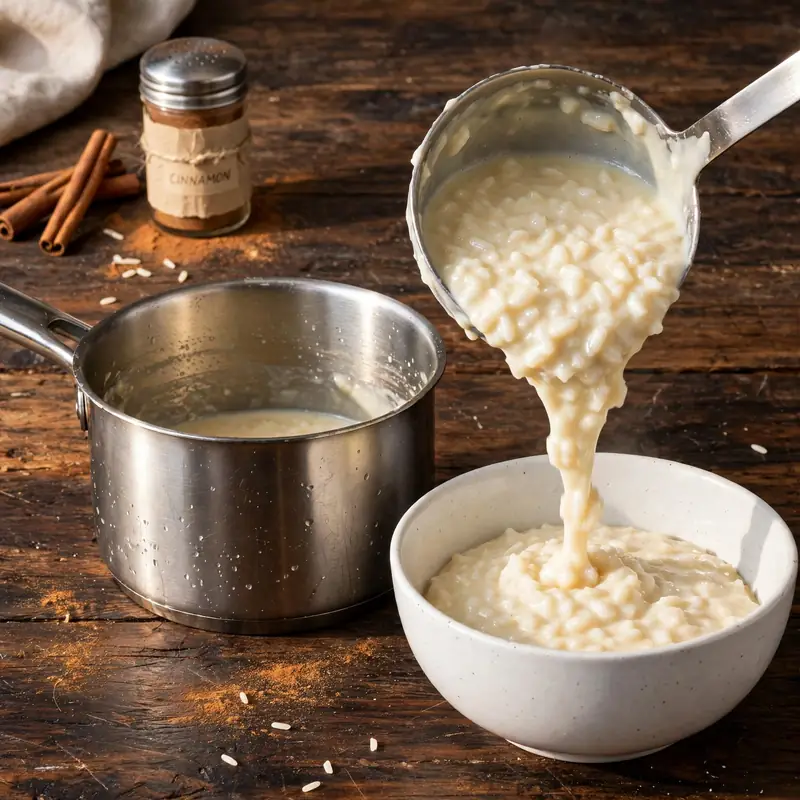
Once the milk reaches a steady gentle simmer with small bubbles breaking consistently at the surface, reduce the heat to low. Cook uncovered, stirring every 3 to 4 minutes, for 20 to 25 minutes. The stirring is not optional: it prevents the rice from settling and sticking to the bottom of the pot and also distributes the starch evenly through the milk as it releases, which produces a uniformly creamy pudding rather than a thick layer at the bottom with thin liquid on top.
The pudding is ready when it has reduced noticeably in volume, coats the back of a spoon thickly, and the rice grains are completely soft with no resistance when pressed between two fingers. It will look slightly thinner than you want at this stage. That is correct: arroz con leche thickens further as it cools.
Chef’s Note: The temptation is to rush this stage by raising the heat. Don’t. A higher heat scorches the milk on the bottom of the pot and produces a burnt, slightly bitter note that carries through the whole pudding. Low and slow is the only way.
Step 5: Add the Sugar and Cook Briefly
Remove the cinnamon stick and the lemon zest strip from the pot. Add the granulated sugar and stir continuously for 2 to 3 minutes over low heat until the sugar dissolves completely and the pudding returns to a gentle simmer. Taste at this point and add more sugar by the tablespoon if you want it sweeter.
Step 6: Serve or Cool
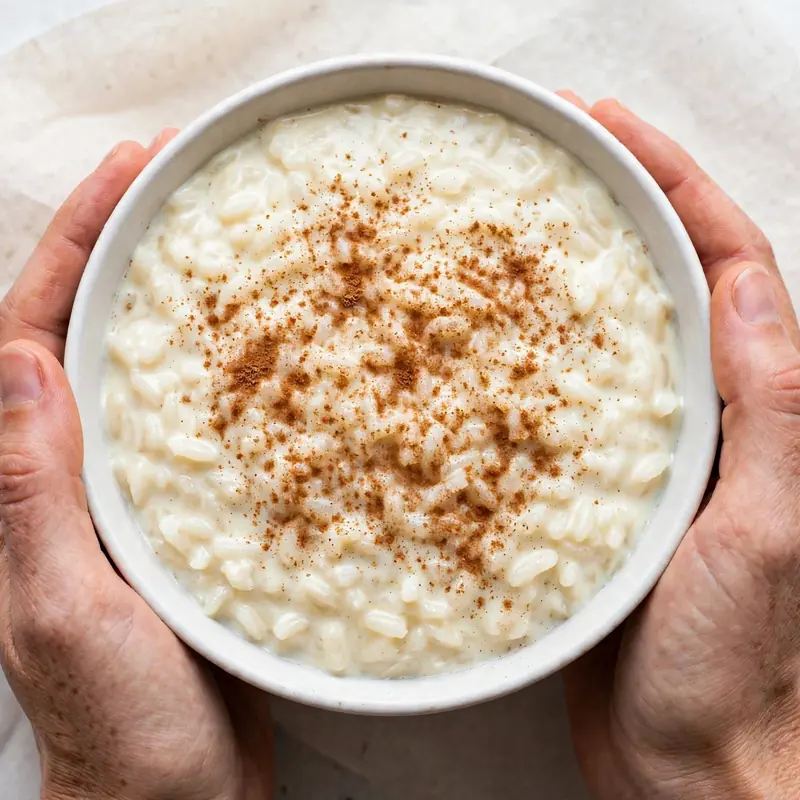
Remove the pot from the heat. The arroz con leche is ready to serve immediately, warm, ladled into bowls and dusted with ground cinnamon. For a chilled version, transfer to a large bowl or individual serving dishes, press a sheet of plastic wrap directly onto the surface of the pudding to prevent a skin from forming, and refrigerate for at least 2 hours or overnight. Dust with ground cinnamon just before serving.
Common Mistakes and Troubleshooting
| Problem | Cause | Solution |
|---|---|---|
| Pudding is gluey and clumping | Rice not rinsed before cooking; too much surface starch | Always rinse short-grain rice under cold water until the water runs mostly clear before starting |
| Milk scorched on the bottom | Heat too high during the milk simmer stage | Keep heat at low once milk is simmering; stir every 3 to 4 minutes and check the bottom of the pot |
| Pudding too thin after cooking | Milk not reduced enough; heat too low for most of the cooking time | Ensure a steady visible simmer throughout; cook for the full 20 to 25 minutes; check spoon-coating thickness before removing from heat |
| Pudding too thick and stiff after refrigerating | Over-reduced during cooking; too little milk used | Stir in 2 to 3 tablespoons of cold milk before serving to loosen it back to the right consistency |
| No cinnamon flavor in the finished pudding | Cinnamon stick too old or low quality; not simmered long enough | Use a fresh cinnamon stick; simmer for the full milk cooking time; add a pinch of ground cinnamon to the pudding at the end if needed |
| Skin formed on the surface after cooling | Pudding cooled uncovered | Press plastic wrap directly onto the surface of the pudding before refrigerating to prevent air contact |
Variations and Substitutions
Coconut Arroz Con Leche: Replace 2 cups of the whole milk with one 400ml can of full-fat coconut milk and use only 2 cups of whole milk for the remaining liquid. The coconut adds a subtle tropical richness that pairs beautifully with the cinnamon. Particularly good served cold.
Vanilla Arroz Con Leche: Add 1 teaspoon of pure vanilla extract and the seeds scraped from half a vanilla bean to the milk along with the cinnamon stick and lemon zest. The vanilla deepens the sweetness and gives the pudding a more dessert-forward character.
Orange Zest Version: Replace the lemon zest strip with an equal strip of orange zest. Orange and cinnamon together in warm milk is a classic flavor combination in many Latin American kitchens. The orange adds a slightly sweeter, less sharp citrus note than lemon.
Condensed Milk Version: Replace the granulated sugar with 1/3 cup (100g) of sweetened condensed milk stirred in at the end alongside the regular sugar (reduce granulated sugar to 1/4 cup if using both). The condensed milk adds a caramel-like depth and an extra layer of creaminess to the finished pudding.
Rice Pudding With Raisins: Stir 1/3 cup (50g) of golden raisins into the pudding along with the sugar in Step 5. They plump in the residual heat and add pockets of sweetness throughout each bowl. A common addition in Spanish and Argentine versions of the recipe.
Cardamom and Rose Version: Add 3 lightly crushed cardamom pods alongside the cinnamon stick and replace the lemon zest with a teaspoon of rose water stirred in at the very end, off the heat. The result is a more Middle Eastern-inspired version with floral warmth that works well served chilled and garnished with a few crushed pistachios.
Serving Suggestions
- Warm, straight from the pot. A bowl of freshly made arroz con leche with a generous dusting of ground cinnamon is the most traditional way to serve it, especially in cooler months when the warmth is half the point.
- Chilled with a drizzle of honey. Cold arroz con leche from the fridge with a thin drizzle of floral honey over the top is a quieter, more refined version that works well as a light dessert after a heavier meal.
- With fresh fruit alongside. Sliced strawberries, peaches, or mango served beside or lightly scattered over the top add color, freshness, and a fruity acidity that cuts through the creaminess of the pudding.
- As part of a dessert spread. A large bowl of arroz con leche served alongside churros, flan, or fresh fruit at a gathering is a natural centerpiece because it requires no last-minute work and presents well at room temperature.
- For breakfast with a cup of coffee or tea. Cold arroz con leche the morning after it was made is a genuinely satisfying breakfast: substantial enough to hold you until lunch, lightly sweet rather than overwhelmingly so, and ready in seconds from the fridge.
- In small cups as individual portions for children. Arroz con leche served in small ceramic cups or ramekins with a dusting of cinnamon is a crowd-pleaser for children’s tables. The individual portions are easy to handle and the cinnamon-milk flavor is broadly loved across all age groups.
Tips for the Best Results
- Use short-grain rice and don’t substitute. Long-grain rice simply does not release enough starch to thicken the milk into a creamy pudding. If you use basmati or jasmine, you will get rice in thin milk rather than rice pudding. Short-grain or medium-grain white rice is the only workable option.
- Watch the milk closely when it first goes in. Cold milk poured onto hot par-cooked rice can take longer to come to a simmer than you expect, then foam up rapidly once it does. Stay at the stove and stir as it heats to catch it before it spills over the edge.
- Remove the cinnamon stick before the sugar. The sugar needs to dissolve into the pudding, and removing the cinnamon stick first makes stirring easier and ensures no pieces of bark end up in the finished bowl.
- Press plastic wrap to the surface when cooling. Arroz con leche develops a thick, rubbery skin on its surface if left uncovered as it cools. A sheet of plastic wrap pressed directly onto the pudding, with no air gap between them, prevents this entirely.
- Stir in cold milk before serving refrigerated leftovers. Cold arroz con leche thickens considerably in the fridge. Stir in 2 to 4 tablespoons of cold whole milk per portion before serving to restore its creamy, spoonable consistency without reheating.
Storage Tips
Refrigerator
Transfer cooled arroz con leche to an airtight container or cover the pot tightly with a lid. Press plastic wrap onto the surface before sealing if using a container to prevent a skin from forming at the top. It keeps in the fridge for up to 4 days. The pudding thickens in the cold, so stir in a splash of milk before serving each portion.
Freezer
Arroz con leche can be frozen, though the texture changes somewhat after thawing: the rice can become slightly granular and the creaminess is somewhat reduced. Freeze in individual airtight containers for up to 2 months. Thaw overnight in the refrigerator and stir in a few tablespoons of warm milk before serving. It works best served cold after freezing rather than reheated.
Reheating
From the fridge: place one portion in a small saucepan over low heat with 2 to 3 tablespoons of whole milk and stir gently for 3 to 4 minutes until warmed through and loosened. The microwave works too: add the milk splash, cover loosely, and heat at 50% power in 60-second intervals, stirring after each, until warm throughout. Don’t overheat or the milk component can separate.
Nutrition Information
Per serving (approximately 1/6 of the full recipe, roughly 200ml)
| Nutrient | Amount |
|---|---|
| Calories | 265 kcal |
| Protein | 7g |
| Carbohydrates | 48g |
| Fiber | 0.5g |
| Sugar | 22g |
| Total Fat | 5g |
| Saturated Fat | 3g |
| Cholesterol | 17mg |
| Sodium | 115mg |
| Vitamin C | 1mg |
| Calcium | 210mg |
| Iron | 0.8mg |
| Potassium | 280mg |
Nutrition values are approximate and may vary based on brands and portion sizes.
Why This Recipe Works
The two-stage liquid method (water first, then milk) is the structural decision that makes this recipe reliable. Milk scorches at temperatures well below what is needed to fully cook raw rice in a reasonable time. Starting the rice in plain water allows it to reach the halfway-cooked stage without any risk of scorching, and then the milk takes over for the remaining 20 to 25 minutes at a temperature that is gentle enough to never risk burning the bottom of the pot.
Short-grain rice is the correct choice not just for tradition but for specific technical reasons. Short-grain varieties contain a higher proportion of amylopectin, the branching form of starch that dissolves readily into cooking liquid and produces a thick, creamy, cohesive texture. Long-grain rice is higher in amylose, the straight-chain starch that remains more intact during cooking, which is why basmati stays fluffy and separate after cooking: exactly the opposite of what you want in a pudding.
The decision to add sugar at the end rather than the beginning is a detail worth understanding. Sugar raises the boiling point of liquid, which can change how the milk reduces and potentially affect the texture of the rice itself during the long simmer. More practically, stirring sugar into an already-thickened pudding near the end allows you to taste and adjust before committing to a final sweetness level. Added at the start, the sugar is impossible to adjust after the fact.
Whole cinnamon sticks simmered in milk extract a completely different flavor profile than ground cinnamon stirred in at any stage. The slow extraction pulls the essential oils from the bark into the fat of the milk over time, producing a warm, rounded, deeply infused flavor that is present throughout every spoonful. Ground cinnamon dusted on top works differently: it sits on the surface and delivers an immediate top note of spice that contrasts with the more background warmth below, and the combination of both approaches is what gives well-made arroz con leche its characteristic layered cinnamon character.
I’ve tested this recipe with both long-grain and short-grain rice for a direct comparison. The long-grain version produced a thinner broth with intact, separate grains that never unified into a creamy pudding regardless of cook time. The short-grain version reached a proper pudding consistency at 25 minutes and continued to thicken as it cooled. The rice choice is not interchangeable here.
Frequently Asked Questions
Note: Questions below are based on typical home cook search patterns. Live search was not available for this article.
Can I make arroz con leche ahead of time?
Yes, and making it ahead is actually recommended. Freshly made arroz con leche is good warm from the pot, but after a few hours in the fridge, the flavors settle and deepen considerably. Make it the day before, press plastic wrap to the surface, refrigerate overnight, and serve cold the next day with a splash of milk stirred through to restore the creamy consistency. It keeps well for up to 4 days refrigerated.
Why is my arroz con leche too thick after it cools?
This is completely normal and expected. Arroz con leche thickens significantly as it cools because the starch in the rice continues to absorb liquid even after the heat is off. The pudding should look slightly looser than you want it when you remove it from the heat. If it has become too thick in the fridge, stir in 2 to 3 tablespoons of cold whole milk per portion and mix vigorously until the consistency is back where you want it.
Can I use long-grain rice instead of short-grain?
Long-grain rice like basmati or jasmine does not produce the same result. Long-grain varieties release significantly less starch into the cooking liquid, which means the milk stays thin and the rice remains separate rather than creating a creamy, unified pudding. Short-grain or medium-grain white rice is the correct choice. If you truly cannot find either, the next closest option is sushi rice, which is also short-grain.
How do I know when the arroz con leche is done cooking?
Look for two signs: the milk has reduced noticeably in volume (roughly by a third from when you poured it in), and the pudding coats the back of a wooden spoon thickly enough that you can draw a clean line through it with your finger without the line immediately filling back in. The rice grains should be completely soft with no resistance when you press one between your fingers. Remember the pudding thickens further as it cools, so pull it from the heat when it is just slightly thinner than your target consistency.
Can I make arroz con leche dairy-free?
Yes. Replace the whole milk with full-fat canned coconut milk for the closest texture result: it reduces to a similarly creamy consistency and pairs naturally with the cinnamon. Oat milk works but produces a thinner result since it contains less fat. Almond milk is too thin for this recipe and will not reduce to the right consistency regardless of cook time. If using coconut milk, the pudding will have a mild coconut flavor alongside the cinnamon, which most people find pleasant.
Why does my arroz con leche taste flat, with no real cinnamon flavor?
Two things cause flat cinnamon flavor: a cinnamon stick that has been sitting in the pantry for over a year and lost most of its volatile oils, or not simmering it in the milk for long enough. A fresh cinnamon stick simmered for the full 20 to 25 minutes should produce a clearly warm, aromatic pudding. If yours still tastes flat, stir 1/4 teaspoon of ground cinnamon directly into the pudding with the sugar at the end as a backup.
Is arroz con leche the same as rice pudding?
They are closely related but not identical. Both are rice cooked in sweetened milk with spices, but arroz con leche is the Spanish and Latin American version that typically uses short-grain white rice, a whole cinnamon stick, and lemon or orange zest, and is often served cold with a dusting of ground cinnamon on top. Rice pudding varies significantly by culture: some versions use eggs, vanilla, or cream; some are baked rather than stovetop. Arroz con leche is one specific tradition within the broader family of milk-cooked rice desserts.

Conclusion
Arroz con leche is one of those recipes where the simplicity is the whole point. Six ingredients, one pot, forty minutes, and you have a dessert that delivers genuine warmth and comfort in a way that more complicated desserts often don’t. The cinnamon stick does its work slowly, the rice releases its starch gradually, and by the time it is done you have something that tastes considered and intentional even though the actual effort was minimal. Whether you serve it warm straight from the pot or cold from the fridge the next morning, arroz con leche rewards patience in a way that makes it worth coming back to regularly.
If you loved this recipe, save it to your dessert recipes Pinterest board so you can find it easily later. For more recipes and daily food inspiration, follow TheCookingVibes on Pinterest.
Arroz Con Leche (Classic Rice Pudding)
Ingredients
Equipment
Method
- Rinse the short-grain rice under cold running water in a strainer until the water runs mostly clear. Drain well.
- Combine rinsed rice and 2 cups of water in a medium saucepan over medium-high heat. Bring to a boil, stir once, then reduce to medium-low and simmer uncovered for 8 to 10 minutes until most of the water is absorbed and the rice is halfway cooked.
- Pour in the whole milk. Add the cinnamon stick, lemon zest strip, and salt. Raise heat to medium, stirring as the milk heats, and bring to a gentle simmer.
- Reduce heat to low. Cook uncovered, stirring every 3 to 4 minutes, for 20 to 25 minutes until the pudding reduces, thickens, and coats the back of a spoon.
- Remove and discard the cinnamon stick and lemon zest. Stir in the granulated sugar and cook over low heat for 2 to 3 minutes, stirring continuously, until fully dissolved.
- Serve warm in bowls dusted with ground cinnamon, or transfer to containers, press plastic wrap onto the surface, and refrigerate until cold. Stir in a splash of milk before serving if chilled.
Notes
- Use short-grain or medium-grain white rice only. Long-grain rice will not thicken the milk into a creamy pudding.
- The pudding thickens significantly as it cools; it should look slightly looser than your target consistency when removed from the heat.
- Always press plastic wrap directly onto the surface when storing to prevent a skin from forming.
- Stir in 2 to 3 tablespoons of cold milk per portion before serving refrigerated leftovers.