Simple Arugula Salad — Peppery, Lemony, Shaved Parmesan
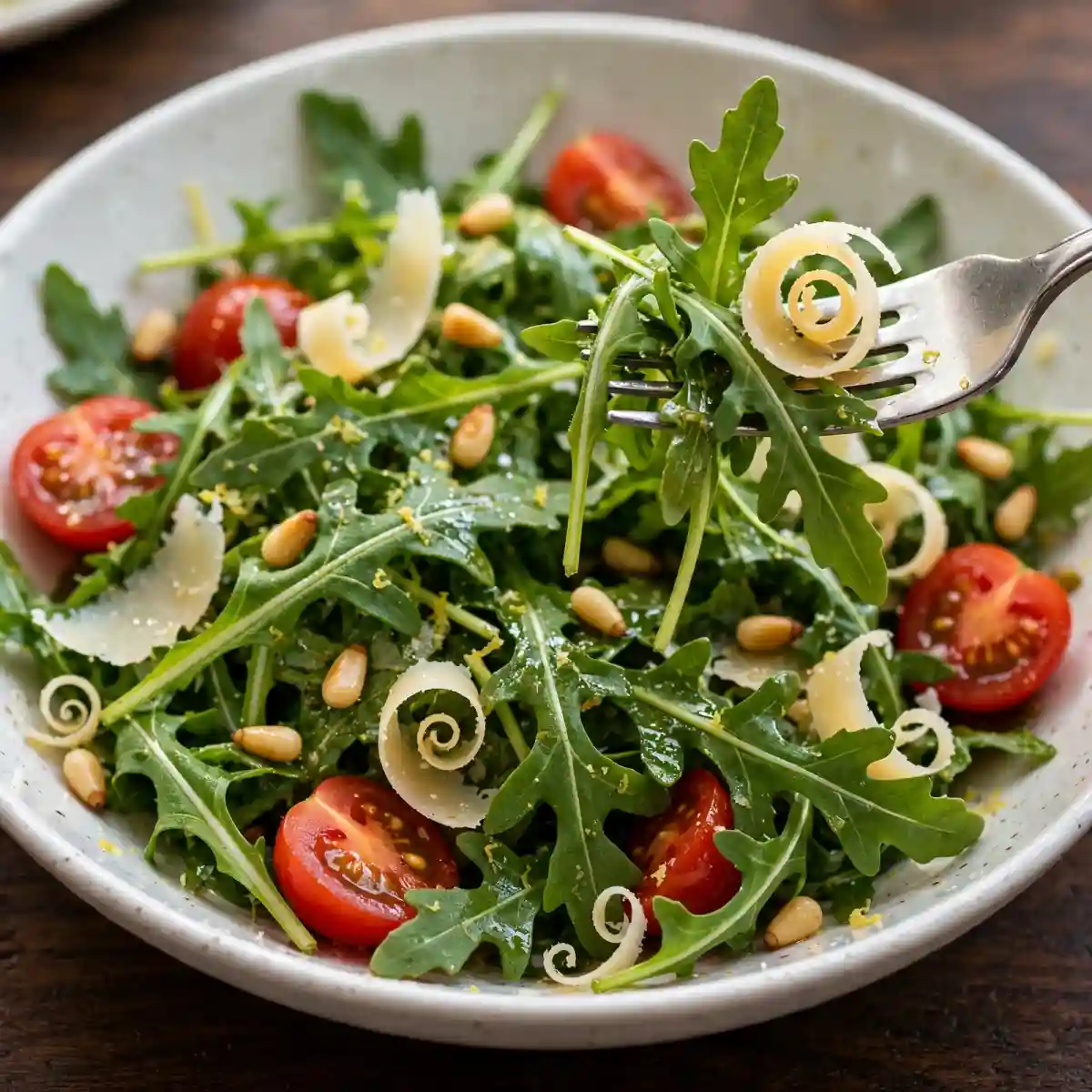
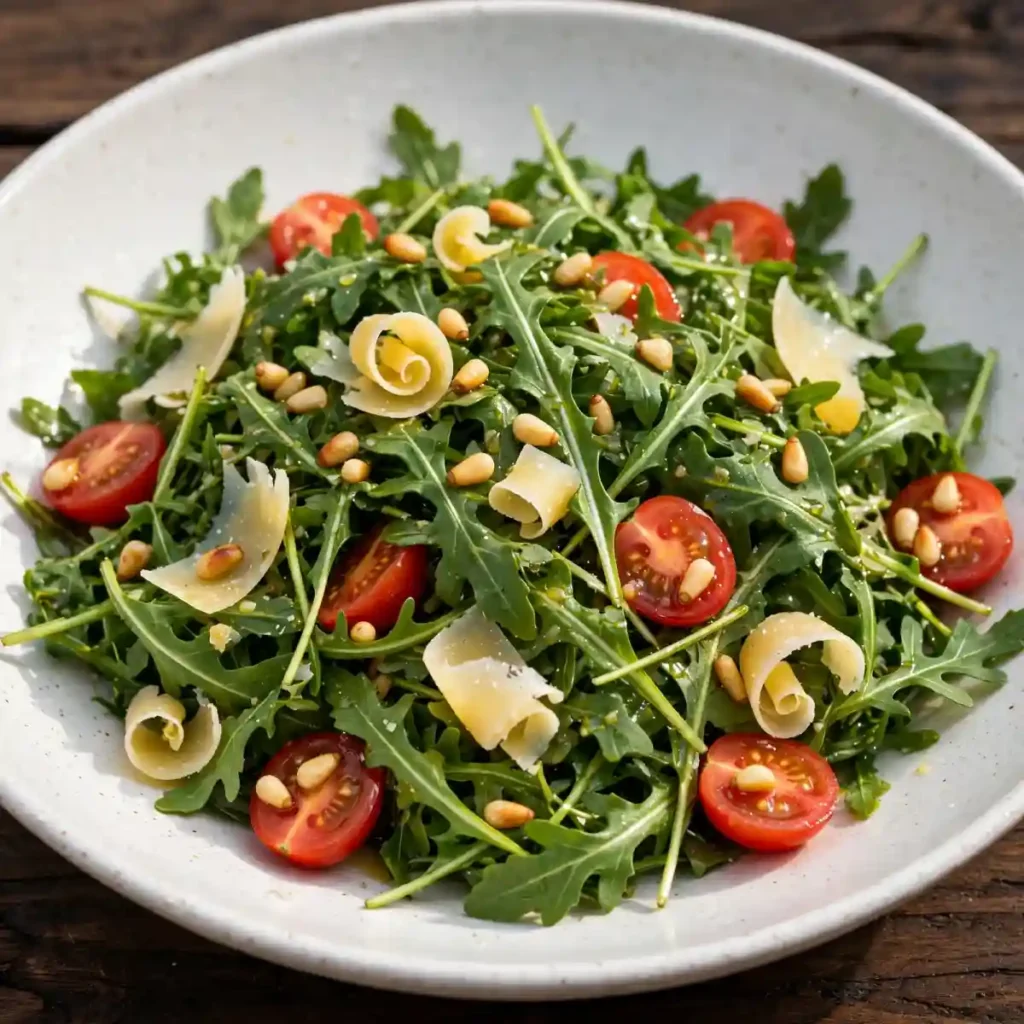
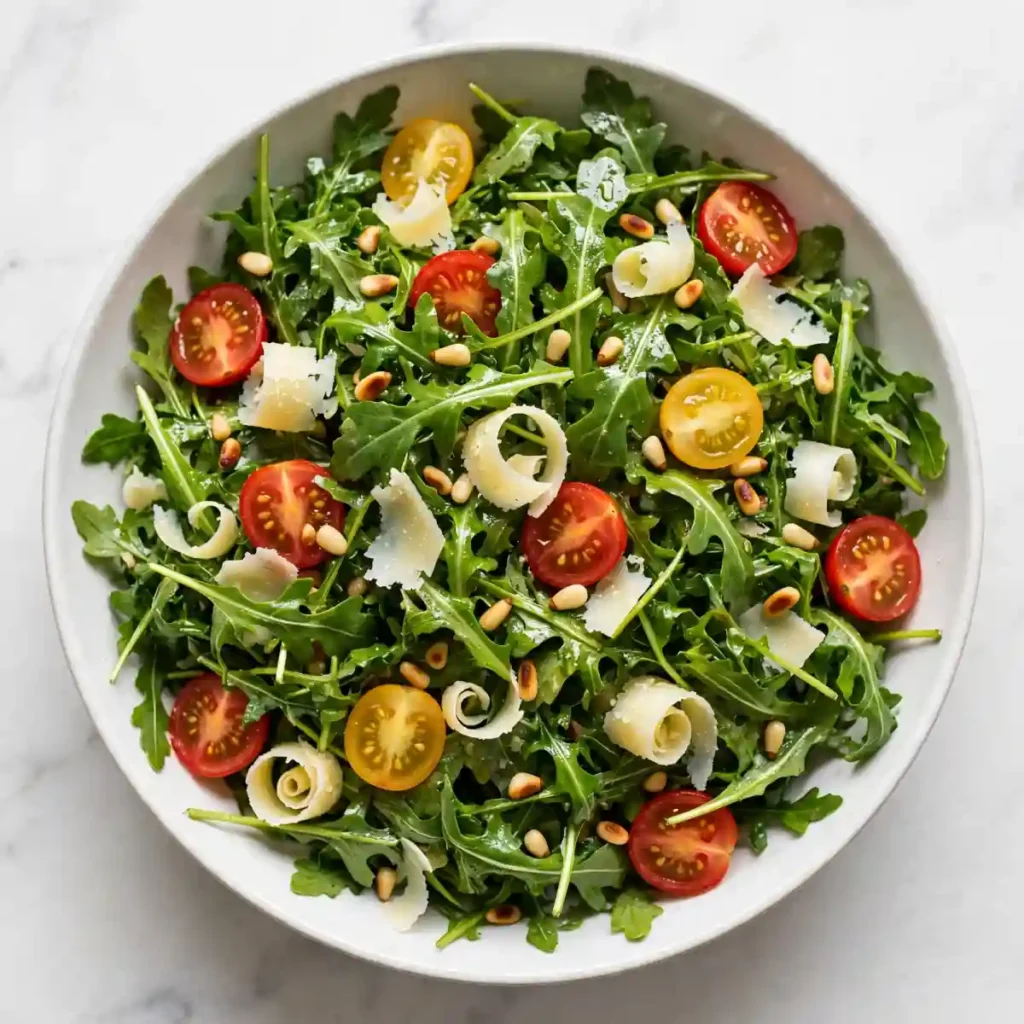
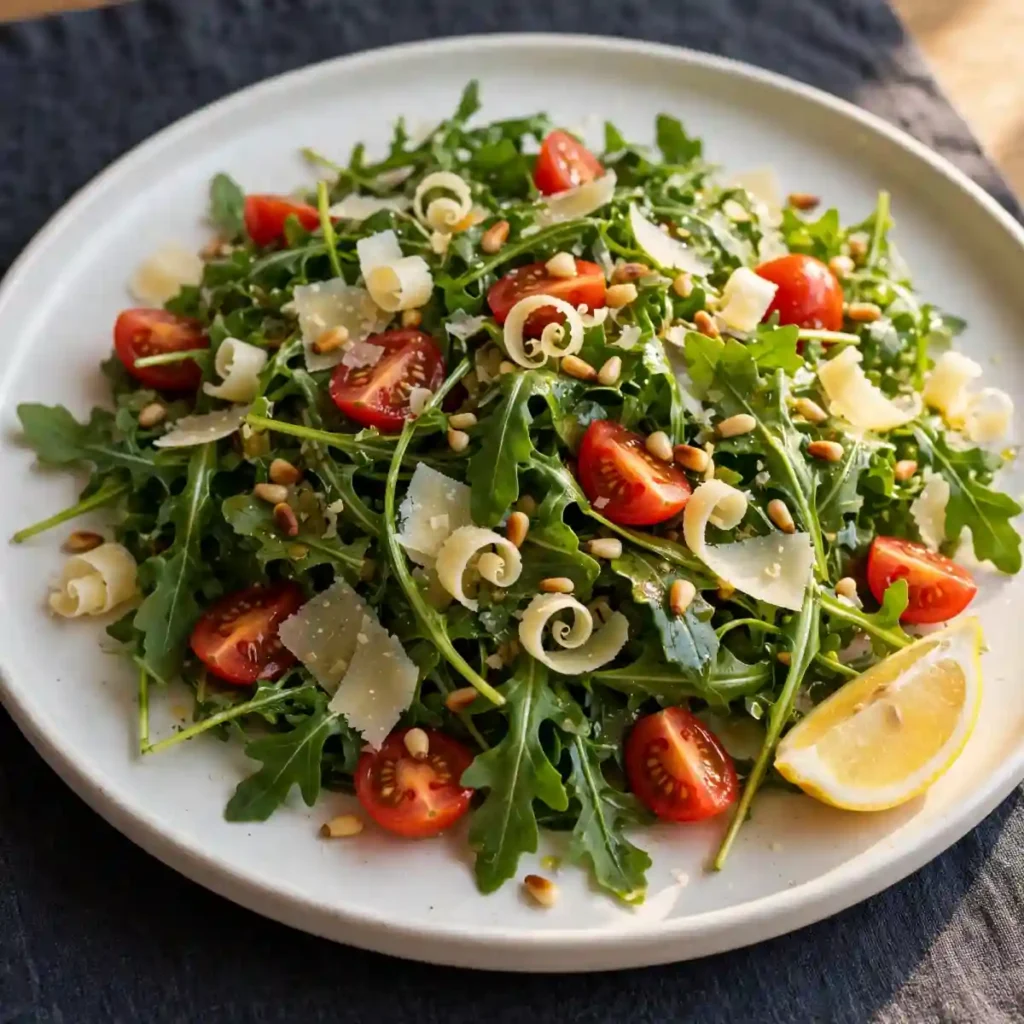
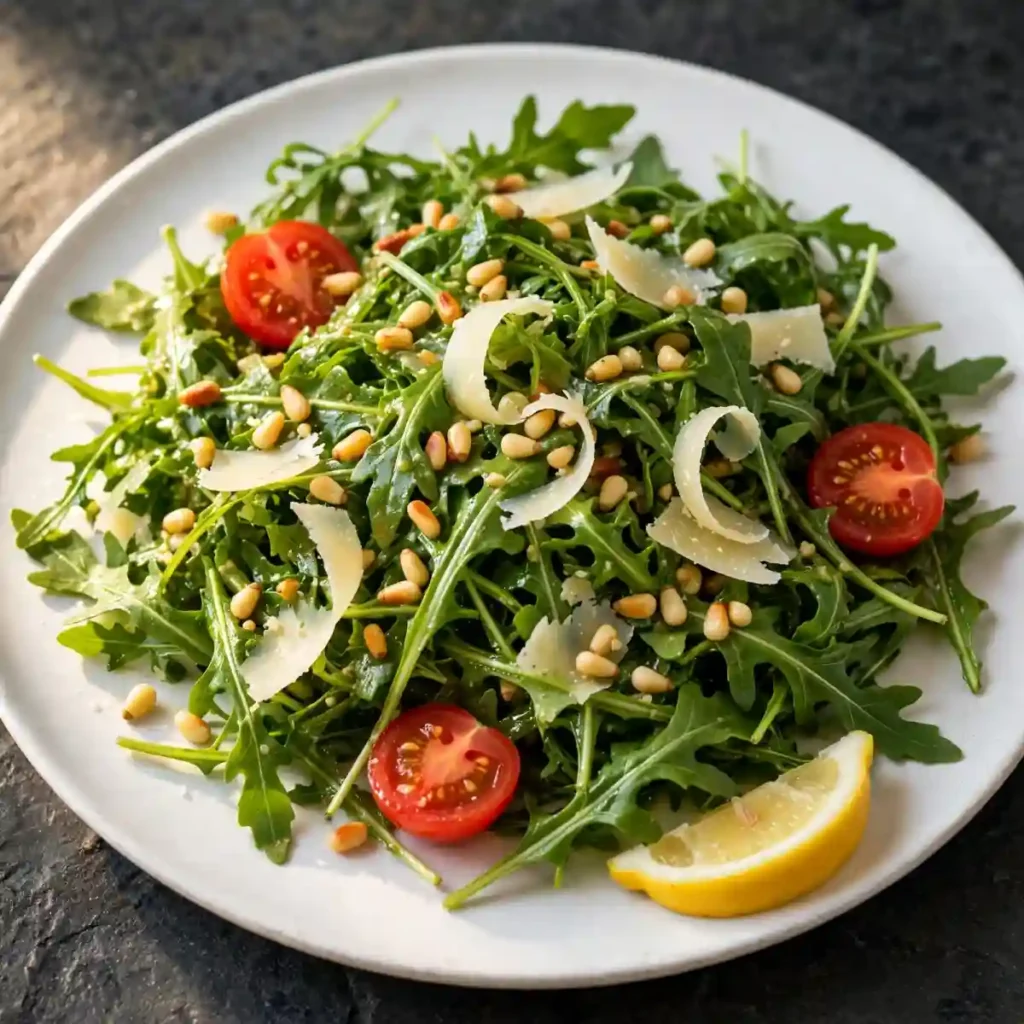
Arugula doesn’t need much. The leaves are already doing something interesting before anything else touches them: a clean, sharp peppery bite that sits at the back of the throat, slightly bitter at the edges, with a brightness that most lettuce simply doesn’t have. Add a lemon dressing that leans on the acid rather than softening it, some shaved Parmesan for salty depth, toasted pine nuts for richness and crunch, and ripe cherry tomatoes for a little sweetness, and the salad tastes composed and genuinely satisfying rather than like a plate of leaves waiting for a main course.
This arugula salad recipe is built around the dressing ratio that makes arugula taste its best: more lemon than olive oil rather than the reverse, because arugula’s bitterness needs acid to feel bright rather than harsh. It comes together in 10 minutes, serves 4 as a side, and works as a starter before pasta, as a plate alongside grilled chicken or fish, or as a light main when you add white beans or roasted chickpeas. The whole recipe requires no cooking beyond toasting the pine nuts, which takes three minutes.
Why You’ll Love This Arugula Salad
- Built around the right dressing ratio. Arugula’s natural bitterness sharpens rather than softens with more lemon than oil; this dressing uses a 1:1 lemon-to-oil ratio that makes the leaves taste vivid and clean rather than muted and heavy.
- Ready in 10 minutes with no cooking required. The pine nuts take 3 minutes in a dry skillet; everything else is assembly. No wilting, no roasting, no waiting.
- Shaved Parmesan rather than grated makes a visual and textural difference. Thin curls pulled with a vegetable peeler provide a salty, nutty counterpoint to the peppery leaves and melt slightly against the dressed arugula; finely grated Parmesan would disappear into the salad instead.
- Scales cleanly from a side salad to a light main. Add white beans, roasted chickpeas, sliced steak, or grilled shrimp and the same bowl becomes a complete meal without changing the dressing or the base.
- The flavor is genuinely complex for how few ingredients it uses. The combination of peppery arugula, sharp lemon, salty Parmesan, sweet cherry tomatoes, and toasted pine nuts produces a salad that tastes like more than the sum of its components.
Ingredients You’ll Need
Recipe Timing
| Servings | 4 as a side, 2 as a light main |
| Difficulty | Easy |
| Course | Salad, Side Dish, Starter |
| Cuisine | Italian-American |
| Prep Time | 7 minutes |
| Cook Time | 3 minutes (pine nut toasting) |
| Rest Time | 0 minutes |
| Total Time | 10 minutes |
For the arugula, buy it loose from a produce section rather than the pre-washed bags if possible. Loose arugula has better air circulation during transport and tends to be crisper and more vibrant than the same leaves compressed into a bag. If using bagged arugula, check the leaves at the bottom; any that show sliminess or yellowing at the edges should be removed because they add a bitter, unpleasant note that’s distinct from arugula’s natural pleasant bitterness. Wash and spin the arugula very dry before dressing; wet leaves dilute the dressing and produce a watery pool at the bottom of the bowl.
For the Parmesan, use a vegetable peeler to shave thin curls directly from a Parmigiano-Reggiano or quality domestic Parmesan block rather than buying pre-shredded. The curls have more surface area and a different textural presence in the salad than grated cheese; they provide identifiable bites of salty, nutty cheese rather than dissolving uniformly into the leaves.
For the lemon, use freshly squeezed juice rather than bottled. Fresh lemon juice has a brighter, cleaner acidity; bottled juice is often slightly bitter from the preservatives and lacks the floral top notes that make the dressing taste vivid on arugula.
For the pine nuts, toasting them in a dry skillet transforms their flavor from mild and slightly raw to warm, golden, and nutty; untoasted pine nuts in this salad contribute very little. Watch them closely: pine nuts have a high fat content and go from pale to golden to burnt in under 60 seconds of inattention. Toast in a dry skillet over medium-low heat with constant stirring rather than in the oven where they’re harder to monitor.
The Salad:
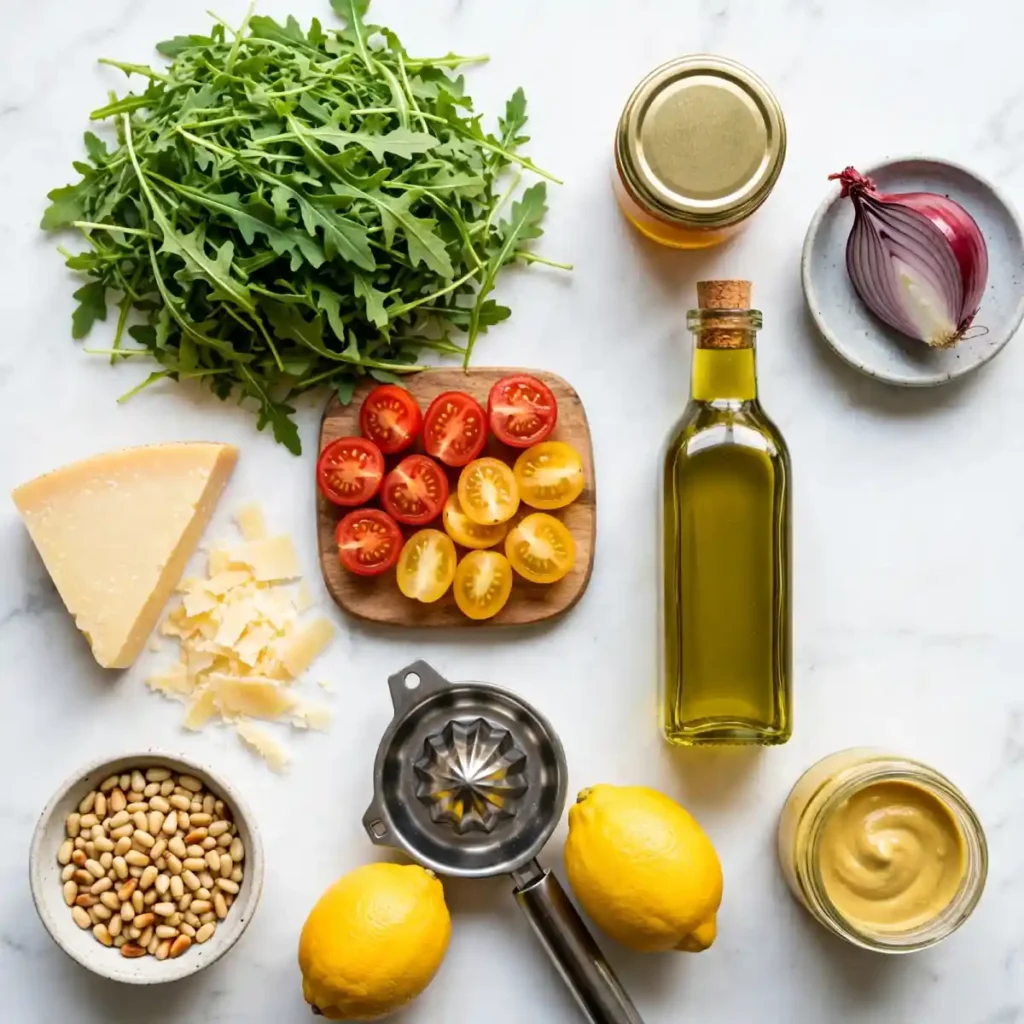
- 120g (about 5 lightly packed cups) fresh arugula, washed and spun very dry — the base; the salad’s character comes from arugula specifically; romaine or spinach don’t produce the same result
- 200g (about 1 1/2 cups) cherry tomatoes, halved — adds sweetness and acidity; a mix of red and yellow tomatoes adds visual variety; use ripe tomatoes for the most flavor
- 50g (about 1/2 cup loosely packed) Parmesan, shaved into thin curls with a vegetable peeler — the salty, nutty richness that balances the arugula’s bitterness
- 40g (about 1/4 cup) pine nuts, toasted in a dry skillet until golden — adds crunch and a warm, buttery nuttiness; walnuts or sliced almonds substitute at the same quantity
- 1/4 small red onion, very thinly sliced — optional; adds a mild sharpness; if using, soak the slices in cold water for 10 minutes then drain to soften the raw onion’s bite
The Lemon Dressing:
- 3 tablespoons fresh lemon juice (from about 1.5 large lemons) — the primary acid; more than the oil to suit arugula’s character
- 3 tablespoons good-quality extra virgin olive oil — the fat base of the dressing; use one with a mild, fruity flavor rather than a sharp, grassy one, which can fight with the arugula’s bitterness
- 1 teaspoon Dijon mustard — the emulsifier; keeps the dressing cohesive rather than separating into lemon and oil layers on the leaves; also adds a mild sharpness
- 1 small garlic clove, finely minced or grated on a Microplane — optional; adds aromatic depth; grating produces a finer dispersion than mincing
- 1/2 teaspoon honey or maple syrup — balances the lemon’s sharpness; a small amount prevents the dressing from tasting purely acidic without making it noticeably sweet
- 1/4 teaspoon fine salt
- 1/8 teaspoon freshly ground black pepper
Allergen and Dietary Disclosure
This arugula salad contains dairy (Parmesan) and tree nuts (pine nuts). It is naturally gluten-free, egg-free, and vegetarian.
For dairy-free or vegan: omit the Parmesan entirely, or replace with 2 tablespoons of nutritional yeast flakes scattered across the dressed salad for a comparable savory, umami depth without dairy. The salad is entirely satisfying without cheese if the dressing is well-seasoned. Confirm the honey substitution with maple syrup for strict vegan compliance.
For nut-free: omit the pine nuts and replace with 2 tablespoons of toasted pumpkin seeds (pepitas) or toasted sunflower seeds. Both provide a comparable crunch and a mild nuttiness without tree nuts. Toast them in the same dry skillet for 2 to 3 minutes over medium-low heat.
This recipe has not been tested in a certified allergen-free kitchen and cannot be guaranteed safe for any specific allergy.
Step-by-Step Directions
Step 1: Toast the Pine Nuts
Place the pine nuts in a dry skillet over medium-low heat. Stir or shake the pan continuously for 2 to 3 minutes until the nuts turn a consistent, warm golden-brown across their surfaces and the kitchen smells toasted and slightly buttery. Remove from the heat immediately and transfer to a plate or small bowl; pine nuts left in the hot pan continue toasting even off the heat and can go from golden to burnt in under a minute.
Allow the toasted pine nuts to cool completely before adding them to the salad; warm pine nuts wilt the arugula on contact.

Chef’s Note: The difference between raw and toasted pine nuts in this salad is not subtle. Raw pine nuts have a mild, slightly waxy flavor that contributes almost no detectable note to the finished bowl; toasted pine nuts develop dozens of Maillard browning compounds from their high fat content and amino acids that produce a warm, distinctly nutty, almost buttery character. That character is one of the three major flavor contrasts in this salad alongside the lemon’s acidity and the arugula’s bitterness. Skipping or rushing the toasting step removes one of the salad’s most important textural and flavor contributions.
Step 2: Make the Lemon Dressing
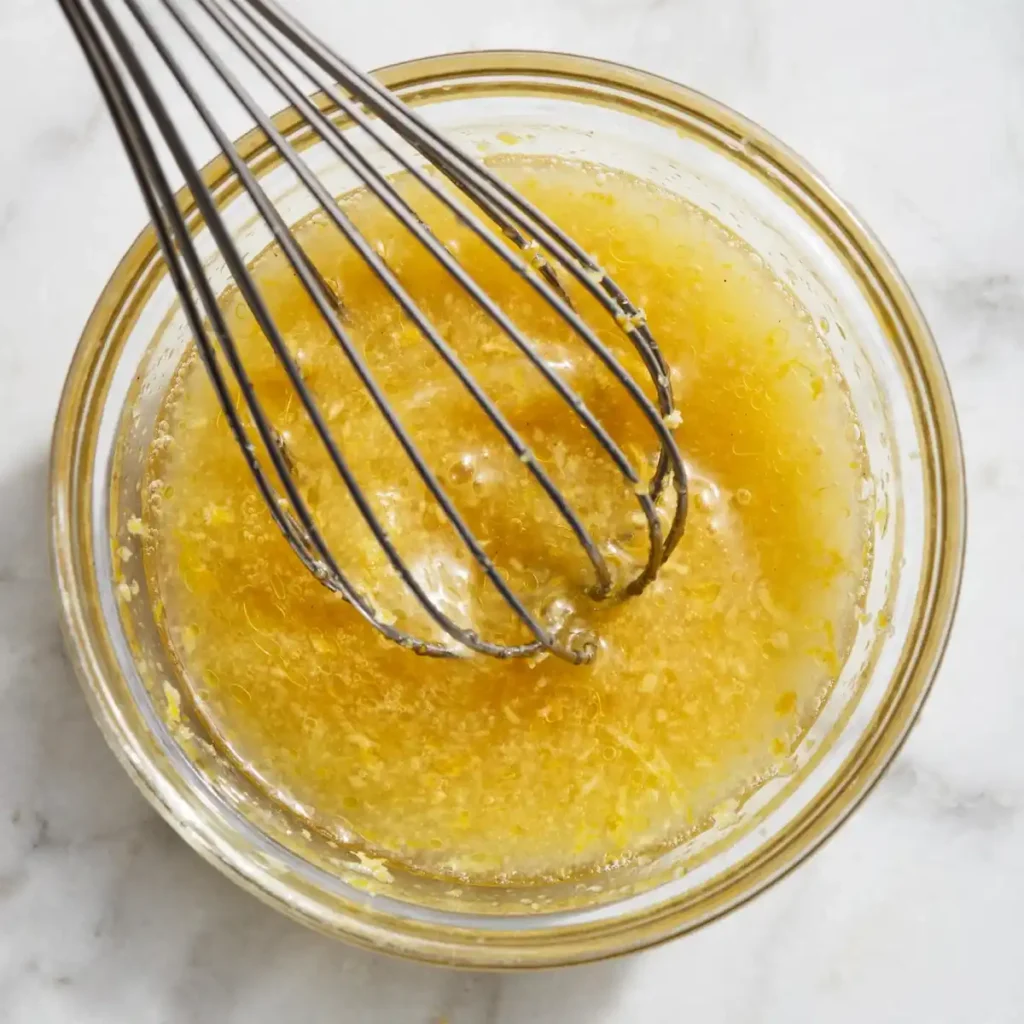
Combine the fresh lemon juice, Dijon mustard, optional garlic, honey or maple syrup, salt, and black pepper in a small jar with a tight-fitting lid or in a small bowl. Whisk or shake vigorously for 20 to 30 seconds until the mustard has fully dissolved into the lemon juice and the mixture looks uniform. Add the extra virgin olive oil and whisk or shake again for 20 seconds until the dressing is emulsified into a slightly cloudy, cohesive liquid that doesn’t immediately separate.
Taste the dressing on a single arugula leaf rather than on its own; it should taste bright and lemony with a clean finish and enough salt to season the leaves without tasting salty in isolation.
Chef’s Note: Whisking the mustard into the lemon juice before the oil is added is the sequencing that produces a stable dressing. Dijon mustard contains mucilage (a natural emulsifying agent from mustard seeds) that coats the oil droplets when they’re introduced to the acidic lemon environment, preventing them from coalescing back into a separate oil layer. Adding the mustard after the oil is already in the bowl reduces its emulsifying effectiveness significantly because the oil droplets have already begun separating; the mustard-first sequence produces a dressing that stays cohesive on the dressed leaves for the duration of the meal.
Step 3: Dress the Arugula
Place the washed, completely dry arugula in a wide, large salad bowl. Drizzle approximately two-thirds of the dressing over the leaves. Using your hands or two large spoons, toss the arugula gently but thoroughly, lifting the leaves from the bottom and folding them over the top rather than pressing down and crushing them. Every leaf should show a light gloss of dressing; underdressed leaves at the bottom of the bowl are the most common sign of insufficient tossing.
Taste a dressed leaf and add more dressing if needed; the salad should taste bright and lightly seasoned rather than wet or heavy. Reserve any remaining dressing for drizzling over the finished bowl or using within 5 days.
Chef’s Note: Dressing the arugula with your hands rather than spoons produces a more evenly coated result because hands can feel where dry spots are and gently coax the dressing into contact with every leaf without breaking the arugula’s delicate texture. The warmth of your hands also very slightly softens the dressing’s olive oil, helping it coat the leaves more evenly. This technique works for any delicate green salad and is worth the minor inconvenience of slightly oily hands.
Step 4: Assemble and Serve
Arrange the dressed arugula in the serving bowl or on individual plates. Scatter the halved cherry tomatoes across the leaves, distributing them evenly so each portion gets both. Add the red onion slices if using. Scatter the shaved Parmesan curls across the top, using a light hand to distribute them broadly rather than piling them in the center. Finish with the toasted pine nuts scattered across the entire surface.
Serve immediately; arugula dressed with lemon wilts noticeably within 5 to 8 minutes and the dressed salad’s texture is at its best in the first few minutes after assembly.
Variations and Substitutions
- Arugula salad with strawberries and balsamic: Replace the cherry tomatoes with 150g of fresh strawberries, hulled and quartered, and substitute the lemon dressing with a simple balsamic vinaigrette (2 tablespoons balsamic vinegar, 3 tablespoons olive oil, 1 teaspoon honey, 1/4 teaspoon Dijon). The strawberries’ sweetness against the arugula’s bitterness and balsamic’s depth produces a spring and summer version that works particularly well for a first course at a dinner party.
- Arugula and roasted beet salad: Add 2 medium beets roasted at 200°C for 45 minutes, peeled and sliced, to the finished salad. The beets’ earthy sweetness is one of arugula’s best pairings; replace the pine nuts with 40g of crumbled goat cheese for a version that covers sweet, bitter, creamy, and tangy in every bite.
- Arugula salad with white beans: Drain and rinse one 400g can of cannellini beans and add them to the dressed arugula before assembling. The beans transform the side salad into a light vegetarian main by adding protein and substance without changing the dressing or the character of the bowl. Season the beans separately with a pinch of salt and a squeeze of lemon before adding.
- Arugula salad with grilled peaches: Halve 2 ripe peaches, brush lightly with olive oil, and grill cut-side down for 2 to 3 minutes until caramelized and slightly charred. Slice and add to the arugula with the standard lemon dressing. The caramelized peach adds a sweet, slightly smoky counterpoint to the peppery leaves that is particularly good in late summer when peaches are at their ripest.
- Arugula salad with avocado: Add 1 ripe avocado, halved, pitted, and sliced into 1cm pieces, scattered across the dressed leaves alongside the tomatoes. The avocado’s creamy, buttery texture softens the arugula’s bite and adds a richness that makes the salad feel more substantial; squeeze a small amount of extra lemon over the avocado pieces after slicing to prevent browning.
- Nut-free arugula salad: Replace the pine nuts with 2 tablespoons of toasted pumpkin seeds for a nut-free version that retains the crunch and savory element. The pumpkin seeds have a milder, slightly earthier flavor than pine nuts; increase the Parmesan quantity slightly to compensate for the reduced nuttiness.
Serving Suggestions
- Serve immediately after assembling; arugula dressed with an acidic lemon dressing begins wilting within 5 to 8 minutes and the textural contrast between the crisp leaves and the dressed bowl is at its peak in the first few minutes. If serving at a gathering, dress and assemble at the table rather than in the kitchen 10 minutes before.
- Serve alongside grilled or pan-seared chicken thighs, fish fillets, or lamb chops; the arugula salad’s sharpness cuts through the richness of the protein and refreshes the palate between bites in a way that a milder green salad doesn’t.
- Plate as a starter before pasta; the salad’s acidity primes the palate for the richness of cream or tomato-based sauces and makes the first bite of pasta taste more vivid. Place the salad bowl in the center of the table and let people serve themselves.
- Serve on top of a wood-fired or oven-baked flatbread straight from the oven; the arugula wilts slightly against the warm bread, the cheese melts at the edges, and the combination of hot bread, cool peppery arugula, and lemon dressing is a genuinely satisfying light meal.
- Use as a bed for a whole seared salmon fillet placed on top; the salmon’s warm, fatty richness against the cool, lemony arugula below is a classic combination that requires no additional sauce or dressing on the fish.
- Pair with cold sparkling water with lemon or a cold pressed apple and ginger juice; both light, slightly acidic drinks echo the salad’s lemon dressing and clean the palate without competing with the arugula’s flavors.
Tips for the Best Results
- Dry the arugula completely before dressing. This is the most practically impactful step in the entire recipe. Water clinging to arugula leaves dilutes the dressing on contact; a salad made with wet leaves tastes watered down even when the dressing is well-seasoned. Spin the washed arugula in a salad spinner until no visible water drops remain, then lay the leaves on a clean kitchen towel for 2 to 3 minutes to absorb any residual surface moisture. The difference between a wet-leaf and a dry-leaf arugula salad dressed with the same dressing is immediately noticeable.
- Taste the dressing on a leaf rather than on a spoon. Dressing tasted alone is always sharper and saltier than it will be on leaves; a dressing that tastes perfectly balanced on a spoon may taste underseasoned on a pile of peppery arugula because the leaves absorb some of the salt and acid. Dip one arugula leaf in the dressing, eat it, and adjust salt, lemon, or honey based on that single dressed leaf rather than the dressing in isolation.
- Shave the Parmesan fresh immediately before serving. Parmesan curls begin drying at their edges within 10 to 15 minutes of shaving; dry curls don’t adhere to the dressed leaves and sit separately in the bowl rather than melding with the other components. Shave directly from the block onto the assembled salad in the final 30 seconds before serving, not before.
- Use a wide, shallow bowl rather than a deep bowl. Arugula is a loose, airy green that needs horizontal space to stay light and uncrushed; a deep bowl compresses the leaves at the bottom under the weight of the leaves above, producing a flattened, slightly dense base and an overdressed bottom layer. A wide, shallow salad bowl or a platter produces a more even, light result.
- Add the toasted pine nuts at the very end. Pine nuts added to the dressed arugula before tossing get coated in dressing and lose their crunch; scattered on top after assembly they stay dry and retain the textural contrast that makes them worth including.
Storage Tips
Refrigerator
Dressed arugula salad does not store well and should not be refrigerated after dressing; the acid wilts the leaves within 20 to 30 minutes and the salad becomes soggy and unpleasant. If you need to prepare ahead, store the components separately: washed and dried arugula in a sealed container lined with a dry paper towel (which absorbs any residual moisture during storage) for up to 2 days; halved tomatoes in a small sealed container at room temperature (not refrigerator; cold tomatoes lose their flavor rapidly and become mealy); toasted pine nuts in a small sealed container at room temperature for up to 5 days; shaved Parmesan in a sealed container refrigerated for up to 3 days. Assemble and dress only at serving time.
Freezer
Arugula salad components are not suitable for freezing. Fresh arugula loses its texture completely on thawing; Parmesan curls and tomatoes also deteriorate. Store components as described above and assemble fresh.
Reheating
This salad is served at room temperature, not reheated. Bring refrigerated arugula to room temperature for 5 to 10 minutes before assembling if it was stored in the refrigerator; cold arugula tastes less vivid than room-temperature arugula and the dressing doesn’t coat the leaves as evenly at refrigerator temperature.
Make-ahead note: The lemon dressing is the most practical component to make ahead. Combine all dressing ingredients except the olive oil, store in a small jar refrigerated for up to 5 days, and add the olive oil and shake to emulsify immediately before using. The dressing’s emulsification is freshest right after the oil is added; pre-emulsified dressing stored with the oil can separate in the refrigerator but shakes back together easily.
Why This Recipe Works
The specific lemon-to-oil ratio in this dressing (1:1 rather than the typical 1:3 vinaigrette ratio) is not an accident; it’s the ratio calibrated to arugula’s particular flavor chemistry. Arugula’s bitterness comes primarily from glucosinolates, the same sulfur-containing compounds found in broccoli and mustard greens. These compounds interact with the perception of other flavors at the palate; at low acid concentrations, glucosinolates produce a bitterness that reads as harsh and dominant because the acid isn’t sufficient to shift the palate’s attention. At higher acid concentrations, the same glucosinolates read as a pleasant, clean bitterness that sits in the background of a vivid lemon-forward flavor rather than occupying the foreground. The 1:1 ratio provides enough acid to shift this perception without making the dressing sourness the dominant note.
The Dijon mustard’s role in the dressing is chemical rather than primarily flavoring. Mustard seeds contain mucilage, a complex polysaccharide that behaves as a natural surfactant at the oil-water interface in the emulsified dressing. When whisked into the acidic lemon juice before the oil is added, the mucilage molecules distribute throughout the aqueous phase; when oil is then incorporated, they insert their hydrophobic segments into the oil droplets and their hydrophilic segments into the surrounding lemon juice, physically preventing the oil droplets from merging and separating. This is a more stable emulsification mechanism than simply vigorous whisking alone; the mustard’s surfactant properties keep the dressing cohesive at room temperature without refrigeration for the duration of a meal.
Toasting pine nuts through Maillard browning is the technique that transforms them from a mild filler to a genuine flavor contributor. Pine nuts have an unusually high fat content of approximately 68% by weight, primarily oleic acid and linoleic acid, alongside a moderate amino acid content. When these components reach approximately 140 to 150°C in a dry pan, the amino acids react with the oxidizing fatty acids through Maillard-adjacent reactions rather than the classic sugar-amino acid Maillard pathway; the resulting compounds include pyrazines, furanones, and various carbonyl compounds that produce the characteristic warm, nutty, slightly buttery aroma that raw pine nuts entirely lack. At the same temperature the surface fats also undergo early oxidative browning that produces additional aromatic compounds. The combined effect converts a neutral-tasting ingredient into one that contributes a distinct, identifiable flavor note.
Drying the arugula completely before dressing addresses a dilution problem that affects the dressing’s emulsification as much as its flavor. When the dressed dressing contacts water on the leaf surface, the water molecules preferentially associate with the lemon juice’s aqueous phase and physically dilute the dressing’s acid and salt concentration on that leaf. This dilution affects flavor perception directly, producing a less vivid, less well-seasoned dressed leaf than the same amount of dressing on a dry leaf. The water also disrupts the mustard emulsion locally by flooding the oil-water interface with excess water molecules, causing the dressing to visually break into separate oil spots and watery liquid on the leaf surface; this is the watery pool at the bottom of an improperly dried green salad.
Shaving Parmesan into curls rather than grating it finely produces a different interaction with the dressed leaves. A finely grated Parmesan dissolves into the dressing and distributes its flavor through the liquid phase of the salad; each bite of arugula tastes uniformly of the dressing’s enhanced saltiness rather than encountering distinct pockets of cheese flavor. Parmesan curls remain solid and distinct among the dressed leaves; each bite that includes a curl delivers a concentrated burst of salty, umami, slightly crystalline Parmesan against the more liquid-coated arugula around it. This textural and flavor contrast, present in one bite and absent in the next, makes the salad more interesting to eat than a uniform distribution of grated cheese would produce.
Frequently Asked Questions
Can I make arugula salad ahead of time?
Dress and assemble only at serving time; dressed arugula wilts within 20 to 30 minutes and doesn’t recover. Prepare each component separately ahead: washed, dried arugula keeps in a sealed container lined with a paper towel in the refrigerator for up to 2 days; the lemon dressing keeps refrigerated without the oil for up to 5 days (add oil and shake immediately before using); toasted pine nuts keep at room temperature in a sealed container for up to 5 days. Assembly takes under 3 minutes from pre-prepared components.
Why does my arugula salad taste watery?
Watery arugula salad comes from wet leaves at the time of dressing. Fresh arugula holds a surprising amount of water in its leaf structure; spin in a salad spinner until no drops are visible, then lay on a kitchen towel for 2 to 3 minutes to absorb surface moisture before dressing. A wet leaf dilutes the dressing on contact and causes the broken dressing to pool at the bottom of the bowl. The fix is entirely in the drying step; it cannot be corrected by adding more dressing after assembly.
What can I substitute for pine nuts?
Toasted walnuts roughly chopped, sliced almonds toasted in the same dry skillet, or toasted pumpkin seeds (for a nut-free option) all substitute at the same 40g quantity. Each has a slightly different flavor: walnuts are earthier and slightly bitter, which works well with arugula’s bitterness; almonds are milder and crunchier; pumpkin seeds are the most neutral. Toast any of these substitutes in a dry skillet using the same 2 to 3 minute method as pine nuts.
How do I know when the arugula is fresh enough to use?
Fresh arugula leaves should be a vivid, deep green throughout with no yellowing or browning at the edges and no slimy or wet patches. The leaves should smell clean and peppery when a small bunch is crushed; fresh arugula has a distinctive mustardy, peppery scent. Leaves that smell flat or slightly fermented are past their prime. The peppery bite in a raw leaf is the most reliable freshness indicator: fresh arugula stings pleasantly at the back of the throat; old arugula is flat and bland.
Is arugula salad gluten-free?
Yes, this arugula salad recipe is naturally gluten-free as written. Arugula, Parmesan, pine nuts, cherry tomatoes, lemon juice, olive oil, Dijon mustard, honey, and garlic are all inherently gluten-free. Verify the Dijon mustard label if strict compliance is needed; some Dijon brands add small quantities of wheat flour as a stabilizer, though most standard varieties are gluten-free. The salad is also naturally egg-free and can be made dairy-free by omitting the Parmesan.
Why is my arugula so bitter that it’s unpleasant?
Arugula’s pleasant bitterness intensifies when the leaves are very mature; younger, smaller leaves are milder and sweeter, while large, fully mature arugula can be too assertive for some palates. If the arugula tastes unpleasantly harsh on its own, dilute it by mixing with an equal volume of baby spinach or mixed spring greens; the milder greens soften the bitterness to a manageable level while preserving the peppery character. Increasing the honey in the dressing slightly also reduces the perception of bitterness without making the salad taste sweet.
Can I use a different cheese instead of Parmesan?
Yes. Shaved Pecorino Romano is the most natural substitute; it’s slightly saltier and more intensely sheepy in flavor but pairs very well with arugula and lemon. A good-quality aged Manchego shaved into curls is a milder, nuttier option. Crumbled feta scattered rather than shaved provides a creamier, saltier, briny counterpoint that works particularly well in the strawberry and balsamic variation. For the classic Italian-American arugula salad character, stay with Parmesan or Pecorino Romano.
Conclusion
Arugula salad rewards the effort of using it rather than a neutral green because the leaves are already doing the work. The bitterness, the peppery sting, the slight brightness at the edges; these things don’t need to be coaxed out or added. They just need a dressing calibrated to work with them rather than against them, and a few components that provide contrast rather than competition.
The 10-minute timeline is genuine. The technique is simply drying the leaves, making the dressing, toasting the pine nuts, and assembling in the last moment before serving. Done in that order, with those proportions, the arugula salad lands as something that tastes worth making rather than worth opening a bag for.
If you loved this recipe, save it to your easy salad recipes and Italian-inspired side dishes Pinterest board so you can find it easily later. For more same recipes must follow Thecookingvibes Pinterest account.
Arugula Salad
Ingredients
Equipment
Method
- Toast pine nuts in a dry skillet over medium-low heat with continuous stirring for 2 to 3 minutes until golden-brown and smelling nutty. Transfer immediately to a plate; cool completely before using.
- Combine lemon juice, Dijon mustard, optional garlic, honey, salt, and pepper in a small jar or bowl. Whisk until the mustard dissolves and the mixture is uniform. Add olive oil and whisk or shake vigorously for 20 seconds until emulsified and slightly cloudy. Taste on a single arugula leaf and adjust salt or lemon.
- Place completely dry arugula in a wide salad bowl. Add two-thirds of the dressing. Toss gently, lifting from the bottom, until every leaf shows a light gloss. Taste and add more dressing if needed.
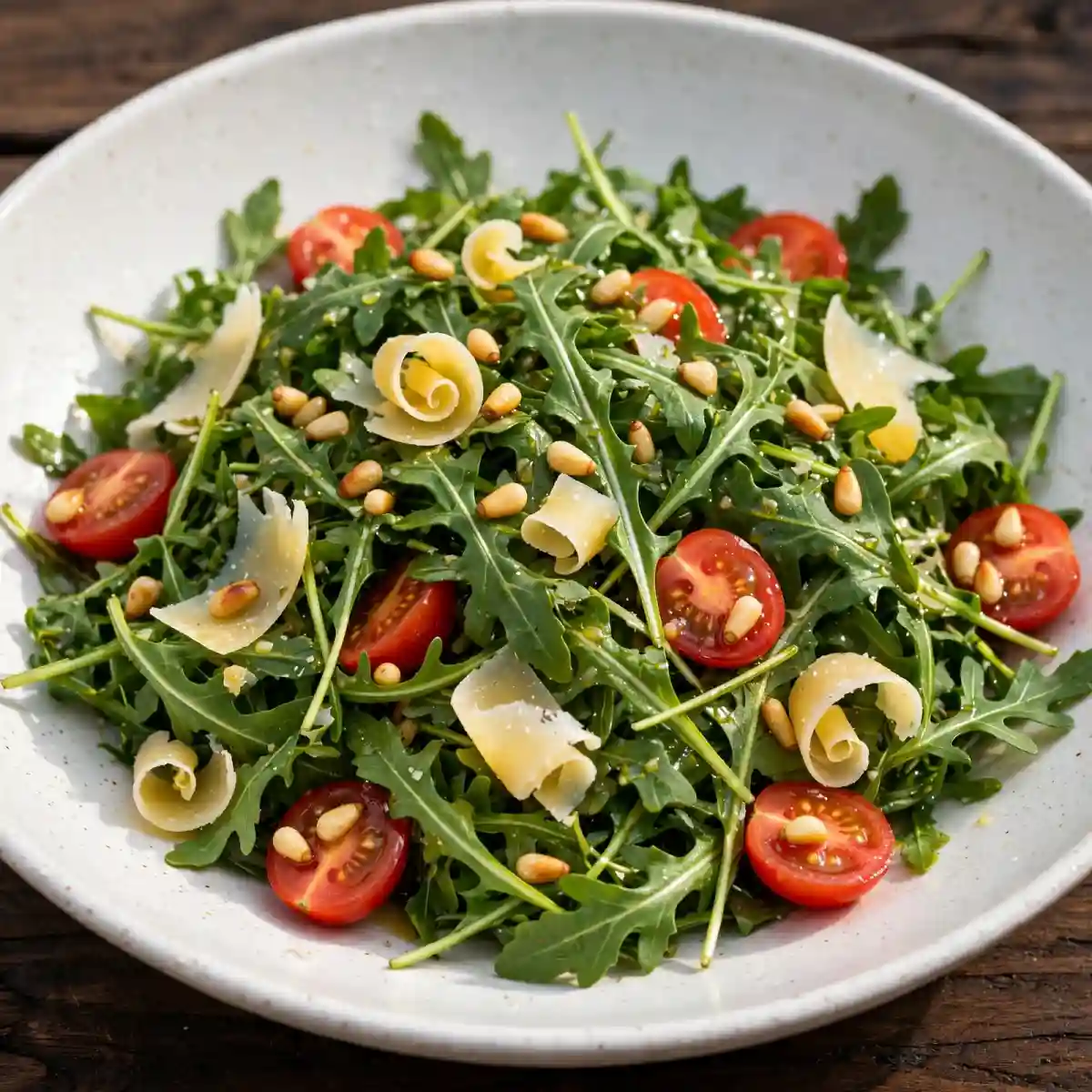
- Scatter halved cherry tomatoes and optional red onion across the dressed arugula. Drape shaved Parmesan curls broadly across the surface. Finish with the cooled toasted pine nuts scattered over everything.
- Serve immediately.
Notes
- Completely dry arugula before dressing is non-negotiable; wet leaves dilute the dressing and cause it to pool at the bowl’s base.
- Taste the dressing on a leaf rather than on a spoon; the seasoning balance reads differently when it’s actually coating arugula.
- Shave Parmesan immediately before serving; curls begin drying within 10 to 15 minutes and lose their texture.
- Scatter pine nuts on top after assembly so they stay dry and crunchy rather than getting coated in dressing.
- Allergens: Contains dairy (Parmesan) and tree nuts (pine nuts). Naturally gluten-free, egg-free, and vegetarian. This recipe has not been tested in a certified allergen-free kitchen and cannot be guaranteed safe for any specific allergy.