Homemade Baked Beans — Smoky, Sweet, Tangy, Slow-Baked
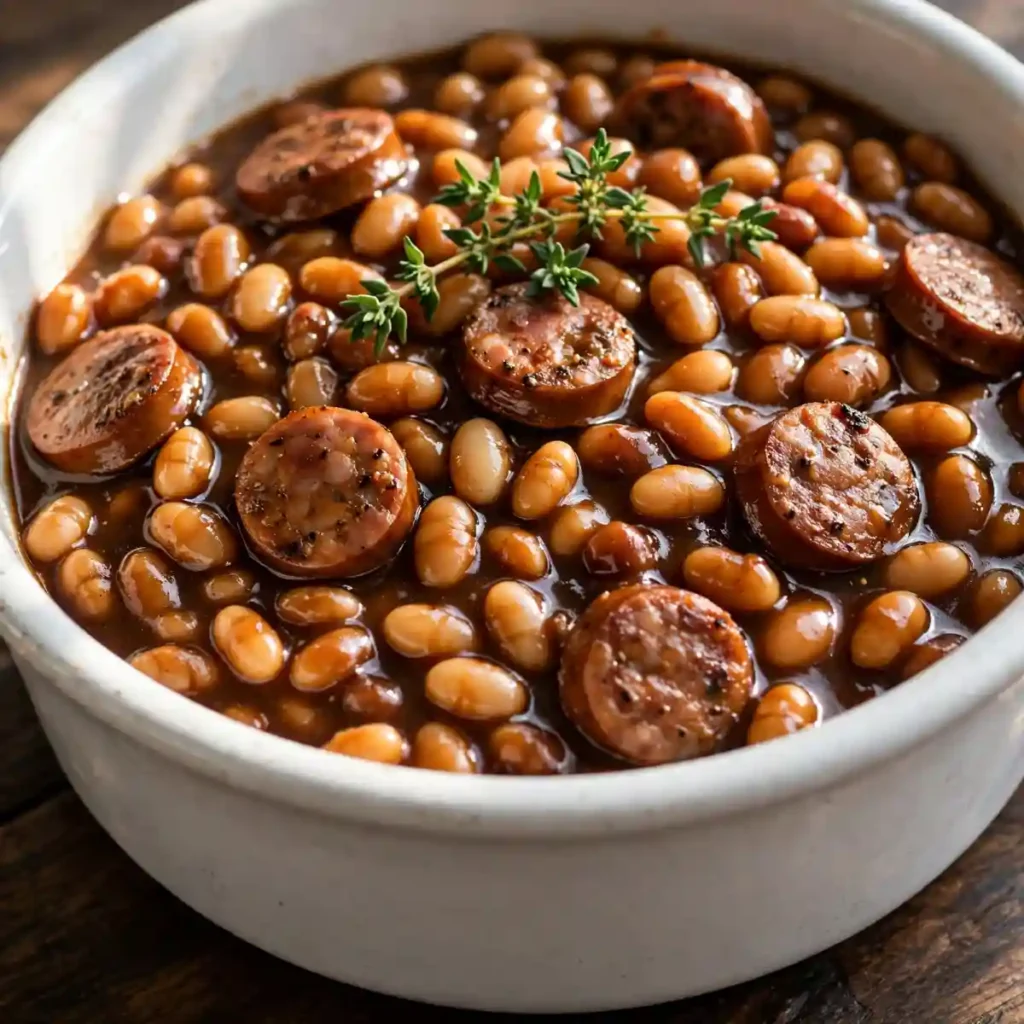
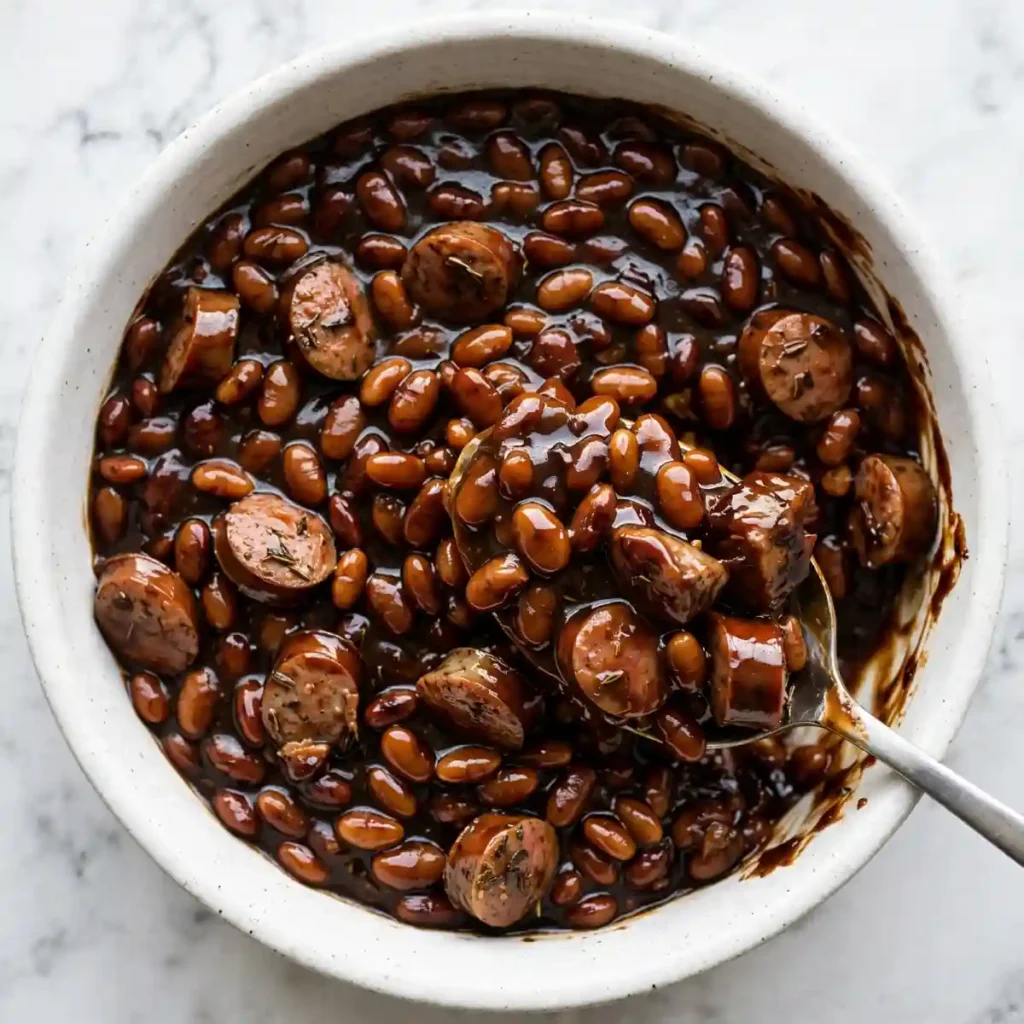
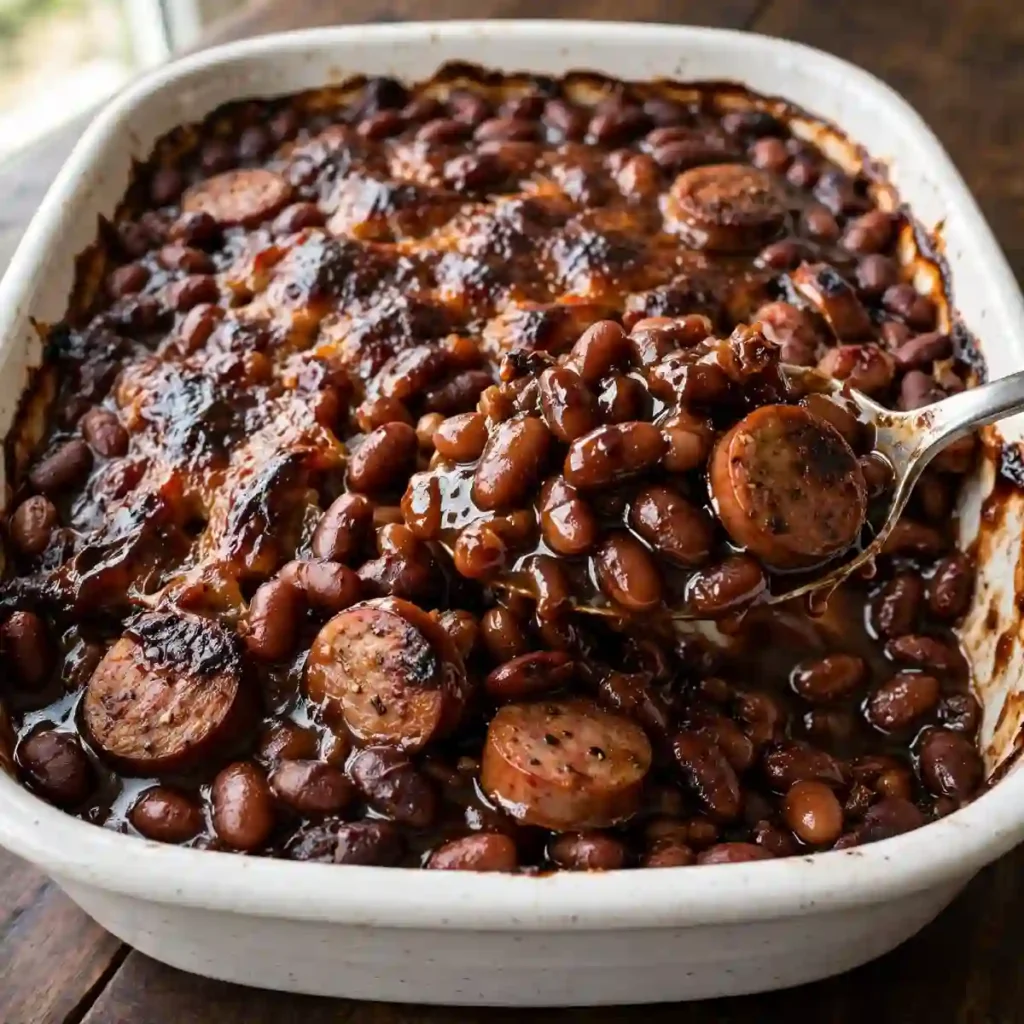
Open a pot of properly made baked beans after three hours in the oven and the smell that comes out is specific and unmistakable: deep, molasses-sweet, smoky, and savory all at the same time, with the kind of concentrated richness that only long, slow cooking produces. The beans at the bottom of the pot have absorbed the sauce entirely; the ones near the surface are coated in something almost lacquered, thick and slightly caramelized where it touched the hot casserole walls. This is the version worth making from scratch rather than opening a can.
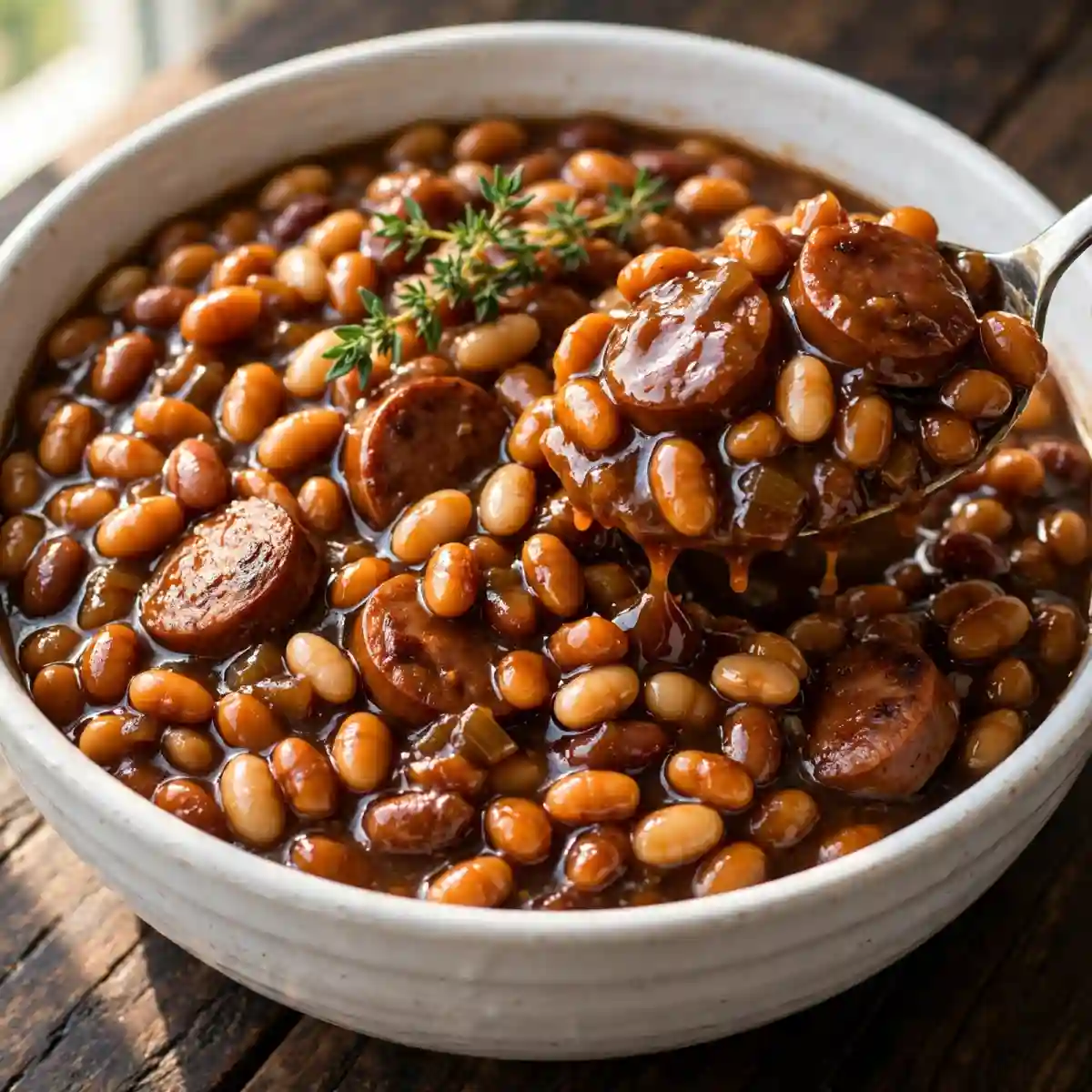
This baked beans recipe starts with navy beans soaked overnight, par-cooked until just tender, then slow-baked in a deeply seasoned sauce of tomato, molasses, brown sugar, apple cider vinegar, Dijon mustard, and smoked beef sausage that provides the smoky depth and savory richness the dish is built on. The recipe serves 8 and takes about 4 hours total, most of which is hands-off oven time. It works as a side dish for a summer cookout, a main course served over rice, or made ahead and refrigerated where it genuinely improves over 24 to 48 hours as the sauce continues to develop.
Why You’ll Love These Homemade Baked Beans
- Sauce that’s genuinely thick and lacquered, not watery. The long, slow bake with the lid off for the final hour allows the sauce to reduce and concentrate; the beans at the top of the pot develop a slightly caramelized exterior that no canned version can produce.
- Built-in smokiness from real ingredients. Smoked beef sausage provides a natural, meaty smokiness that integrates into the sauce during the long cook rather than sitting as a separate element; the finished dish tastes cohesive rather than assembled.
- Multiple layers of flavor from the sauce. Molasses, brown sugar, apple cider vinegar, Dijon, and tomato paste each contribute a different dimension: depth, sweetness, acidity, sharpness, and umami respectively; together they produce a sauce that tastes developed rather than simply sweet.
- Better the next day. Refrigerating overnight allows the sauce to fully permeate every bean and the flavors to integrate completely; the day-2 version consistently tastes more cohesive and richly flavored than the fresh-from-the-oven batch.
- Make-ahead friendly for gatherings. The entire dish can be baked up to 3 days in advance and reheated gently; it holds and reheats better than almost any other slow-cooked dish.
Ingredients You’ll Need
Recipe Timing
| Detail | Info |
|---|---|
| Servings | 8 as a side, 4 to 6 as a main |
| Difficulty | Easy to Moderate |
| Course | Side Dish, Main Course |
| Cuisine | American |
| Prep Time | 20 minutes (plus overnight soaking) |
| Cook Time | 3 hours 30 minutes |
| Rest Time | 10 minutes |
| Total Time | 4 hours (plus overnight soak) |
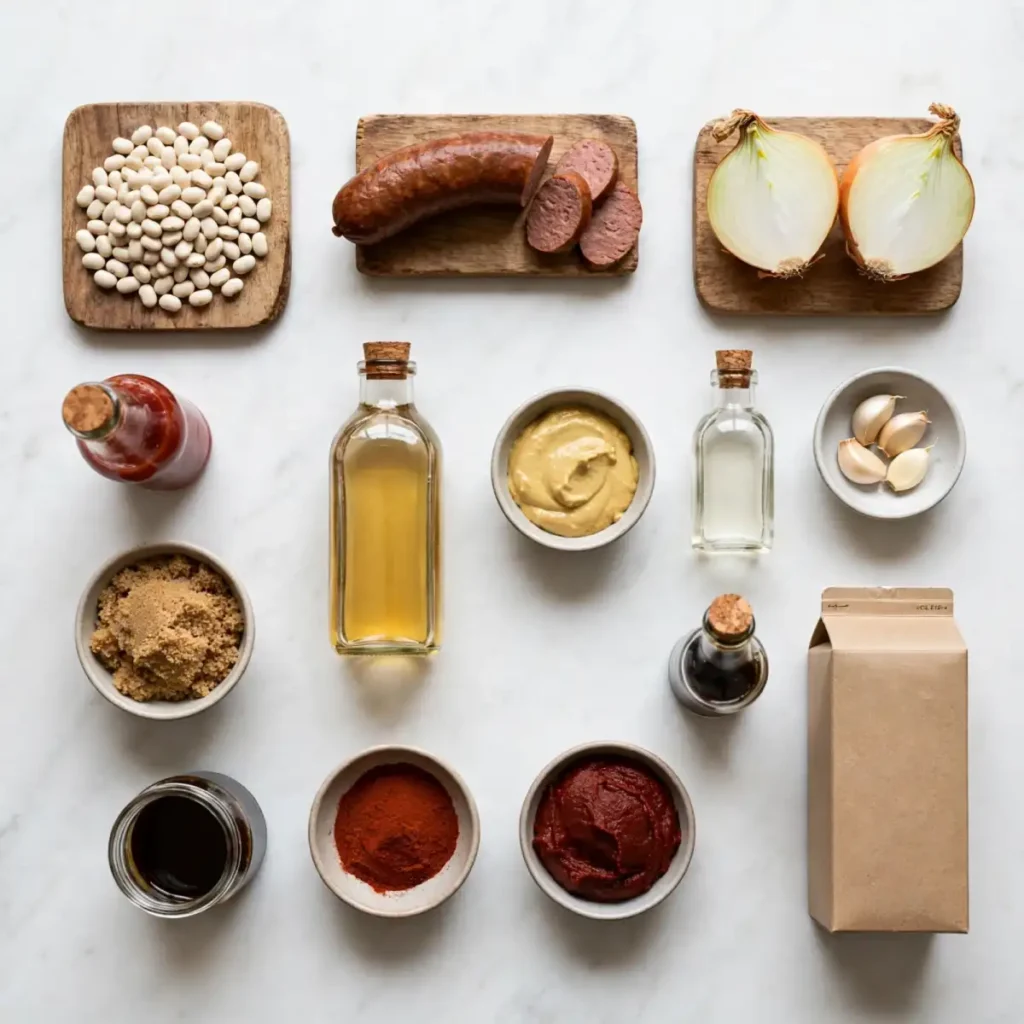
For the beans, dried navy beans are the traditional and best choice for baked beans. They’re small, white, and have a thin skin that allows the sauce to penetrate completely during the long bake while still holding their shape without disintegrating. Great Northern beans are the closest substitute and work very well at the same quantity. Canned beans can be used for a faster version; see the notes at the end of the ingredients section. Avoid kidney beans or chickpeas for this recipe; their firmer texture and thicker skins resist the sauce absorption that makes traditional baked beans so satisfying.
The overnight soak is not strictly optional for dried beans; beans soaked for 8 to 12 hours cook more evenly, have fewer split skins, and require a shorter par-cooking time than unsoaked beans. If time is short, a quick-soak works: cover the dried beans in cold water, bring to a boil, boil for 2 minutes, remove from heat, cover, and let stand for 1 hour; drain and continue with the recipe.
For the smoked beef sausage, choose a fully cooked, smoked variety available at most grocery stores. The sausage provides savory depth and smokiness to the sauce during the long bake; it doesn’t need to be raw since the goal is flavor contribution to the sauce rather than the sausage itself being the star. Slice it into 1 to 1.5cm rounds before adding.
For the molasses, use unsulfured dark molasses rather than blackstrap. Unsulfured dark molasses has a rich, sweet, slightly bitter depth that integrates beautifully with the tomato and mustard; blackstrap molasses is more intensely bitter and can produce a sauce that tastes medicinal rather than deeply sweet-savory.
The Beans:
- 450g (about 2 1/2 cups) dried navy beans, soaked overnight in cold water and drained — the structural base; yields approximately 1kg cooked beans
- Cold water for par-cooking — enough to cover the soaked beans by at least 5cm
The Sauce:
- 200g fully cooked smoked beef sausage, sliced into 1 to 1.5cm rounds — the smoky, savory depth component; its rendered fat carries flavor into the sauce during baking
- 1 large yellow onion, finely diced — adds sweet, savory background flavor that dissolves into the sauce during the long bake
- 4 garlic cloves, finely minced — adds aromatic depth; mellows from sharp to sweet during the extended bake time
- 2 tablespoons olive oil or neutral oil — for sautéing the onion and garlic; also provides a fat medium for the sausage’s flavor to disperse
- 180ml (3/4 cup) tomato ketchup — the base of the sauce; already cooked down and sweetened, it provides acidity and sweetness simultaneously
- 2 tablespoons tomato paste — adds concentrated, umami-rich tomato depth beyond what the ketchup provides
- 3 tablespoons unsulfured dark molasses — the defining sweet-bitter depth note; non-negotiable for the characteristic baked bean flavor
- 3 tablespoons light brown sugar, packed — adds caramelizing sweetness; the molasses in brown sugar contributes additional depth
- 2 tablespoons apple cider vinegar — provides acidity that balances the sweetness of the molasses and brown sugar; the acid brightens the whole sauce
- 1 tablespoon Dijon mustard — adds a sharp, slightly tangy note that prevents the sauce from tasting one-dimensionally sweet
- 1 tablespoon Worcestershire sauce — adds umami depth and a background savory complexity; ensure the brand used is vegetarian-safe if needed, as some contain anchovies
- 1 teaspoon smoked paprika — reinforces the smokiness from the sausage and deepens the sauce’s color
- 1/2 teaspoon ground black pepper
- 1/2 teaspoon fine salt — the beans have no seasoning from their par-cook; adjust at the end of baking
- 240ml (1 cup) water or low-sodium chicken broth — added to ensure adequate liquid for the initial bake; the beans absorb considerable moisture during the long cook
Canned bean shortcut note: Replace the dried beans with 3 cans (400g each) of drained and rinsed navy or cannellini beans. Skip the soaking and par-cooking steps. Reduce the initial bake liquid (water or broth) by half and bake at 160°C (325°F) for 2 to 2.5 hours total, uncovering for the last 45 minutes. The flavor is excellent; the texture is slightly less uniform than the dried bean version since canned beans are already fully cooked before the bake begins.
Allergen and Dietary Disclosure
This baked beans recipe contains no dairy, no eggs, and no nuts as written. It contains gluten if the Worcestershire sauce brand used includes wheat-derived ingredients; verify the label if gluten-free compliance is needed. The smoked beef sausage should be verified gluten-free if strict compliance is required.
For gluten-free: replace the Worcestershire sauce with an equal quantity of certified gluten-free tamari or a certified gluten-free Worcestershire sauce. Verify the smoked beef sausage is labeled gluten-free. All other ingredients are naturally gluten-free.
For vegetarian or vegan: omit the smoked beef sausage entirely and replace the flavor contribution by adding 1 teaspoon of liquid smoke to the sauce and increasing the smoked paprika to 1.5 teaspoons. Replace the chicken broth (if using) with vegetable broth or water. Verify the Worcestershire sauce is vegan; a standard Worcestershire contains anchovies. Coconut aminos at the same quantity is a fully vegan substitute for Worcestershire.
For lower sugar: reduce the brown sugar to 1 tablespoon and the molasses to 1.5 tablespoons. The sauce will be noticeably less sweet and more savory-tangy; increase the apple cider vinegar to 2.5 tablespoons to maintain the acid balance.
This recipe has not been tested in a certified allergen-free kitchen and cannot be guaranteed safe for any specific allergy.
Equipment Needed
- Large 3 to 4-quart heavy-bottomed oven-safe casserole dish or Dutch oven with a lid — the casserole is used both for sautéing on the stovetop and for the full baking period in the oven. A Dutch oven is ideal because its tight-fitting lid retains moisture during the covered baking phase while the heavy walls distribute heat evenly, preventing the beans at the edges from overcooking before the center is done. A regular baking dish covered tightly with foil works as an alternative but produces less even heat distribution.
- Large saucepan — for par-cooking the soaked beans before they go into the sauce. The beans need to cook in a separate pot of water first; par-cooking in the sauce before the bake would over-reduce the sauce and produce tough bean exteriors that resist absorbing it.
- Colander — for draining the soaked beans before par-cooking and the par-cooked beans before adding to the sauce. Reserve 240ml of the par-cooking liquid before draining; this starchy water adds body to the sauce if it becomes too thick during baking.
Step-by-Step Directions
Step 1: Soak and Par-Cook the Beans
The night before, place the dried navy beans in a large bowl and cover with cold water by at least 8cm; the beans absorb a significant amount of water during soaking and swell to roughly double their original size. The next day, drain and rinse the soaked beans.
Place the drained soaked beans in the large saucepan and cover with fresh cold water by at least 5cm. Bring to a full boil over high heat, skimming any foam that rises to the surface during the first few minutes; this foam is dissolved proteins from the beans and removing it produces a cleaner-flavored finished dish. Reduce to a steady simmer and cook uncovered for 45 to 60 minutes until the beans are just tender throughout with no chalky center when a single bean is pressed between two fingers, but still holding their shape without splitting. They should be fully cooked through but not mushy; they’ll continue softening during the long oven bake.
Reserve 240ml (1 cup) of the bean cooking liquid before draining. Drain the cooked beans in a colander and set aside.

Chef’s Note: Par-cooking the beans to just-tender before the sauce is added is the technique that ensures every bean finishes the bake at the same level of doneness. Beans added raw to the sauce would require a much longer bake time, during which the sauce’s acidity and sugar would create a toughening effect on the outer bean skin, preventing full softening even with extended cooking. Par-cooked beans have already softened their skins enough to absorb the sauce freely during the oven phase.
Step 2: Sauté the Aromatics and Sausage
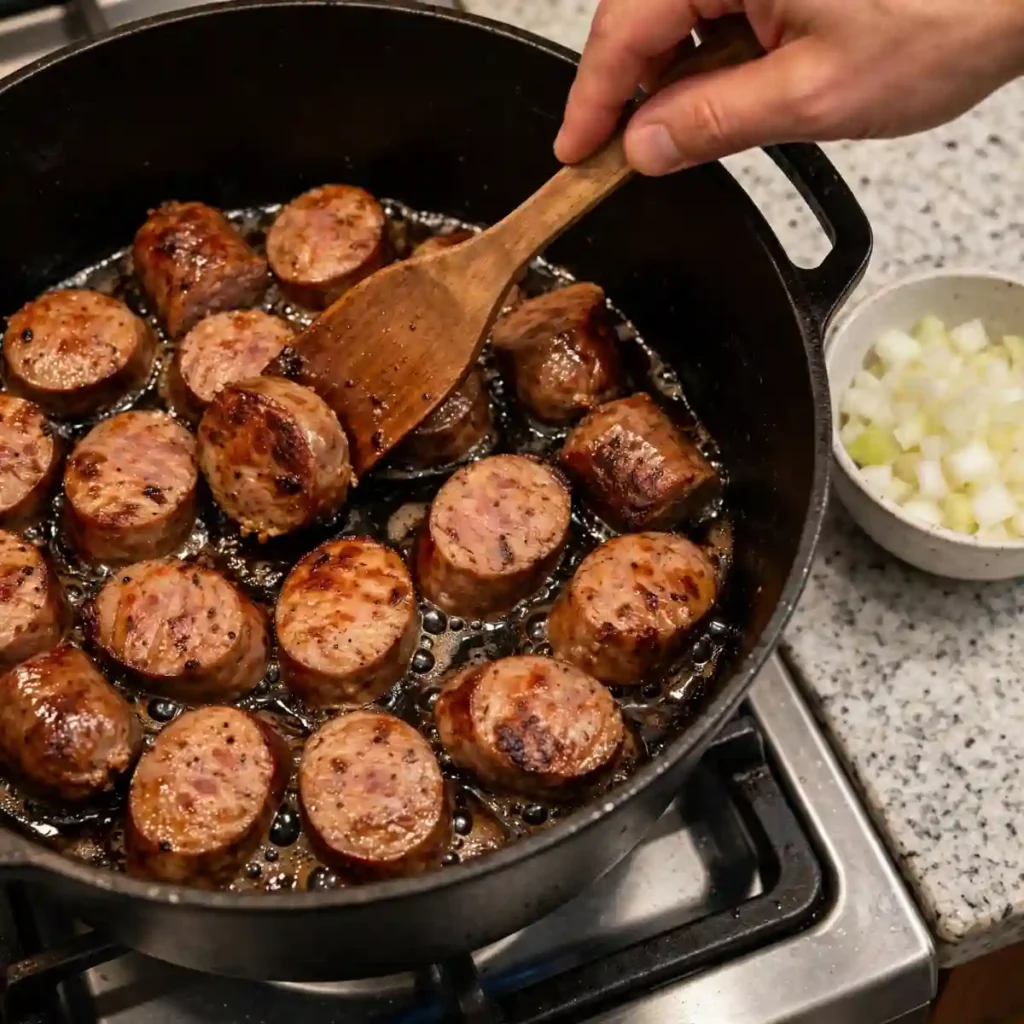
Preheat the oven to 150°C (300°F). Set the Dutch oven or oven-safe casserole over medium heat on the stovetop and add the olive oil. Add the sliced smoked beef sausage and cook for 2 to 3 minutes per side until the slices develop a light golden-brown sear and begin releasing their rendered fat into the pan. The rendered fat from the sausage is the first flavor contribution; it stays in the pan and infuses the aromatics that go in next.
Remove the sausage to a plate and add the diced onion to the same pan with the rendered fat. Cook over medium heat for 5 to 6 minutes, stirring regularly, until the onion has softened completely throughout and turned translucent and slightly golden at the edges. Add the minced garlic and cook for 60 seconds until fragrant.
Chef’s Note: Searing the sausage first before the aromatics accomplishes two things. It develops a light golden crust on the sausage’s exterior through Maillard browning, which produces additional flavor compounds that remain in the finished dish. More importantly, the rendered fat left in the pan is infused with the sausage’s smoked aromatic compounds; sautéing the onion and garlic in this flavored fat carries those smoky notes into the aromatics at the base of the sauce rather than keeping them isolated to the sausage pieces.
Step 3: Build the Sauce
Add the tomato paste to the softened onion and garlic in the pan and stir continuously over medium heat for 60 to 90 seconds until it darkens from bright red to a deeper brick-red color and caramelizes slightly against the pan bottom. This caramelization step converts some of the tomato paste’s raw, slightly sharp flavor into something sweeter and more complex.
Add the ketchup, molasses, brown sugar, apple cider vinegar, Dijon mustard, Worcestershire sauce, smoked paprika, salt, and black pepper. Stir everything together and cook for 2 minutes until the sauce is uniform and beginning to bubble gently. Taste it at this point; it should taste sweet, smoky, and slightly tangy with a noticeable depth from the molasses. The raw flavors will mellow considerably during the long bake, but the overall balance of sweet, acid, and savory should be present in roughly the right proportions.
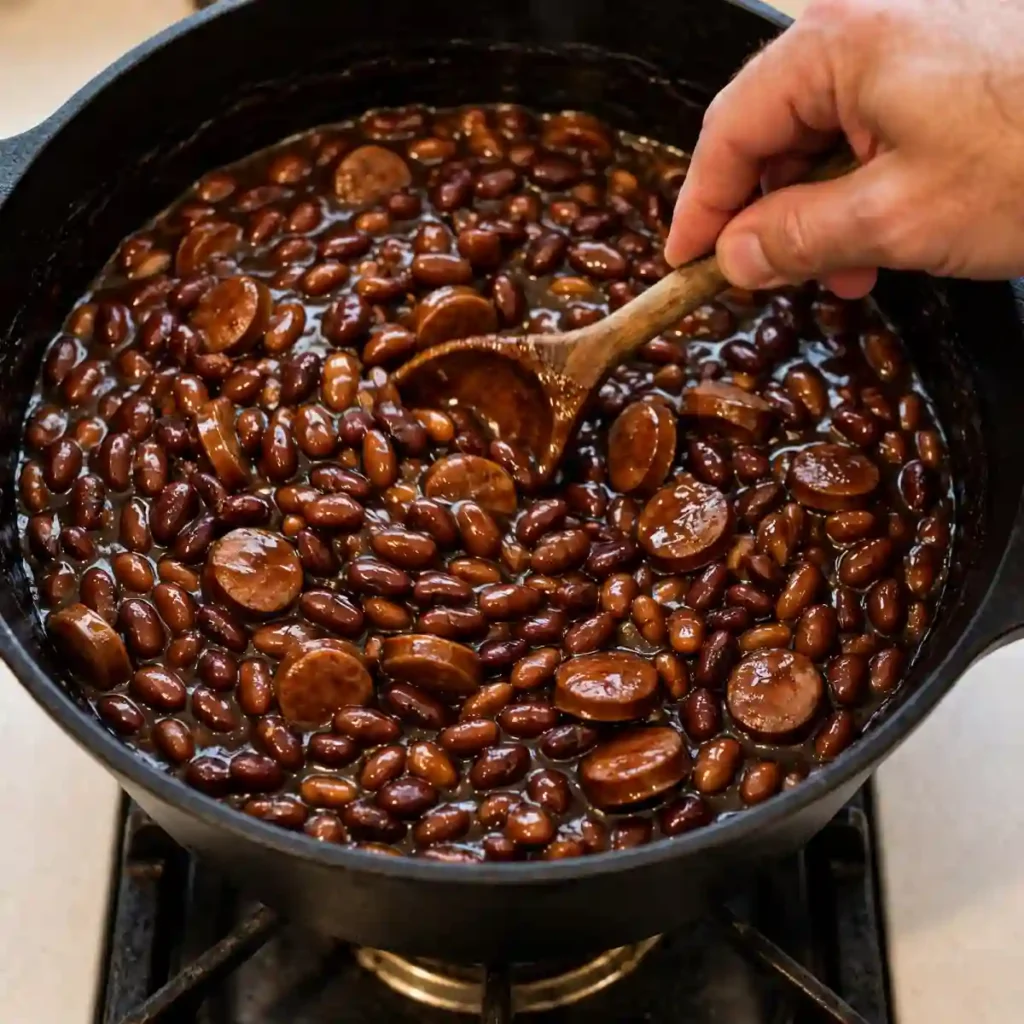
Add the par-cooked beans and the reserved sausage. Pour in the water or chicken broth. Stir to combine everything thoroughly, ensuring the beans are coated in the sauce.
Step 4: Covered Bake
Cover the Dutch oven tightly with its lid and transfer to the preheated 150°C (300°F) oven. Bake covered for 2 hours. During this time the beans continue absorbing the sauce and the flavors meld; check every 45 to 60 minutes and add a splash of water or reserved bean liquid if the sauce looks like it’s reducing too quickly and the beans are threatening to emerge above the liquid level. The beans should remain just barely submerged or at the liquid line during the covered bake; if the sauce becomes very thick before the uncovered phase, the beans on top will dry rather than absorb.
Chef’s Note: The low, 150°C oven temperature is deliberate and not interchangeable with a faster, hotter bake. The beans need gentle, sustained heat to absorb the sauce gradually all the way through each bean rather than having their outer surface harden in a hot oven before the center has had time to soften. At 150°C, the sauce simmers just barely, maintaining the ideal gentle absorption rate.
Step 5: Uncovered Bake for Sauce Concentration
After 2 hours, remove the lid and continue baking uncovered for 1 to 1.5 more hours. The uncovered baking phase allows the sauce to reduce, thicken, and concentrate. The beans at the top of the pot will begin to develop a slightly caramelized, lacquered appearance as the sauce reduces around them. Stir gently once at the 30-minute mark and once at the 60-minute mark during the uncovered phase; stirring too often disrupts the caramelization that forms at the top. The baked beans are ready when the sauce is thick and glossy, coating the beans in a heavy, draping layer rather than a thin watery liquid, and the beans on top look darkened and richly coated.
Step 6: Rest and Serve
Remove the casserole from the oven and allow to rest uncovered for 10 minutes before serving. The sauce continues to thicken during this resting period from residual heat; beans served immediately from the oven often look slightly runnier than those rested for 10 minutes. Taste and adjust salt, pepper, or a small splash of additional apple cider vinegar if the balance has tipped too sweet during the long bake.
Common Mistakes and Troubleshooting
| Problem | Cause | Solution |
|---|---|---|
| Beans still tough after the full bake | Beans under-par-cooked before the sauce, or acid from tomato/vinegar added too early | Par-cook beans until genuinely tender before the sauce; never add acidic ingredients to under-cooked beans |
| Sauce too thin and watery | Too much liquid added, or uncovered bake phase too short | Use only the stated liquid quantity; bake uncovered for the full 1 to 1.5 hours; add no extra water during uncovered phase |
| Sauce too thick and beans drying out | Oven too hot during covered phase, or not enough liquid added initially | Keep covered bake at 150°C; check every 45 minutes and add reserved bean liquid in 60ml increments if needed |
| Beans split and mushy | Par-cooked too long before the sauce, or oven temperature too high | Par-cook only until just-tender; maintain 150°C throughout |
| Sauce tastes too sweet | Molasses and brown sugar ratio too high, or not enough acid | Add apple cider vinegar 1 teaspoon at a time; a pinch of salt also balances perceived sweetness |
| No smoky flavor | Sausage not properly seared, or low-quality sausage used | Sear the sausage properly until browned; ensure it is a genuinely smoked variety, not just flavored |
Variations and Substitutions
- Spicy baked beans: Add 1 to 2 finely diced chipotle peppers in adobo sauce alongside the garlic. The chipotle provides a smoky, earthy heat that works beautifully with the molasses base, adding complexity rather than just heat. Start with 1 pepper, as the heat builds over the long bake. For a milder heat, add 1 teaspoon of cayenne and 1/2 teaspoon of hot sauce to the sauce base instead.
- Boston-style baked beans: This New England classic uses more molasses and less sugar for a more intensely dark, bitter-sweet flavor. Increase the molasses to 5 tablespoons and reduce the brown sugar to 1 tablespoon. Add 1 teaspoon of dry mustard powder alongside the Dijon. The result is darker, denser, and more intensely flavored than the standard version.
- Slow cooker baked beans: Sear the sausage and sauté the onion and garlic on the stovetop, then transfer everything including the par-cooked beans and sauce to a slow cooker. Cook on low for 7 to 8 hours or high for 4 to 5 hours. Remove the lid for the final 30 minutes to allow some liquid to reduce. The slow cooker version produces very tender beans with an excellent sauce; the texture is slightly softer than the oven version.
- Molasses-free version: Replace the molasses entirely with an equal quantity of pure maple syrup. The flavor profile shifts from the characteristic deep, slightly bitter-sweet molasses note to a cleaner, more floral sweetness; the dish is lighter and less intensely flavored but very pleasant. Add an extra tablespoon of apple cider vinegar to compensate for the reduced acidity.
- Bean variety swap: Great Northern beans, cannellini beans, and black-eyed peas all work in place of navy beans at the same quantity with identical preparation. Great Northern and cannellini beans have a creamier texture after the long bake; black-eyed peas produce a more earthy, Southern-style result. Avoid kidney beans, which are too firm and dense for the sauce to penetrate fully during the bake.
- Vegetarian baked beans: Omit the smoked beef sausage entirely and substitute with 1 teaspoon of liquid smoke, 1.5 teaspoons of smoked paprika (total), and 2 tablespoons of soy sauce added to the sauce. The smokiness comes from the liquid smoke, the depth from the soy sauce, and the intensity from the increased paprika. Use vegetable broth and vegan Worcestershire.
Serving Suggestions
- Serve as the central side dish at a summer cookout alongside grilled chicken thighs or beef burgers; the sweet-smoky beans contrast grilled proteins particularly well and the sauce soaks into any bread placed alongside.
- Spoon over thick slices of toasted crusty bread or cornbread for a simple, satisfying main meal that requires nothing else. The beans’ sauce acts as the dressing for the bread in the same way that baked beans on toast is served across the United Kingdom.
- Serve alongside simple coleslaw dressed in apple cider vinegar and a small amount of olive oil; the crunchy, acidic slaw provides textural contrast to the tender, sweet beans and cleanses the palate between bites.
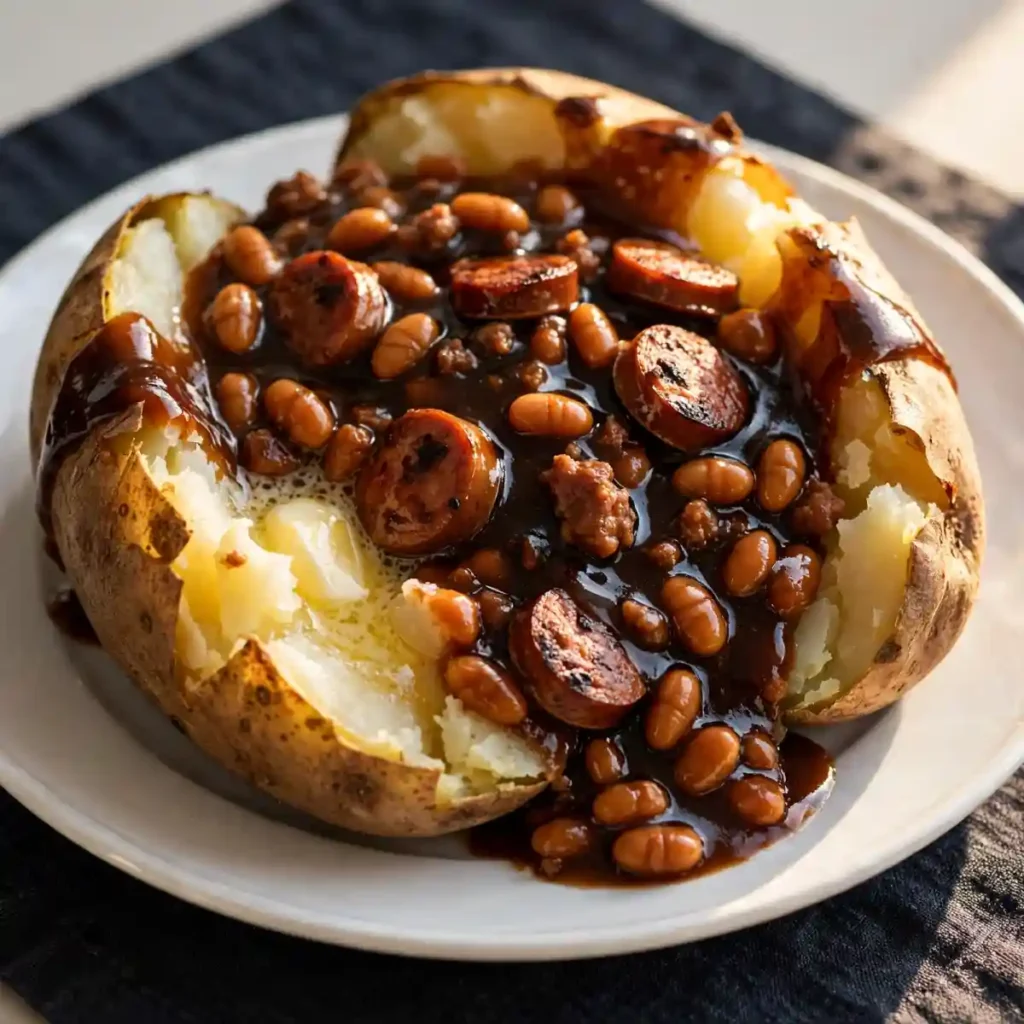
- Use as a filling for jacket potatoes (large baked potatoes split and topped); the bean sauce soaks into the starchy potato interior and the combination is a complete, warming meal without any other component needed.
- Include as part of a full brunch spread alongside scrambled eggs, roasted tomatoes, sautéed mushrooms, and toast. The beans provide the hearty, protein-rich component that makes a full brunch plate feel genuinely filling.
- Pair with cold sparkling water with lemon or a cold pressed apple juice; both provide a clean, slightly sweet-acid contrast to the deep molasses-smoky richness of the beans and refresh the palate between bites.
Tips for the Best Results
- Don’t add acidic ingredients to under-cooked beans. Tomatoes, vinegar, molasses, and ketchup all contain acids that react with the outer cell walls of beans and prevent them from softening further, no matter how long they subsequently cook. This is why the par-cooking step in plain water must produce beans that are genuinely tender before the sauce ever touches them; under-cooked beans added to the acidic sauce will remain tough throughout the entire 3-hour bake regardless of additional time.
- Keep the covered bake temperature genuinely low. Many recipes recommend 165 to 175°C for baked beans; this recipe specifically uses 150°C because the lower temperature allows the beans to absorb the sauce more gradually and thoroughly. At higher temperatures, the outer bean surface sets faster than the interior absorbs the sauce, producing a bean that looks lacquered on the outside but isn’t fully flavored through to the center.
- Reserve the bean par-cooking liquid before draining. This starchy water is the ideal consistency adjuster for the bake if the sauce reduces too aggressively during the covered phase; it thickens more cleanly than plain water because the dissolved starches help the sauce maintain its body rather than thinning it. Set 240ml aside before draining the beans every time.
- Taste the sauce before the beans go into the oven and adjust. The long bake will mellow and integrate the flavors significantly, but it won’t fundamentally change an imbalanced sauce; a sauce that’s too sweet going into the oven will be too sweet coming out. Taste for the balance of sweet, acid, and savory before the casserole is covered; the sauce should taste slightly more assertive than you’d want in the finished dish since the extended heat mellows everything.
- Let the finished beans rest for at least 10 minutes before serving. The sauce continues to thicken from residual heat during this rest period, and the temperature equalizes throughout the casserole so beans at the edges and beans at the center are at the same temperature when served. Serving immediately from the oven often means the beans at the edges are overdone while those in the center are still absorbing.
Storage Tips
Refrigerator
Baked beans keep in the refrigerator in a sealed container for up to 5 days. As mentioned earlier, the flavor genuinely improves between day 1 and day 2 as the sauce continues to permeate every bean and the spice flavors integrate more fully. The sauce also thickens considerably during refrigerator storage; the day-2 version straight from the refrigerator will look much thicker and more concentrated than the fresh-baked version. This is correct; the sauce loosens to the ideal consistency as it heats.
Freezer
Baked beans freeze very well for up to 3 months. Cool completely before freezing; freeze in portion-sized sealed containers or freezer bags laid flat. The beans thaw and reheat almost identically to the fresh version; the texture of the beans holds well through the freeze-thaw cycle because the long bake has already fully broken down the cell structure to a stable, thoroughly cooked state. Thaw overnight in the refrigerator before reheating.
Reheating
Stovetop reheating produces the best result: transfer the refrigerated beans to a saucepan over medium-low heat with 3 to 4 tablespoons of water added per 2 cups of beans. Cover and heat for 6 to 8 minutes, stirring gently every 2 minutes, until the sauce has loosened and the beans are steaming throughout. Microwave reheating at 60% power in 90-second intervals with stirring between works well for single portions; add 1 to 2 tablespoons of water before microwaving to prevent the top layer from drying out.
Make-ahead note: Baked beans are one of the genuinely ideal make-ahead dishes for gatherings. Make the full batch up to 3 days before the event, refrigerate, and reheat gently either on the stovetop or in a 150°C oven covered with foil for 20 to 25 minutes with a splash of water added. The reheated version is indistinguishable from the fresh-baked batch and is often preferred for the deeper, more integrated flavor that develops during refrigerator storage.
Nutrition Information
Per serving, approximately 1/8 of the recipe as a side dish:
| Nutrient | Amount |
|---|---|
| Calories | 320 kcal |
| Protein | 14g |
| Total Carbohydrates | 52g |
| Dietary Fiber | 11g |
| Total Sugar | 22g |
| Total Fat | 7g |
| Saturated Fat | 2g |
| Cholesterol | 20mg |
| Sodium | 580mg |
| Vitamin C | 4mg |
| Calcium | 90mg |
| Iron | 4.2mg |
| Potassium | 680mg |
Nutrition values are approximate and may vary based on sausage brand, molasses type, and exact bean quantity after soaking and cooking.
Why This Recipe Works
The texture superiority of properly made baked beans, tender beans that hold their shape while absorbing the sauce completely throughout, depends on understanding the relationship between bean cell wall chemistry and acid. Bean cell walls are composed primarily of pectin, a polysaccharide that forms the structural gel holding individual cells together. Pectin is stabilized by calcium and magnesium ions naturally present in the bean; at neutral or slightly alkaline pH, these ions cross-link with the pectin chains and maintain a firm cell wall structure. When acidic ingredients such as tomatoes, vinegar, or molasses are added to beans before they are fully cooked, the low pH environment (below approximately 5.0) promotes calcium ion release from the pectin cross-links and alters the cross-link geometry in a way that paradoxically stiffens the outer cell wall rather than softening it. This is why beans cooked directly in acidic sauce often remain stubbornly tough even after hours of cooking; the acid has locked the outer cell wall in a toughened state. Par-cooking in plain water allows full hydration and softening to occur at a neutral pH before the acid is introduced; at this point the beans are cooked through and the subsequent acid exposure cannot reverse the softening that already occurred.
The 150°C bake temperature’s effect on sauce absorption is directly related to osmosis and diffusion rates in the bean’s cellular interior. At 150°C, the sauce surrounding each bean is at a gentle simmer (approximately 95 to 97°C inside the covered casserole). At this temperature, the difference in solute concentration between the bean’s interior and the surrounding sauce drives a slow, steady diffusion of the sauce’s sugar, salt, and flavor molecules into the bean through the now-permeable cell walls. This process is slow and even at 97°C; at a higher casserole temperature (achieving 100 to 103°C inside), the more vigorous boiling disrupts the diffusion gradient by continuously disturbing the boundary layer between the bean surface and the sauce, reducing the rate of steady-state absorption and producing beans that are simmered rather than truly baked in the sauce.
Molasses’s role in the sauce is both flavor and functional. Dark molasses contains approximately 65 to 70% total sugars including significant quantities of glucose and fructose in addition to sucrose; it also contains organic acids including acetic, lactic, and citric acid at low concentrations, and significant quantities of potassium, calcium, and iron from the sugar refining process. During the long bake, the reducing sugars in molasses participate in Maillard browning reactions with the amino acids from the bean surfaces and the sausage, producing the characteristic dark, deeply complex flavor of well-made baked beans that cannot be approximated by simple brown sugar alone. The organic acids in the molasses also contribute to the sauce’s tartness, supplementing the apple cider vinegar’s contribution.
Caramelizing the tomato paste for 60 to 90 seconds before the other sauce ingredients are added produces a significantly different flavor than simply adding raw tomato paste to the liquid. Tomato paste contains concentrated glutamate (the amino acid responsible for umami) and reducing sugars; at the medium-high heat of the stovetop caramelization step, Maillard reactions occur between these components, producing the same toasted, browned flavor compounds that make pan sauces and stews built on caramelized tomato paste taste noticeably more complex and savory than those where the tomato was added raw to the liquid. This 90-second step is small in time but significant in flavor contribution.
The uncovered final baking phase serves two distinct purposes simultaneously. First, it allows the sauce to reduce and concentrate through evaporation, thickening from a relatively liquid state to the characteristic draping, lacquered consistency. Second, the exposure of the top bean layer to the oven’s dry heat allows the sauce coating those exposed beans to caramelize slightly through the same Maillard browning that occurs during the tomato paste caramelization step; at the oven’s 150°C ambient temperature, the sauce’s sugars and amino acids on the exposed bean surfaces react and develop the deeply colored, slightly sticky exterior that makes the top layer of properly baked beans taste noticeably more complex and caramelized than the beans submerged in sauce below them.
Frequently Asked Questions
Can I make baked beans ahead of time?
Yes, and they actively improve with advance preparation. Make the full batch up to 3 days before serving, cool completely, and refrigerate in a sealed container. The sauce continues to permeate each bean during refrigerator storage and the flavor integrates more fully; the day-2 and day-3 versions consistently taste more cohesive and deeply flavored than the fresh-from-the-oven batch. Reheat gently with a splash of water on the stovetop or covered in a 150°C oven. Baked beans are one of the best make-ahead dishes available for a gathering.
Why are my baked beans still hard after hours of cooking?
Tough baked beans after a long cook almost always trace back to adding acidic ingredients to the beans before they were fully cooked. The acid in tomatoes, vinegar, and molasses stabilizes the bean’s outer cell wall and prevents further softening, so beans added to the sauce in an undercooked state remain tough regardless of additional cook time. The solution is to par-cook the beans in plain water until fully tender before the sauce makes contact. Never add acidic ingredients to under-cooked beans; this is the single most consequential rule in the recipe.
Can I use canned beans instead of dried?
Yes. Replace the 450g of dried navy beans with 3 cans (400g each) of drained and rinsed navy or cannellini beans. Skip the overnight soak and the par-cooking step entirely. Reduce the initial liquid quantity (water or broth) in the sauce by half to 120ml since the canned beans are already fully cooked and don’t need as much liquid to absorb during the bake. Bake at 160°C (325°F) for 2 to 2.5 hours total, uncovering for the last 45 to 60 minutes. The flavor is excellent; the texture is slightly softer than the dried bean version.
How do I know when baked beans are done?
The two indicators used together are the most reliable. The sauce should be thick and glossy, coating the back of a spoon in a heavy, draping layer rather than running off thinly. The beans should be completely tender throughout with no resistance when pressed between two fingers, and the top layer should look darkened and slightly caramelized from the uncovered bake phase. If the sauce is thick but the beans still have any firmness, the par-cook was insufficient; cover and bake for 30 more minutes at the same temperature. If the beans are tender but the sauce is thin, uncover and bake for 15 to 20 additional minutes.
Are homemade baked beans gluten-free?
The beans, olive oil, ketchup, molasses, brown sugar, apple cider vinegar, Dijon mustard, spices, and tomatoes are all naturally gluten-free. The two ingredients that require label verification are the Worcestershire sauce (some brands contain barley-derived malt vinegar) and the smoked beef sausage (some manufacturers use wheat as a filler or binder). Choose a certified gluten-free Worcestershire sauce and a sausage labeled gluten-free; with these substitutions the entire recipe is reliably gluten-free.
Can I make baked beans in a slow cooker?
Yes. Sear the sausage and sauté the onion and garlic on the stovetop first, then transfer everything to the slow cooker with the par-cooked beans, sauce ingredients, and liquid. Cook on low for 7 to 8 hours or on high for 4 to 5 hours. During the final 30 to 45 minutes, remove the lid to allow some liquid to evaporate and the sauce to thicken; without this step the slow cooker’s sealed environment prevents any evaporation and the sauce remains quite liquid. The slow cooker version produces excellent flavor and very tender beans; the texture is slightly more uniform and less caramelized at the surface than the oven version.
What’s the difference between baked beans and regular stewed beans?
The defining difference is the extended dry-oven baking, specifically the uncovered final phase, which produces the characteristic caramelized surface, concentrated sauce, and bean texture that stovetop-simmered beans cannot develop. Stovetop-stewed beans cook in liquid that evaporates at a controlled rate and maintains the beans in a wetter environment; the beans never develop the lacquered, caramelized exterior layer. Additionally, the low oven temperature’s slow absorption mechanism produces beans that are more uniformly flavored through to the center than stovetop-simmered beans, which tend to be more fully flavored at the surface.
Conclusion
Baked beans are worth making from scratch primarily because of the sauce: a canned bean produces a reasonable approximation, but the long, slow bake that allows the sauce to reduce, caramelize at the surface, and permeate every bean produces something genuinely different from anything a can delivers in that regard. The flavor improvement on day 2 is real and worth factoring in as a reason to make them ahead rather than same-day.
The par-cooking rule, fully tender beans before any acid goes near them, is the technique that determines whether the whole thing works or doesn’t. Get that right and the remaining 3-hour bake is mostly hands-off time that produces the deeply satisfying baked beans worth bringing to every gathering.
If you loved this recipe, save it to your easy side dishes and comfort food recipes Pinterest board so you can find it easily later. For more recipes and daily food inspiration, follow TheCookingVibes on Pinterest.
Homemade Baked Beans
Ingredients
Equipment
Method
- The night before: place dried navy beans in a large bowl covered with cold water by 8cm. The next day, drain and rinse. Place beans in a large saucepan with fresh water covering by 5cm. Bring to a boil, skim foam, reduce to a simmer and cook 45 to 60 minutes until just tender throughout with no chalky center. Reserve 240ml cooking liquid before draining.
- Preheat oven to 150°C (300°F). Place Dutch oven or oven-safe casserole over medium heat. Add oil. Sear sausage slices 2 to 3 minutes per side until golden-brown. Remove sausage to a plate.
- Add diced onion to the same pan with the rendered fat. Cook 5 to 6 minutes until fully softened and translucent. Add minced garlic; cook 60 seconds until fragrant.
- Add tomato paste; stir continuously 60 to 90 seconds until brick-red and caramelized. Add ketchup, molasses, brown sugar, apple cider vinegar, Dijon, Worcestershire, smoked paprika, salt, and pepper. Stir and cook 2 minutes. Taste and adjust balance.
- Add par-cooked beans, seared sausage, and water or broth. Stir to combine.
- Cover tightly and bake at 150°C for 2 hours, checking every 45 minutes and adding reserved bean liquid in 60ml increments if the sauce reduces too aggressively.
- Remove lid. Bake uncovered 1 to 1.5 more hours until sauce is thick, glossy, and caramelized on the top bean layer. Stir gently once at 30 minutes and once at 60 minutes during uncovered bake.
- Remove from oven. Rest 10 minutes uncovered. Taste and adjust salt and vinegar before serving.
Notes
- Always par-cook beans until fully tender before adding to any acidic sauce; acid prevents under-cooked beans from ever softening regardless of additional cook time.
- Keep the covered bake at a true 150°C; higher temperatures prevent the slow sauce absorption that makes baked beans taste thoroughly flavored.
- Reserve the par-cooking liquid before draining; it’s the best consistency adjuster if the sauce reduces too fast during the covered bake.
- The beans taste noticeably better on day 2 as the flavors integrate fully during refrigerator storage.
- May contain gluten (Worcestershire sauce if wheat-derived, smoked beef sausage; verify labels). Naturally dairy-free and egg-free.
- This recipe has not been tested in a certified allergen-free kitchen and cannot be guaranteed safe for any specific allergy.
This recipe has not been tested in a certified allergen-free kitchen and cannot be guaranteed safe for any specific allergy.