Easy Egg Drop Soup — Silky Golden Broth, Perfect Egg Ribbons
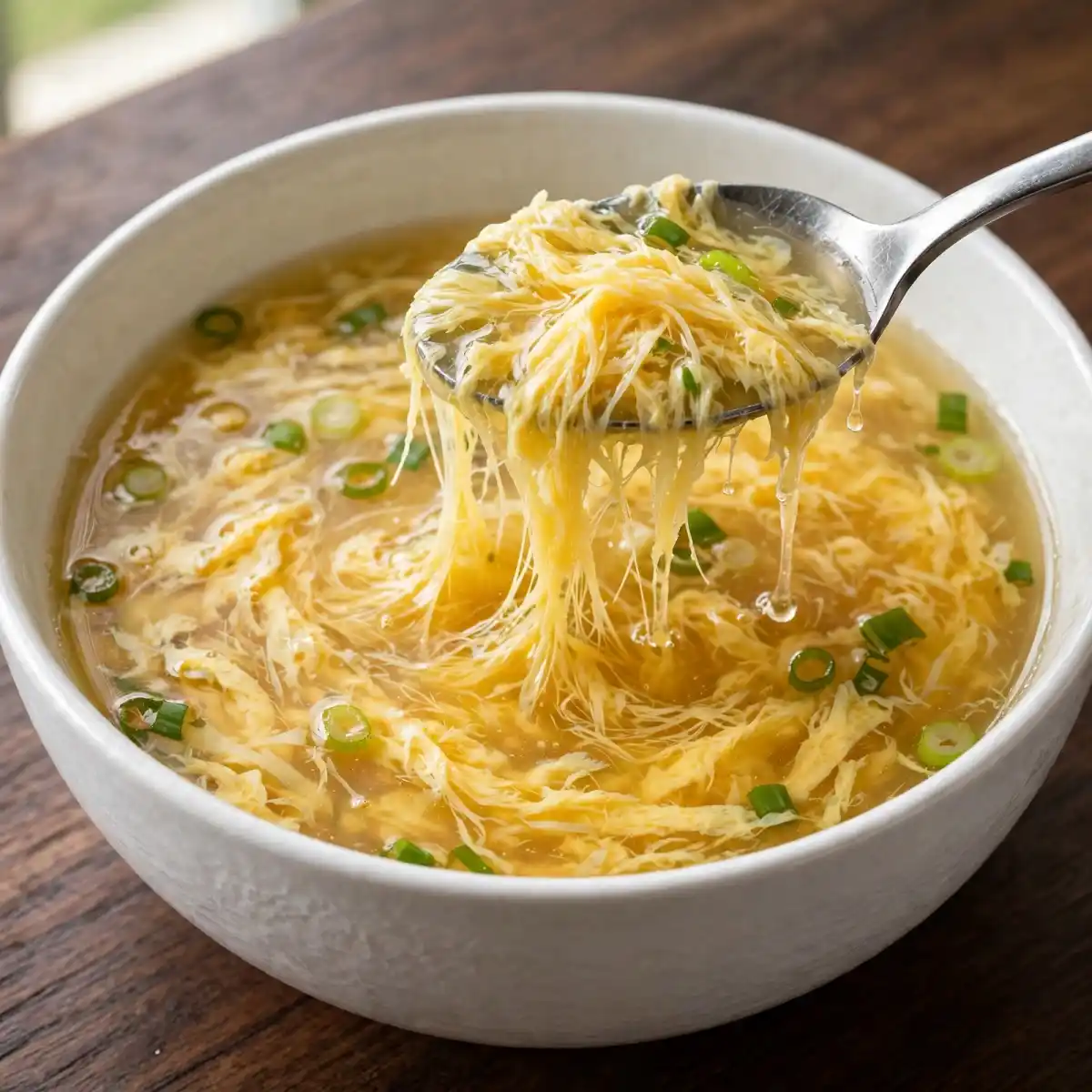
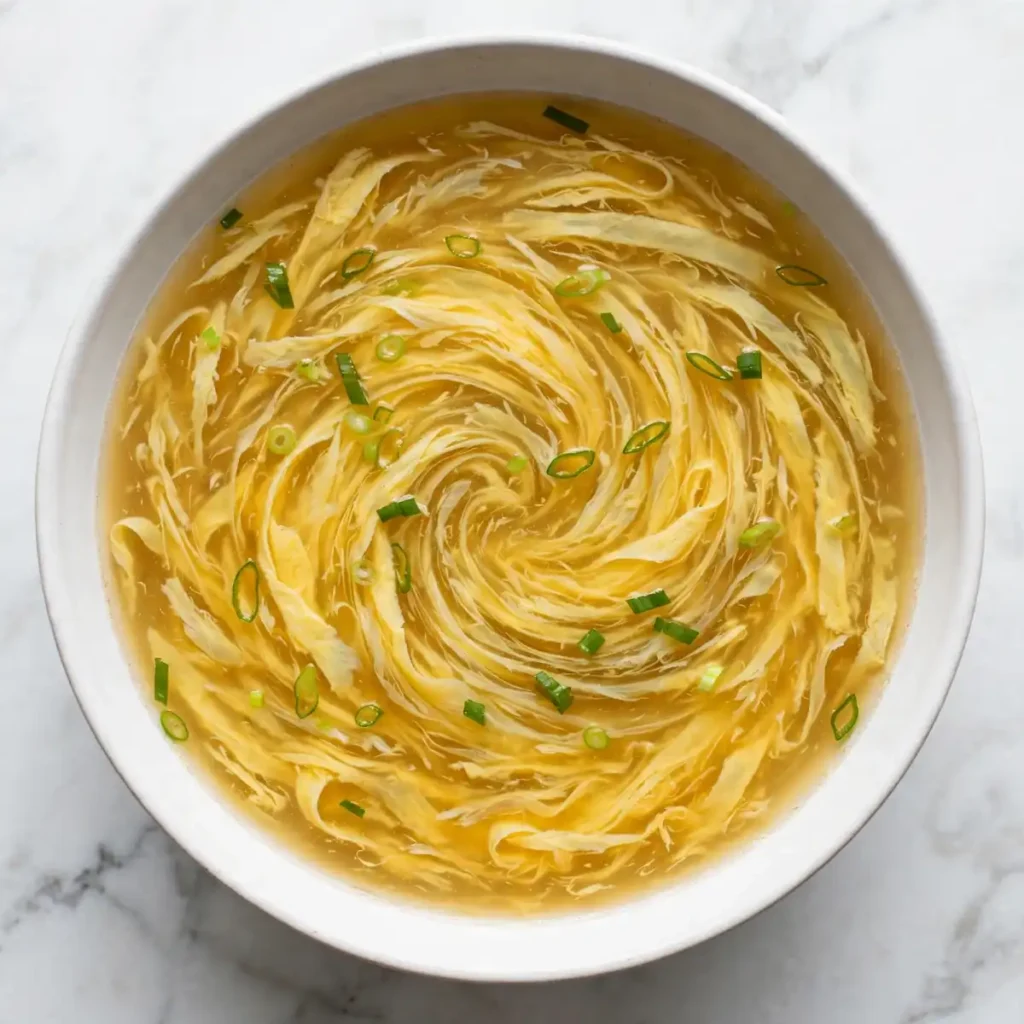
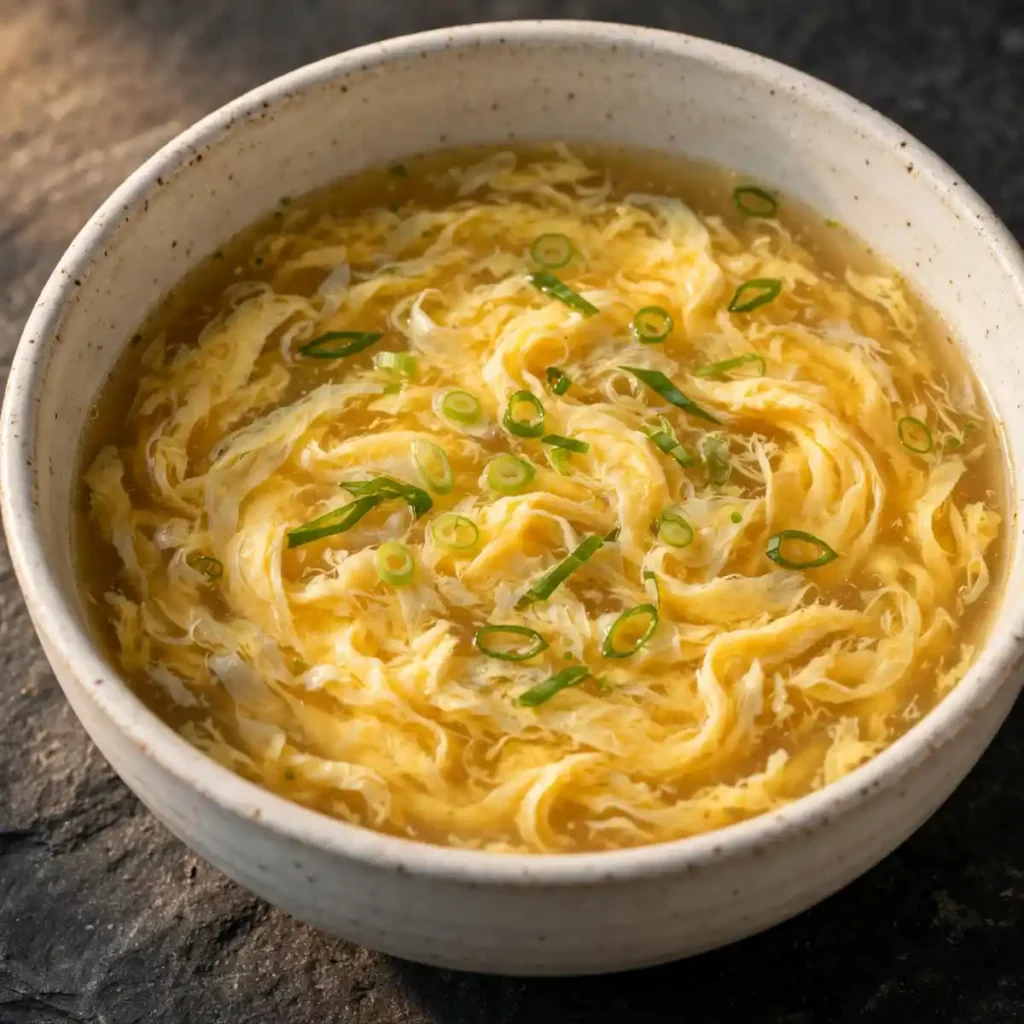
Order egg drop soup at a good Chinese-American restaurant and the broth arrives a deep, translucent gold, the egg strands are thin and silky rather than clumped and rubbery, and the whole bowl has a warmth from ginger and sesame that makes it taste like something that took effort. Make it at home without understanding a few specific steps and you get cloudy broth, scrambled egg chunks, and a starchy, gluey texture that tastes like it came from a packet. The gap between the two versions is entirely technique, and the technique is not complicated.
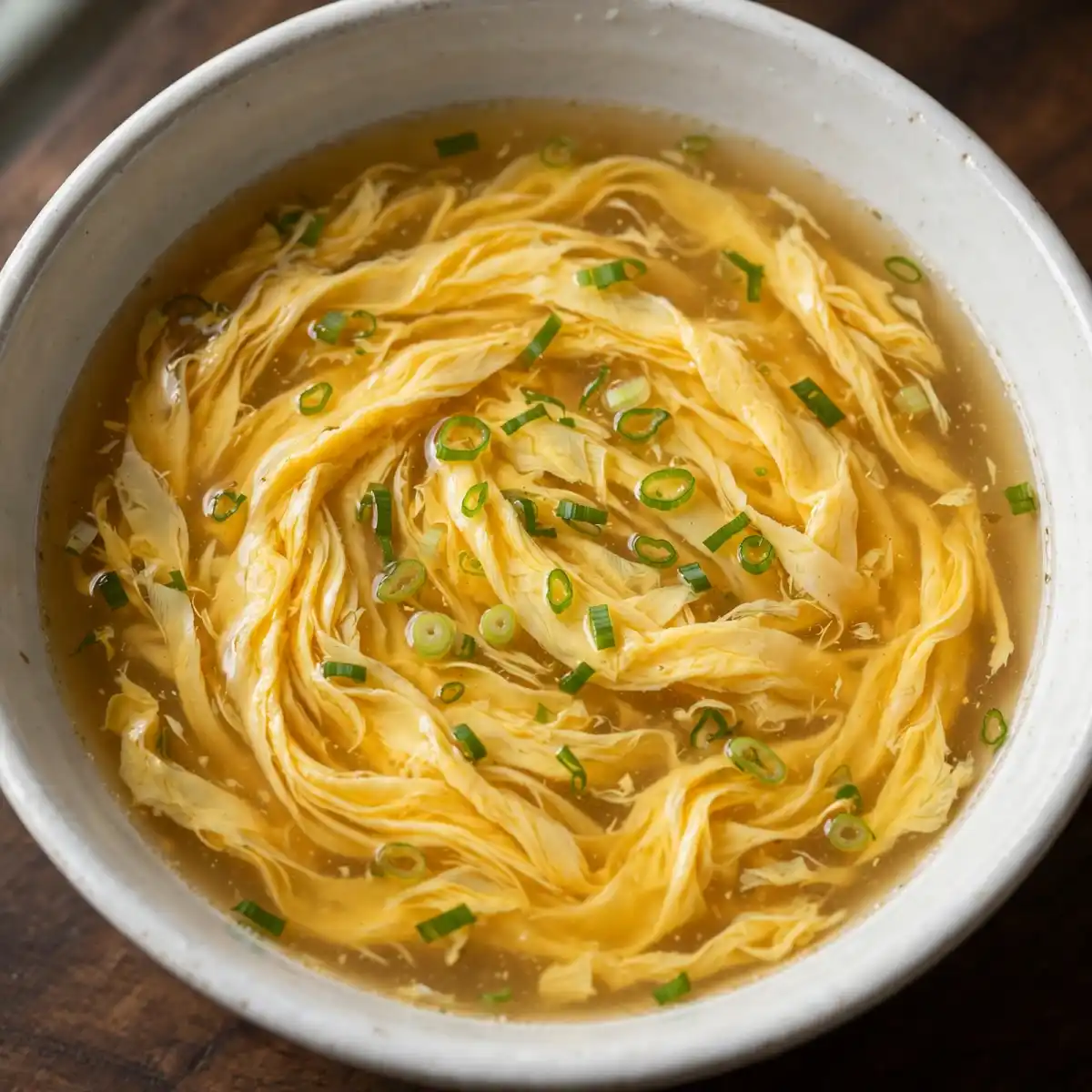
This egg drop soup recipe uses a well-seasoned chicken broth base with fresh ginger, garlic, soy sauce, and a measured amount of cornstarch slurry that thickens the broth to exactly the right consistency for egg ribbons to form properly. The eggs are beaten with a small amount of water and poured in a thin, steady stream while the broth is stirred gently in one direction, which produces the characteristic long, silky egg ribbons rather than chunks. It serves 4 as a starter or 2 as a light main, and the entire recipe takes 15 minutes from start to finish.
Why You’ll Love This Egg Drop Soup
- Silky egg ribbons, not clumpy scrambled chunks. The technique of pouring eggs in a thin stream while stirring the broth slowly in one direction produces consistently thin, delicate ribbons rather than the chunky egg masses that result from pouring too fast or stirring too vigorously.
- Restaurant-quality broth in 15 minutes. A good low-sodium chicken broth seasoned with fresh ginger, garlic, soy sauce, sesame oil, and white pepper produces a broth that tastes developed and savory rather than thin and plain.
- Cornstarch slurry at the right ratio changes everything. The right amount of thickening produces a broth that’s silky and slightly viscous, which is what allows the egg to form ribbons rather than immediately dispersing into tiny fragmented particles.
- Genuinely one of the fastest scratch soups available. No sautéing, no long simmering, no building complex layers; this soup is ready before most pasta reaches al dente.
- Naturally gluten-free and dairy-free. All the base ingredients are inherently free of both common allergens; the only label to verify is the soy sauce.
Ingredients You’ll Need
Recipe Timing
| Servings | 4 as a starter, 2 as a light main |
| Difficulty | Easy |
| Course | Soup, Starter |
| Cuisine | Chinese-American |
| Prep Time | 5 minutes |
| Cook Time | 10 minutes |
| Rest Time | 0 minutes |
| Total Time | 15 minutes |
For the broth, use a good-quality low-sodium chicken broth rather than a regular-sodium version; the soy sauce, seasoning salt, and naturally salty components of the finished soup add enough sodium without starting from a high-sodium base. A homemade chicken broth or a good quality store-bought broth with a golden color and a noticeable chicken flavor produces the best result. Broth that tastes thin and watery before seasoning will produce a thin-tasting soup; taste it before you start and add an extra 1/2 teaspoon of soy sauce if it needs more base depth.
For the eggs, use 3 large eggs at room temperature. Cold eggs beaten from the refrigerator mix less uniformly and their lower temperature drops the broth’s temperature slightly when added, which can slow ribbon formation. Room temperature eggs beaten with 1 tablespoon of water disperse more evenly into the hot broth and produce longer, more uniform ribbons.
For the cornstarch, the slurry ratio in this recipe is specifically calibrated to produce the right broth viscosity for egg ribbon formation. Too little cornstarch and the broth is too thin; the eggs disperse as tiny fragments rather than forming ribbons. Too much cornstarch and the broth becomes gluey and starchy in a way that overwhelms the soup’s other flavors. Measure the cornstarch and cold water precisely and stir the slurry immediately before adding it since cornstarch settles quickly.
For the ginger, fresh ginger grated on a fine grater or a Microplane produces a more vivid, cleanly flavored result than ground dried ginger. Fresh ginger’s aromatic compounds are significantly more volatile and intense than dried; 1 teaspoon of freshly grated ginger is not equivalent to dried and should not be substituted at a 1:1 ratio.
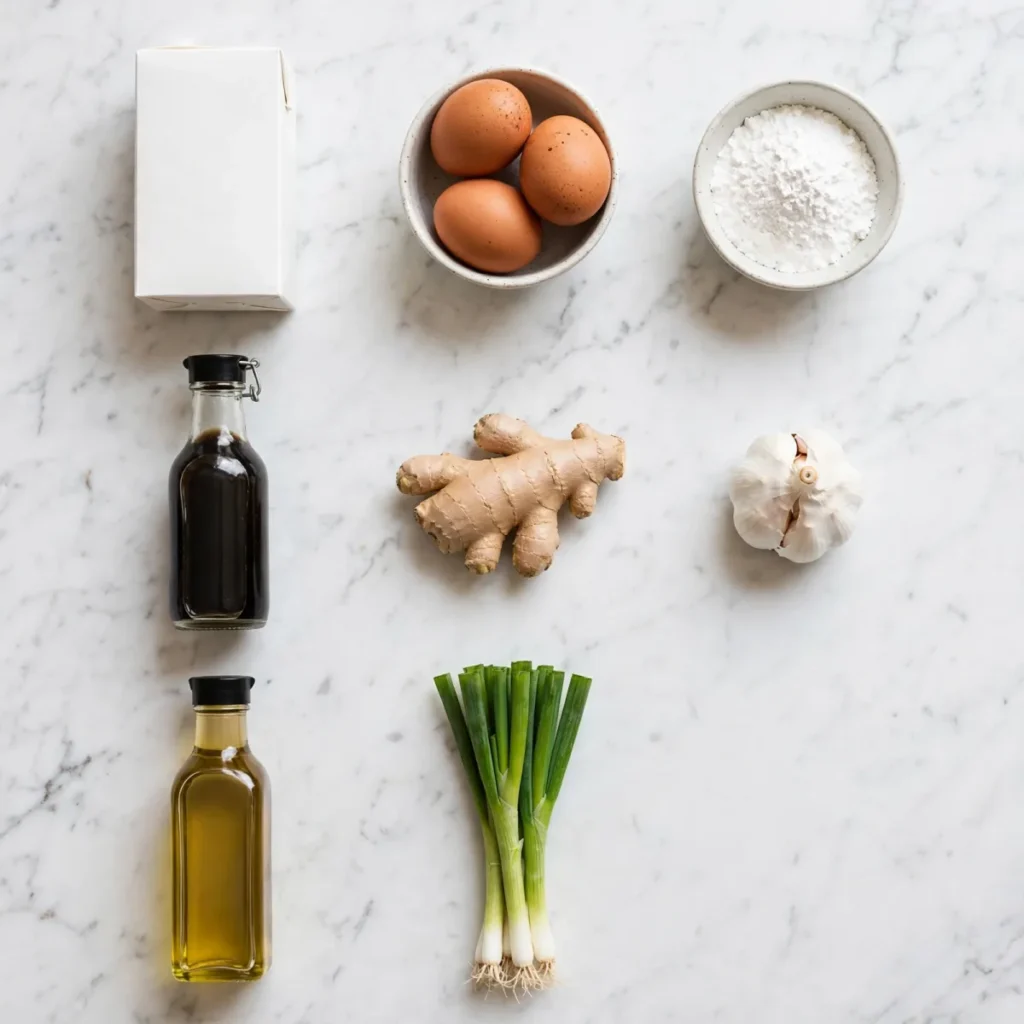
- 1 litre (4 cups) low-sodium chicken broth — the flavor and color base of the entire soup; must taste noticeably savory before seasoning
- 1 teaspoon fresh ginger, finely grated on a Microplane — provides the characteristic warm, slightly sharp aromatic note that separates restaurant egg drop soup from plain egg soup
- 2 garlic cloves, finely minced — adds savory depth; mellows quickly in the hot broth
- 2 tablespoons low-sodium soy sauce — seasons the broth and deepens its color; use regular soy sauce for a saltier, darker result
- 1/2 teaspoon fine white pepper — provides the gentle background warmth traditional in Chinese-American soups; white pepper is preferred over black because it distributes more evenly and produces a cleaner heat without visible black specks
- 1/2 teaspoon fine salt — adjust at the end based on the broth’s starting saltiness
- 3 tablespoons cornstarch — the thickening agent; combined with cold water to make a slurry before adding
- 3 tablespoons cold water — for mixing with the cornstarch; must be cold to prevent premature starch gelatinization in the slurry
- 3 large eggs, at room temperature — the defining ingredient; beaten with water to produce thin, silky ribbons
- 1 tablespoon cold water — beaten with the eggs to thin them slightly and help them disperse more evenly into the broth
- 1.5 teaspoons toasted sesame oil — added at the very end, off the heat; provides the aromatic sesame finish that makes egg drop soup smell as good as it tastes; toasted sesame oil loses its aroma at high heat so it must go in last
- 3 green onions (spring onions), thinly sliced — for garnish; the green parts add color and a mild fresh onion note
- Optional: a few drops of additional sesame oil for serving
Allergen and Dietary Disclosure
This egg drop soup contains eggs as its defining ingredient. It is naturally dairy-free and gluten-free when made with certified gluten-free soy sauce or tamari; standard soy sauce is brewed with wheat and is not gluten-free. It contains no nuts.
For gluten-free: replace the standard soy sauce with an equal quantity of certified gluten-free tamari or certified gluten-free soy sauce. All other ingredients including cornstarch, chicken broth, ginger, garlic, sesame oil, and white pepper are naturally gluten-free; verify the chicken broth label if strict compliance is needed.
For vegetarian or vegan: replace the chicken broth with an equal quantity of a well-seasoned vegetable broth. For vegan, omit the eggs and add 1/2 block (200g) of soft silken tofu cut into 1cm cubes, stirred in gently after the cornstarch slurry. The silken tofu provides a comparable soft, protein-rich texture. The broth flavor will be lighter than the chicken version; add an extra 1/2 teaspoon of soy sauce to compensate.
This recipe has not been tested in a certified allergen-free kitchen and cannot be guaranteed safe for any specific allergy.
Step-by-Step Directions
Step 1: Season the Broth
Pour the chicken broth into a medium saucepan and place over medium-high heat. Add the finely grated ginger, minced garlic, soy sauce, white pepper, and fine salt. Stir to combine and bring the broth to a full, steady boil, allowing the ginger and garlic 2 to 3 minutes of active simmering to release their aromatic compounds into the liquid. The broth should taste savory, slightly gingery, and well-seasoned before the cornstarch goes in; taste it now and adjust with additional soy sauce or salt if needed.

Chef’s Note: Seasoning the broth before adding the cornstarch slurry is not simply a sequencing preference; it’s a flavor clarity decision. Cornstarch begins coating the palate’s taste receptors the moment it enters the broth; tasting and adjusting a thickened broth requires significantly more mental effort than tasting and adjusting a thin, clear liquid. Getting the seasoning exactly right in the unthickened broth means the finished soup is correctly seasoned without any additional guesswork.
Step 2: Make the Cornstarch Slurry
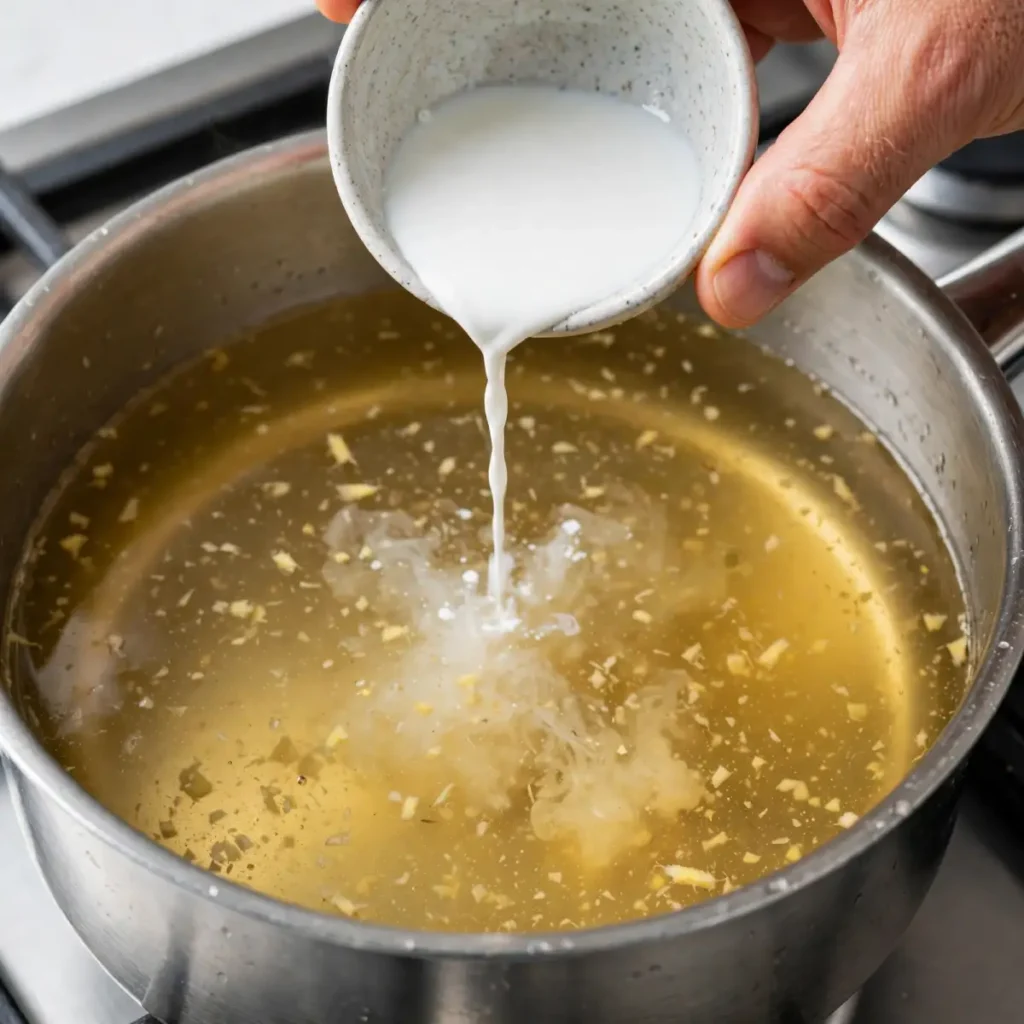
While the broth heats, combine the cornstarch and cold water in a small bowl and stir vigorously until completely smooth with no dry lumps remaining. The slurry should look milky-white and uniform; any visible starch lumps in the slurry will appear as cooked starch lumps in the finished broth. Stir the slurry again immediately before pouring since the starch settles to the bottom within 30 to 60 seconds of mixing.
Step 3: Thicken the Broth
Once the seasoned broth is at a full boil, reduce the heat to medium so the boil subsides to a gentle simmer. Pour the cornstarch slurry into the simmering broth in a slow, steady stream while stirring with a spoon in a circular motion. Continue stirring for 60 to 90 seconds as the broth transforms from thin and clear to slightly viscous and translucent; it should coat the back of the spoon in a thin, draping layer rather than running off immediately. The thickened broth will look slightly cloudy while hot; it clears as it cools slightly.
Chef’s Note: The specific viscosity produced by this slurry ratio is the physical mechanism that makes egg ribbons form rather than egg fragments. When eggs are poured into plain water, the low viscosity liquid creates turbulent currents around the poured egg that immediately break it into tiny pieces. When the same eggs are poured into a viscous, lightly thickened broth, the increased resistance to flow slows the egg’s dispersion and allows surface tension to maintain the poured strand’s shape long enough for the heat to set it into a ribbon. Too little cornstarch and the ribbons break; too much and the soup tastes starchy.
Step 4: Beat the Eggs
In a small bowl or measuring cup with a pour spout, beat the room-temperature eggs and 1 tablespoon of cold water together with a fork until the yolks and whites are fully combined and the mixture looks uniformly yellow with no visible streaks of unbeaten white. The eggs should flow in a smooth, continuous stream when the bowl is tipped; if the mixture looks too thick to pour in a thin stream, add an additional teaspoon of water and beat again.
A measuring cup with a spout is specifically useful here because it allows precise control over the poured egg stream width; a bowl requires tilting to find a narrow pour angle. The thinner the stream, the longer and more delicate the ribbons.
Step 5: Pour the Eggs and Form the Ribbons
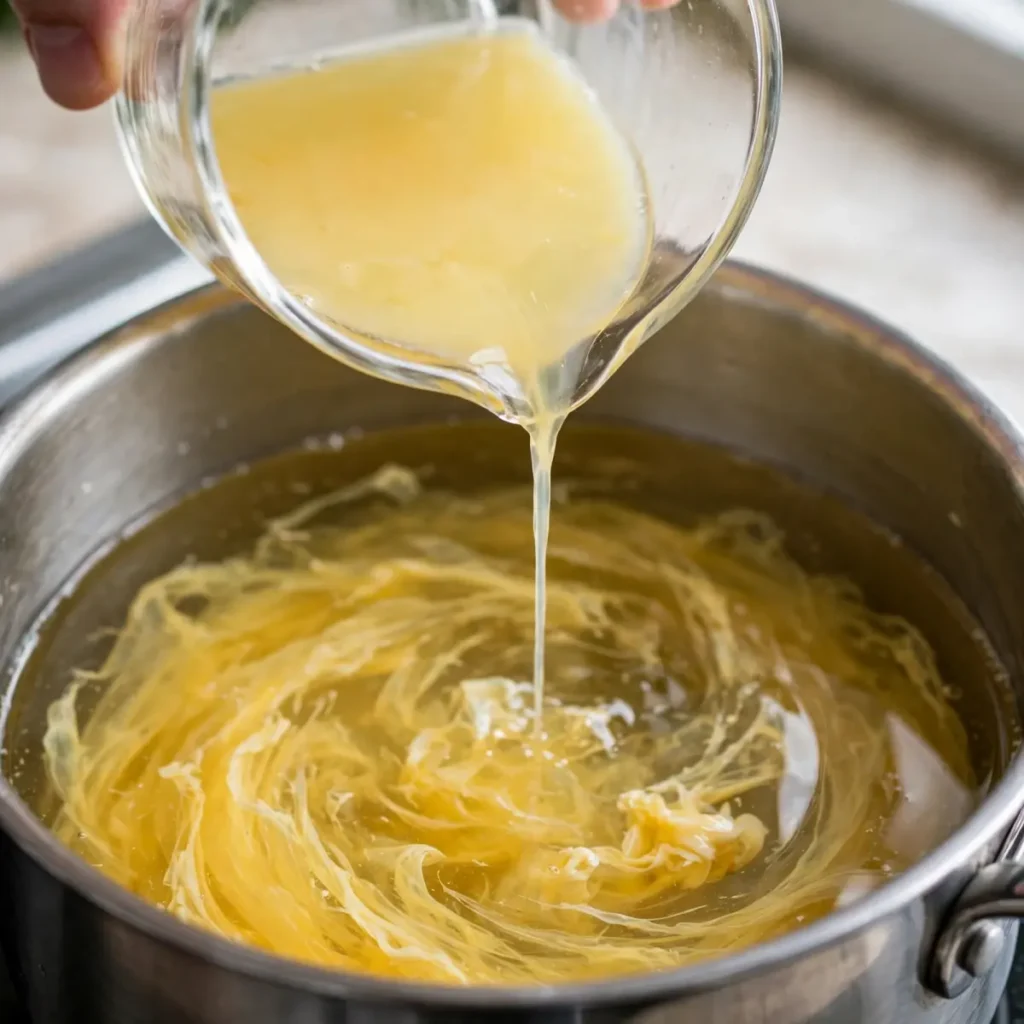
This is the step that requires the most technique and the least amount of time. Bring the thickened broth back to a gentle simmer if it has cooled, then reduce the heat to low. Use a fork, chopstick, or the handle of a spoon to stir the broth slowly in a single circular direction, creating a gentle, steady whirlpool in the pot. While the broth is moving in that consistent circle, pour the beaten egg mixture in a very thin, slow, continuous stream from a height of about 15 to 20cm above the pot surface, moving the pour around the circumference of the pot rather than pouring all in one spot.
The egg will cook on contact with the hot broth and form thin, silky ribbons that trail through the liquid. Stop stirring immediately after all the egg is added; continued stirring after the egg is in the broth breaks the ribbons that have already formed.
Chef’s Note: The height of the pour matters as much as the stream’s width. Pouring from 15 to 20cm above the broth surface stretches the egg stream thinner than gravity alone achieves when poured from just above the liquid; a thinner stream produces finer, more delicate ribbons. Pouring too close to the surface adds the egg in too concentrated a mass and produces thicker, chunkier egg pieces rather than ribbons. This is a 10-second technique adjustment that produces a visibly different result.
Step 6: Finish and Serve
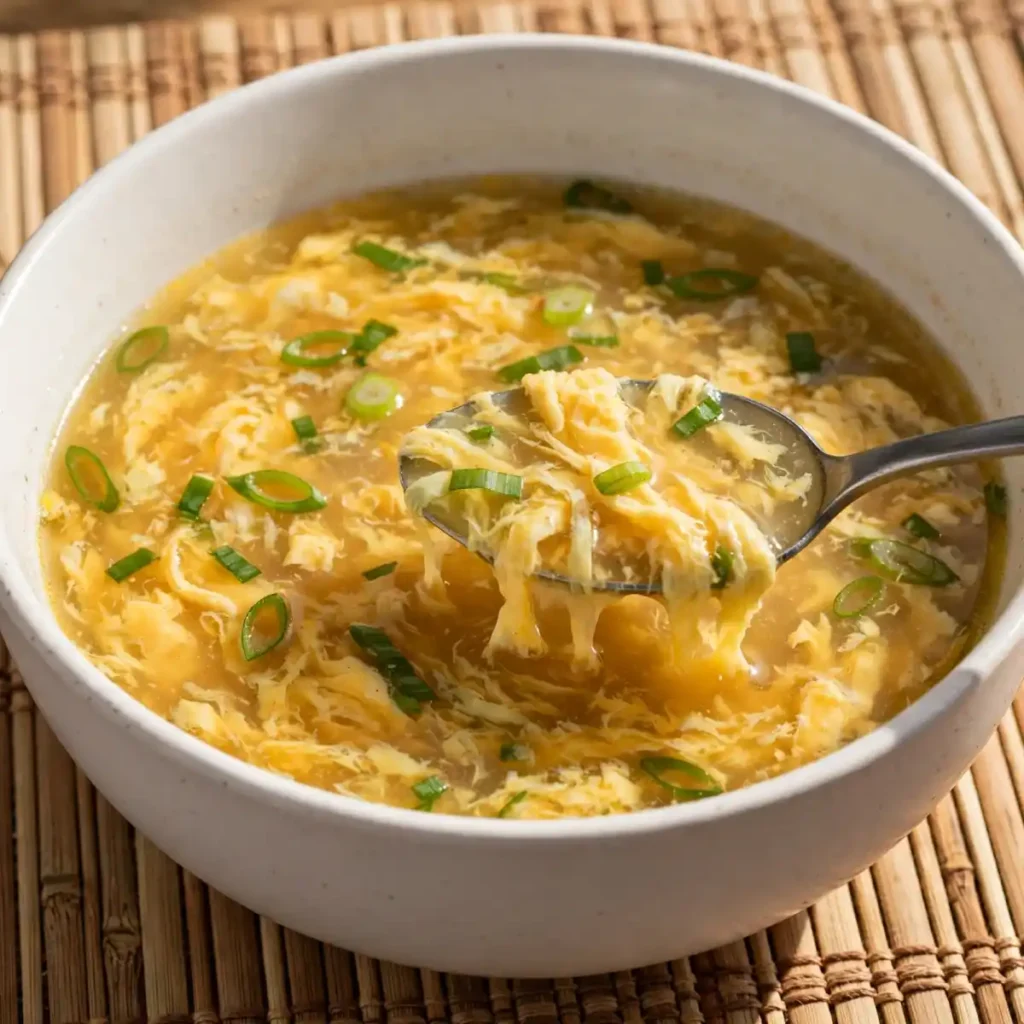
Remove the saucepan from the heat. Add the toasted sesame oil and stir once gently to distribute it through the soup without breaking the egg ribbons. Taste the finished soup and adjust salt or soy sauce if needed; the flavor should be clean, savory, gingery, and warming, with the sesame oil detectable as a subtle aromatic rather than a dominant flavor.
Ladle the soup into bowls immediately and garnish each portion generously with thinly sliced green onions. Serve hot; egg drop soup does not hold well and the egg ribbons continue to set and toughen if left in the hot broth for more than a few minutes after cooking.
Common Mistakes and Troubleshooting
| Problem | Cause | Solution |
|---|---|---|
| Egg clumped into chunks rather than ribbons | Egg poured too fast, too close to the surface, or broth not thickened enough first | Pour in a very thin stream from 15 to 20cm height; confirm the slurry produced a slightly viscous broth before adding eggs |
| Broth gluey and starchy-tasting | Too much cornstarch, or cornstarch added to boiling rather than simmering broth | Measure cornstarch precisely; add slurry to a gentle simmer, not a full boil |
| Broth cloudy and unappealing | Broth quality was poor, or slurry lumps went in unblended | Use a good-quality golden broth; ensure slurry has no lumps before pouring |
| Egg ribbons broke apart immediately | Broth stirred too vigorously after the egg was added, or broth too thin | Stop stirring the moment all the egg is in; confirm the broth has the right viscosity before adding eggs |
| Soup tastes flat and bland | Broth not tasted and seasoned before the slurry, or ginger and garlic not simmered long enough | Season the broth aggressively before thickening; simmer ginger and garlic for at least 2 to 3 minutes |
| Sesame oil taste too faint or absent | Added during cooking rather than off the heat | Sesame oil’s aroma evaporates at heat above 70°C; always add after removing from the burner |
Variations and Substitutions
- Corn and egg drop soup: Add 200g of sweet corn kernels (fresh, frozen-thawed, or canned-drained) to the broth alongside the ginger and garlic. The corn’s natural sweetness and bright yellow color add both flavor and visual interest; this is one of the most popular egg drop soup variations and tastes noticeably different from the plain broth version. Increase the cornstarch to 4 tablespoons to maintain the right viscosity since corn releases some liquid into the broth.
- Tomato egg drop soup: Add 2 medium ripe tomatoes, roughly chopped, to the broth and simmer for 5 minutes before straining them out or blending them into the broth for a vivid red-orange soup. This Chinese home cooking classic produces a tangy, slightly sweet broth that is significantly different from the standard savory version; the tomato’s acidity brightens all the other flavors.
- Mushroom egg drop soup: Add 100g of thinly sliced shiitake mushrooms or oyster mushrooms to the broth with the ginger and garlic and simmer for 3 to 4 minutes until the mushrooms are tender and their umami has released into the broth. Leave the mushrooms in the soup; they provide textural contrast to the delicate egg ribbons.
- Spicy version: Add 1 teaspoon of chili garlic sauce or 1/2 teaspoon of dried chili flakes to the broth with the other seasonings. The heat adds a welcome contrast to the egg’s mild richness; increase to taste after the first batch if you prefer a more pronounced heat.
- Tofu egg drop soup: Add 150g of firm silken tofu cut into 1cm cubes directly after the cornstarch slurry has thickened the broth. Stir very gently to avoid breaking the tofu, then proceed with the egg addition. The silken tofu provides a soft, protein-rich addition that makes the soup substantially more filling without changing its character significantly.
- Richer broth version: Replace 240ml (1 cup) of the chicken broth with the same quantity of coconut aminos mixed with an equal part of water for a slightly sweeter, deeper broth, or simmer the broth for 10 minutes with 2 dried shiitake mushrooms and 2 slices of ginger before straining and proceeding with the recipe. The pre-simmering step adds notable depth to a plain store-bought broth and reduces the need for soy sauce adjustment.
Serving Suggestions
- Serve as the first course before a larger Chinese-American meal of stir-fried noodles, fried rice, or steamed dumplings; the light, clean broth prepares the palate for more substantial dishes without filling the stomach.
- Pair alongside steamed jasmine rice and a simple stir-fried vegetable dish for a light, warming weeknight dinner that is satisfying without being heavy.
- Serve in small cups as an appetizer at a dinner party; the soup holds in a preheated thermos for up to 30 minutes without significant quality loss, making it one of the more practical first-course options for a home gathering.
- Finish each bowl with a few drops of chili oil drizzled over the surface alongside the green onions; the chili oil adds a visible red shimmer and a background warmth that elevates the presentation without changing the soup’s fundamental character.
- Pair with cold jasmine tea or warm green tea; both provide a clean, slightly astringent contrast to the soup’s savory richness and reflect the flavor traditions the dish comes from.
- For a cold-weather meal, serve in deep bowls with a side of warm steamed buns or a small portion of plain white rice; the starchy side provides substance alongside the light soup and turns a starter into a complete, warming light dinner.
Tips for the Best Results
- Use a measuring cup with a pour spout for the eggs. The difference in ribbon quality between pouring from a measuring cup versus tilting a regular bowl is significant and immediately visible. A pour spout allows a consistently thin, controlled stream; a bowl requires awkward tilting to achieve the same stream width and the stream width varies throughout the pour as the bowl angle changes. If a lipped measuring cup isn’t available, use a fork to pour the eggs slowly off the fork’s tines into the moving broth; this produces a similarly thin, controlled stream.
- Stir in one direction only. The gentle whirlpool created by stirring in a single circular direction concentrates the kinetic energy of the broth into a consistent, predictable flow pattern; the poured egg follows this flow and sets into ribbons as it moves through the hot liquid. Reversing direction creates turbulent cross-currents that break the forming ribbons before they set; always maintain the same stirring direction from the first stir to the last.
- Stop stirring immediately after the egg is added. The ribbons need 20 to 30 seconds of undisturbed contact with the hot broth to fully set. Any stirring during this period breaks partially-set ribbons before they’ve firmed enough to hold their shape. Put the spoon down the moment the last drop of egg enters the soup and leave the pot alone until the ribbons have set.
- Season the broth before thickening, not after. Once the cornstarch has thickened the broth, the increased viscosity coats the palate and makes it harder to accurately assess saltiness; you’ll either under-season or over-correct. Taste and adjust the thin, clear broth before the slurry goes in and the finished soup will be correctly seasoned without additional guesswork.
- Add sesame oil off the heat, every time. Toasted sesame oil contains highly volatile aromatic esters that evaporate rapidly above approximately 70°C; adding it to a boiling or even simmering broth destroys the majority of its aroma within seconds. Added to a just-removed-from-heat soup, the oil’s full aromatic complexity survives into the bowl and is detectable as the first smell when the soup reaches the table, which is exactly the role it’s meant to play.
Storage Tips
Refrigerator
Egg drop soup keeps in the refrigerator for up to 2 days in a sealed container. The egg ribbons continue to absorb liquid and swell slightly during storage, and the cornstarch-thickened broth becomes noticeably thicker and more gel-like when cold; both are normal and reverse when the soup is reheated gently. The flavor actually deepens slightly after 24 hours as the ginger and garlic continue to infuse into the broth. Store with the egg ribbons in the soup; don’t attempt to remove them separately.
Freezer
Egg drop soup does not freeze well as an assembled dish. The egg ribbons become rubbery and watery on thawing and the cornstarch-thickened broth often separates into a grainy, broken-looking liquid that doesn’t return to its original smooth texture regardless of stirring. If you want to prepare in advance for a larger batch: freeze only the seasoned, unseasoned broth without the slurry or eggs, in a sealed container for up to 2 months; thaw in the refrigerator and proceed with the slurry and egg steps fresh when ready to serve.
Reheating
Reheat leftover egg drop soup in a saucepan over medium-low heat, stirring gently, until it just returns to a bare simmer. The gel-like refrigerated soup will loosen as it heats; add 2 to 3 tablespoons of chicken broth or water if the reheated soup is thicker than desired. Add a few drops of fresh sesame oil after removing from the heat before serving again; the sesame oil from the original batch will have dissipated during refrigerator storage and the soup benefits from a small fresh addition. Microwave reheating at 60% power in 60-second intervals with stirring between works adequately for a single portion.
Make-ahead note: The seasoned broth base, without the cornstarch slurry or eggs, can be made up to 2 days ahead and refrigerated. When ready to serve, reheat the broth to a simmer, add the slurry, let it thicken, and proceed with the fresh egg addition. This reduces the active cooking time on the day to under 5 minutes and produces a result indistinguishable from a fully same-day version.
Nutrition Information
Per serving, approximately 1/4 of the recipe as a starter:
| Nutrient | Amount |
|---|---|
| Calories | 110 kcal |
| Protein | 8g |
| Total Carbohydrates | 7g |
| Dietary Fiber | 0g |
| Total Sugar | 1g |
| Total Fat | 5g |
| Saturated Fat | 1.2g |
| Cholesterol | 140mg |
| Sodium | 540mg |
| Vitamin C | 2mg |
| Calcium | 35mg |
| Iron | 0.9mg |
| Potassium | 185mg |
Nutrition values are approximate and may vary based on chicken broth brand, soy sauce sodium content, and egg size.
Why This Recipe Works
The silky, long egg ribbons that define a well-made egg drop soup result from a specific interaction between the broth’s viscosity and the heat’s effect on egg proteins, and both variables need to be in the right range simultaneously. When egg proteins denature in hot liquid, they unfurl from their native folded structure and bond with adjacent proteins to form a continuous solid network; this is what transforms liquid egg into cooked egg. In a plain, unthickened broth, the low viscosity liquid creates turbulent flow currents around the incoming egg stream that immediately disperse it into tiny droplets before the heat has had time to set a continuous ribbon structure; the result is small egg flecks rather than ribbons. In a cornstarch-thickened broth at the right viscosity, the increased resistance to flow slows the dispersion rate enough that the heat can set the outer surface of the poured egg stream into a continuous solid ribbon before turbulence tears it apart. The ribbon’s outer surface sets first, creating a protective shell that holds the strand’s shape as the interior continues to cook. This is why the cornstarch concentration is not adjustable in either direction without changing the egg texture fundamentally.
The specific temperature at which the eggs are added to the thickened broth is also non-trivial. Egg proteins begin denaturing around 60°C and are fully set by 80°C. Adding eggs to a full boil (100°C) causes the outer surface of the poured stream to set so rapidly that the rapid thermal shock creates brittleness rather than the elastic flexibility of a properly cooked ribbon; the boiling turbulence then breaks these brittle ribbons into small pieces. Adding eggs to a gentle simmer (around 85 to 90°C) produces the ideal result: fast enough heat to set the outer ribbon surface before turbulence disperses the stream, but gentle enough to allow the ribbon to form a continuous structure rather than shattering. The instruction to reduce to low heat before adding eggs is not conservative caution; it’s the specific temperature management that produces the ribbon structure.
Fresh ginger’s contribution to the broth is both aromatic and chemical. Ginger contains gingerols, the primary aromatic compounds responsible for its characteristic pungent, slightly citrusy warmth; these compounds are volatile and water-soluble, releasing rapidly into a simmering broth within 2 to 3 minutes of contact. Ginger also contains shogaols (formed when gingerols are heated) which have a sharper, more intense heat than the gingerols they convert from. The 2 to 3 minute simmer specifically balances these two compound types: enough time for the gingerols to fully release their aroma into the broth, but not so long that the shogaol conversion produces an overpowering pungency that dominates the soup’s delicate flavor.
Sesame oil’s addition off the heat is not simply a matter of preserving aroma; it’s about maintaining the structural complexity of the oil’s volatile compound profile. Toasted sesame oil contains pyrazines, furanones, and thiophenes produced during the sesame seeds’ roasting process; these compounds have boiling points well below water’s 100°C and begin evaporating rapidly above 70°C. Added to a 15°C reduction in temperature from a boiling soup, the sesame oil’s full compound profile remains intact; added to actively boiling broth, 60 to 70% of the volatile aromatics evaporate within the first 60 seconds. The difference in perceived sesame aroma between these two addition points is noticeable in the finished bowl.
I’ve made this recipe with cornstarch quantities ranging from 1.5 tablespoons to 5 tablespoons per litre of broth to map the viscosity-to-ribbon-quality relationship. At 1.5 tablespoons, the broth was too thin for reliable ribbon formation; the eggs produced primarily small flecks with occasional short ribbons. At 2 tablespoons, the ribbons were more consistent but still occasionally fragmenting. At 3 tablespoons, the ribbons formed reliably, were long and silky, and the broth’s texture felt appropriately body-rich without being starchy. At 4 tablespoons, the ribbons were excellent but the broth’s starch presence was detectable on the palate; at 5 tablespoons, the soup was gluey and the cornstarch flavor competed with the ginger and soy. Three tablespoons per litre is the reliable sweet spot for ribbon quality without starch intrusion.
Frequently Asked Questions
Can I make egg drop soup ahead of time?
The most practical make-ahead approach is to prepare the seasoned broth base up to 2 days ahead without the cornstarch slurry or eggs; refrigerate in a sealed container. When ready to serve, reheat the broth to a simmer, add a freshly made cornstarch slurry, let it thicken for 60 to 90 seconds, then add fresh beaten eggs in the stream method. This keeps the active serving-time work to under 5 minutes while still producing a fresh-made result. Fully assembled egg drop soup refrigerates for up to 2 days but doesn’t freeze well.
Why are my egg ribbons clumpy instead of silky?
Clumpy egg results from one or more of three causes. The eggs were poured too fast and too close to the broth surface, landing in a mass rather than dispersing as a thin stream. The broth wasn’t thickened adequately before the egg was added, so the low viscosity didn’t support ribbon formation. Or the broth was at a full rolling boil rather than a gentle simmer; the violent turbulence at a full boil breaks forming ribbons immediately. For the next batch: confirm the broth is thickened and simmering gently, pour from 15 to 20cm height in the thinnest stream possible, and stop stirring the moment the last egg is in.
Can I use vegetable broth instead of chicken broth?
Yes, vegetable broth substitutes directly at the same 1-litre quantity. The finished soup will have a lighter, less savory depth than the chicken broth version; compensate by adding an extra 1/2 teaspoon of soy sauce and 1/4 teaspoon of additional white pepper to bring the seasoning level to the same point. A good-quality vegetable broth with a golden color and genuine vegetable flavor produces an excellent result; a pale, thin vegetable broth produces a pale, thin soup.
How do I know when the cornstarch slurry has thickened the broth enough?
The broth is correctly thickened when it coats the back of a spoon in a smooth, thin, draping layer that doesn’t run off immediately when the spoon is tilted; it should look slightly more viscous than plain water and feel slightly resistant when you stir it. It shouldn’t look gluey or thick like gravy; it should look like a lightly thickened clear liquid. If the broth returns to a watery consistency within seconds of removing the spoon, add another tablespoon of cornstarch slurry and stir for 30 more seconds.
Is egg drop soup gluten-free?
The recipe as written contains soy sauce, which is typically brewed with wheat and is not gluten-free. All other ingredients are naturally gluten-free. To make the full recipe gluten-free, replace the standard soy sauce with an equal quantity of certified gluten-free tamari or certified gluten-free soy sauce; the flavor is identical. Verify the chicken broth label for a gluten-free declaration if strict compliance is required.
Can I add more eggs for a thicker, more egg-forward soup?
Yes. Increasing to 4 eggs produces a noticeably more egg-rich soup with more ribbons throughout the broth; the technique is identical. Beyond 4 eggs per litre of broth, the ribbon density becomes so high that the soup’s broth-to-egg ratio tips toward scrambled eggs in broth rather than the delicate ribbons-in-broth texture that defines the dish. If you prefer a very egg-forward version, 4 eggs is the practical maximum before the character of the soup fundamentally changes.
Why does my egg drop soup taste flat even after seasoning?
A flat-tasting egg drop soup usually means the ginger and garlic didn’t have enough time to simmer before the slurry was added; their aromatic compounds release into the broth during simmering rather than instantaneously. Simmer the ginger and garlic in the broth for at least 2 to 3 minutes at a genuine simmer before proceeding. Also check that the sesame oil was added off the heat; sesame oil added to hot broth loses its aroma immediately and the soup tastes as though it’s missing something without the ability to identify what. Finally, a good-quality broth makes a genuinely detectable difference; a thin, flavorless broth cannot be seasoned into a deeply flavored soup.
Conclusion
Egg drop soup rewards the 60 seconds it takes to understand why the cornstarch goes in before the eggs and why the eggs are poured in a thin stream from height rather than simply added to the pot. Those two things are the entire technique; everything else is seasoning and timing. Once you’ve made it once and seen the ribbons form, the recipe becomes the kind of thing you can make from memory on a cold weeknight in 15 minutes without thinking about it.
The make-ahead broth option is what makes egg drop soup genuinely practical for more than just solo cooking. Season a litre of broth on Sunday and you have the base for a first-course soup that takes 5 minutes to finish all week; that’s a genuinely useful thing to know.
If you loved this recipe, save it to your easy soup recipes and Chinese-American dinner ideas Pinterest board so you can find it easily later. For more same recipes must follow Thecookingvibes Pinterest account.
Egg Drop Soup
Ingredients
Equipment
Method
- Combine chicken broth, grated ginger, minced garlic, soy sauce, white pepper, and salt in a medium saucepan over medium-high heat. Bring to a full boil, stirring once. Simmer actively for 2 to 3 minutes until ginger and garlic have released their aromatics into the broth. Taste and adjust seasoning now.
- Stir together cornstarch and 3 tablespoons of cold water until completely smooth. Stir again immediately before using.
- Reduce broth to a gentle simmer. Pour cornstarch slurry in a slow, steady stream while stirring in a circular motion. Continue stirring for 60 to 90 seconds until the broth becomes slightly viscous and coats the back of a spoon in a thin draping layer.
- Beat eggs with 1 tablespoon of cold water in a measuring cup with a pour spout until yolks and whites are fully uniform.
- Reduce heat to low. Stir the thickened broth slowly in one consistent circular direction to create a gentle whirlpool. While the broth is moving, pour the beaten egg in the thinnest possible stream from 15 to 20cm above the pot, moving the pour around the pot's circumference. Stop stirring immediately when all the egg is added. Allow 20 to 30 seconds for the ribbons to fully set.
- Remove from heat. Add sesame oil and stir gently once. Taste and adjust salt if needed. Ladle into bowls immediately and garnish with sliced green onions. Serve hot.
Notes
- Always season and taste the broth before adding the cornstarch slurry; a thickened broth is harder to taste and adjust accurately.
- Pour eggs in the thinnest possible stream from at least 15cm height; this is the single step that most determines ribbon quality.
- Stop stirring the moment all the egg is in the soup; continued stirring breaks forming ribbons.
- Add sesame oil only after removing from heat; it loses its aroma at cooking temperatures.
- Allergens: Contains eggs. Naturally dairy-free. Contains gluten (soy sauce brewed with wheat); use certified gluten-free tamari for a fully gluten-free version. This recipe has not been tested in a certified allergen-free kitchen and cannot be guaranteed safe for any specific allergy.
- Nutrition values are approximate and may vary based on chicken broth brand, soy sauce sodium content, and egg size.